
Every marketing tool now claims to be AI-powered, which makes it harder, not easier, to work out what deserves your budget. This guide separates the AI marketing trends that are changing outcomes in 2026 from the ones that are still mostly demos, gives concrete first steps for each, and ends with an honest order of adoption for a team that cannot do everything at once.
Quick answer: The AI marketing trends that matter most in 2026 are AI search visibility (being cited by ChatGPT, Perplexity and AI Overviews), AI copilots embedded in everyday marketing tools, agentic AI that executes multi-step campaign tasks, first-party data as the fuel for useful personalisation, and conversational AI across the customer journey. Adopt in this order: fix AI search visibility first because it affects whether you are found at all, then copilots for productivity, then data foundations, and pilot agentic AI rather than betting on it. Human judgement still owns strategy, brand voice and anything with legal or reputational risk.
Why 2026 is different
Two things changed. First, AI moved from a separate tool you open to a layer inside the tools you already use, so adoption is no longer a decision you make once. Second, and more consequentially, AI became a discovery channel: people ask assistants questions they used to type into Google, and the assistant names a few sources. That reshapes how customers find you, which is a marketing problem, not an IT one.
1. AI search visibility is now a channel
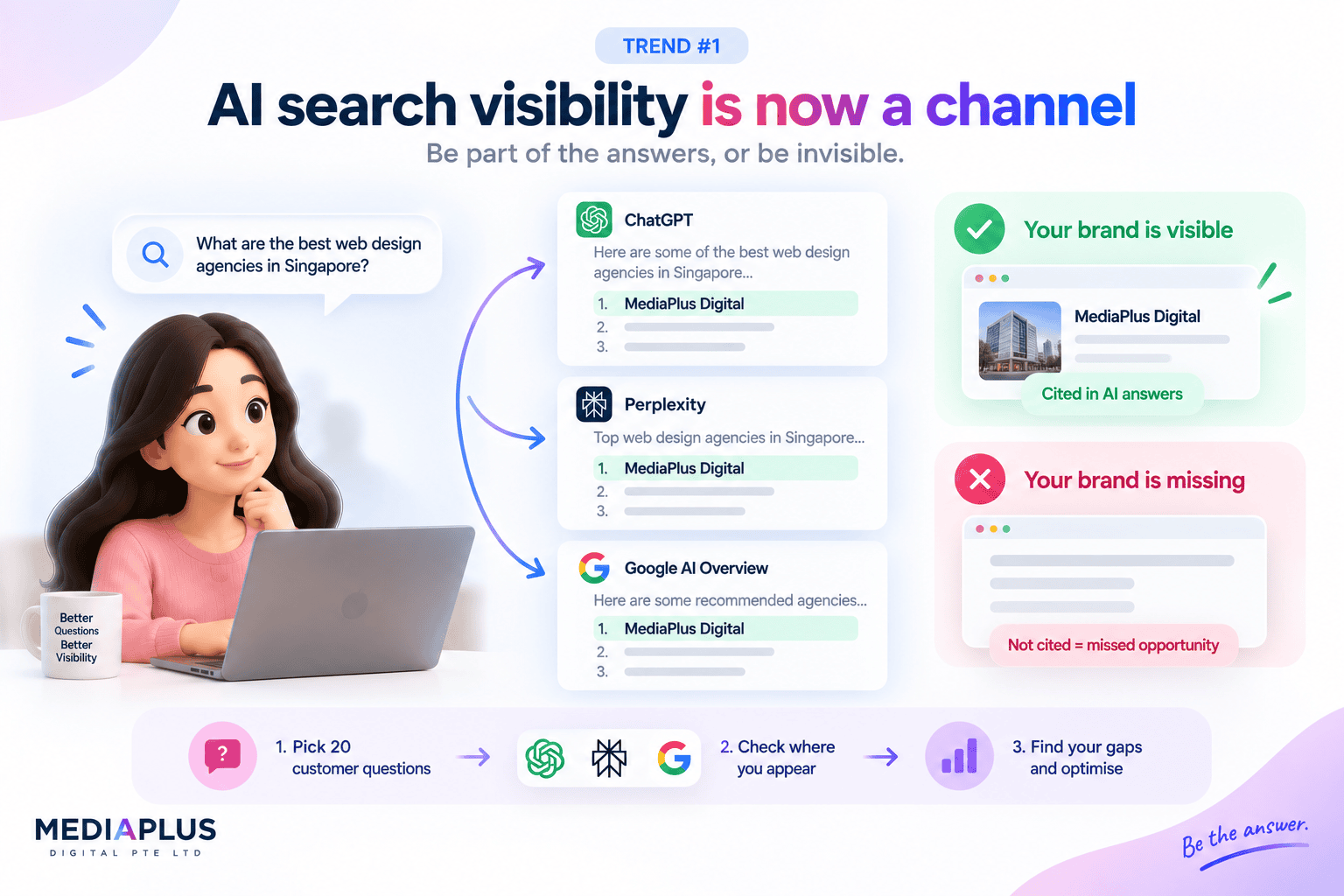
The most important trend, because it affects whether anything else you do gets seen. When a buyer asks ChatGPT or Perplexity for recommendations, or reads a Google AI Overview, a small number of sources get named. Being absent from those answers is the modern equivalent of being on page three.
The mechanics, concretely. AI answers draw on content that is retrievable, parseable and corroborated. In practice that means:
- Answer-first structure. Lead each page with a direct, self-contained answer of two or three sentences. AI systems lift passages, so a passage that only makes sense in context rarely gets quoted.
- Question-shaped headings that match how people actually ask.
- Structured data (Organization, Article, Product, FAQ) so machines can identify entities rather than infer them.
- Entity consistency. Your business name, description, services and location should match across your site, Google Business Profile, LinkedIn and directories. Contradictory information reduces confidence in you as a source.
- Crawler access. Confirm AI crawlers are not blocked in robots.txt if you want to be cited.
- Corroboration. Being described consistently on third-party sites matters more than any on-page tweak.
First step: pick 20 questions a customer would ask before buying from you, run them through ChatGPT, Perplexity and Google AI Overviews, and record where you appear and who gets cited instead. That is your baseline. See what GEO is and our AI SEO services.
2. AI copilots became infrastructure
AI assistants are now built into the ad platforms, CRMs, analytics tools and content systems marketers already use. The productivity gain is real but unevenly distributed: it is large for drafting, summarising, variant generation and analysis, and small for anything requiring judgement about your specific market.
First step: pick the two most repetitive tasks in your week, ad copy variants and reporting summaries are the usual candidates, and use the copilot already inside your existing tool before buying anything new.
3. Agentic AI: promising, still worth piloting
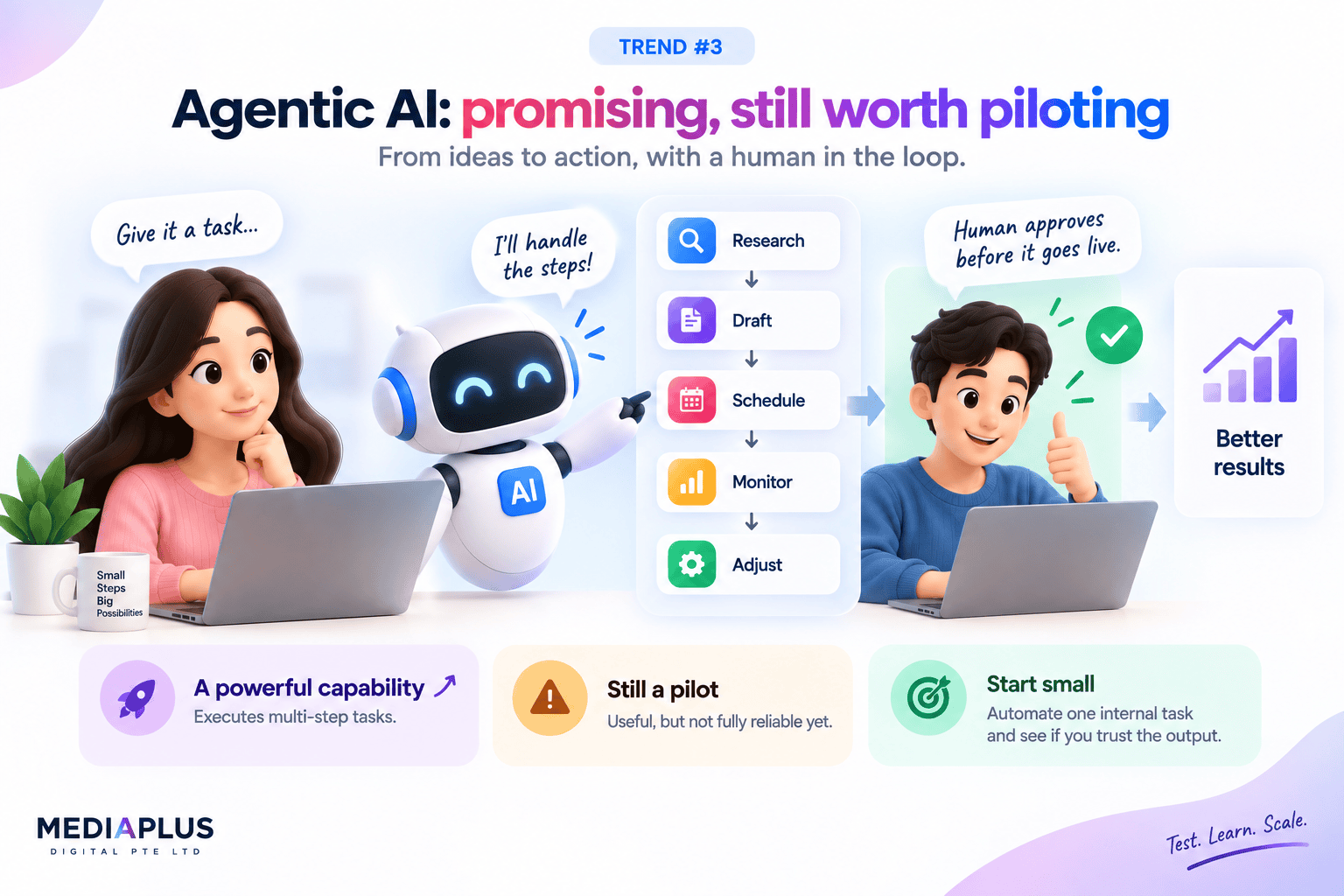
Agentic AI executes multi-step tasks rather than answering a single prompt: research a segment, draft a campaign, schedule it, monitor and adjust. The capability is genuinely improving, and the vendor claims are running well ahead of typical results.
Honest position: treat it as a pilot, not a foundation. Give an agent a bounded, reversible task with a human approving output before anything reaches a customer. The failure mode is not that agents do nothing, it is that they do something plausible and wrong at scale.
First step: automate one internal workflow with no customer exposure, such as compiling a weekly competitive or performance summary, and judge it on whether you trust the output.
4. Relevance beats hyper-personalisation
The industry spent years promising individually tailored everything. What consistently outperforms is simpler: right message, right moment, right segment. Over-personalisation frequently reads as intrusive, and it multiplies the cost of every campaign.
First step: get three or four segments genuinely right, by lifecycle stage or by need, before attempting anything more granular.
5. First-party data is the constraint on everything else
AI personalisation is limited by the data you own. As third-party cookies and cross-site tracking continue to erode, the businesses with real first-party and zero-party data (what customers tell you directly) have the advantage.
First step: audit what you actually hold, purchase history, preferences, engagement, consent status, and fix collection and consent before buying a personalisation tool that has nothing useful to work with.
6. Conversational AI across the journey
Chat is now a genuine channel, not just a support deflection tool: qualifying leads, answering pre-purchase questions, booking, and post-purchase support. In Singapore, where WhatsApp is the default way people message businesses, this matters more than in markets that live in email.
What works: answer common questions instantly, hand over to a human cleanly when the query is complex or emotional, and never pretend the bot is a person.
First step: take your 15 most common pre-sale questions and automate those answers only. Route everything else to a human.
7. Content authenticity as a differentiator
As AI-generated content saturates every channel, the material that stands out is what a model cannot produce: your own data, your own client results, named experts with real credentials, genuine opinions. This is also what AI systems prefer to cite, because it is original rather than derivative.
First step: publish one thing this quarter that only your business could publish, an original dataset, a real case study with numbers, or a named expert’s genuine point of view.
8. Multi-modal marketing, made practical
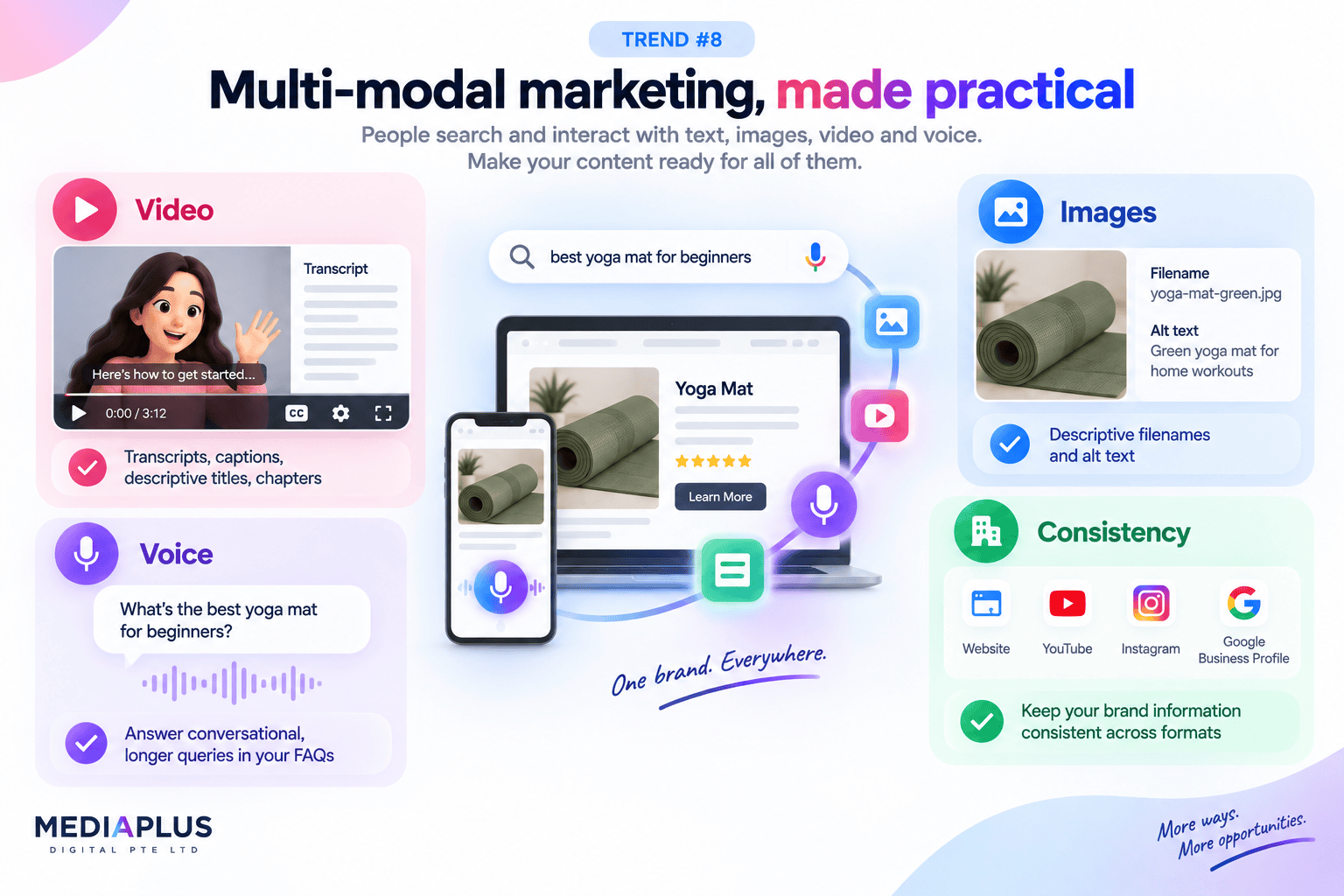
“Multi-modal” gets stated as a trend and rarely explained. Concretely, it means people search and interact with images, video and voice as well as text, and AI systems increasingly read all of them.
What to actually do:
- Make video content machine-readable: accurate transcripts, captions, descriptive titles, on-screen text, and chapters. A transcript turns a video into something search and AI systems can quote.
- Give images real descriptive filenames and alt text, particularly product images, so visual search can identify them.
- Write for spoken queries in your FAQ sections, since voice questions are longer and more conversational.
- Keep your entity information consistent across formats, so the brand described in your video matches the one on your site.
What to adopt first
|
Priority |
Trend |
Why this order |
|
1. Now |
AI search visibility |
Determines whether you are found at all |
|
2. Now |
AI copilots in existing tools |
Immediate productivity, no new spend |
|
3. Next |
First-party data foundations |
Everything downstream depends on it |
|
4. Next |
Conversational AI on top questions |
Fast conversion gains, contained risk |
|
5. Pilot |
Agentic AI |
Real potential, unproven at scale |
|
6. Ongoing |
Authenticity and multi-modal |
Compounds slowly, differentiates lastingly |
How to measure any of this
The common failure is adopting AI tools and never establishing whether they helped.
- AI visibility: citations and mentions across named prompts and engines, measured against your baseline.
- Copilots: hours saved and output volume, checked against quality, not just speed.
- Conversational AI: containment rate, response time, and conversion from chat.
- Personalisation: conversion rate and revenue per visitor by segment.
- Everything: enquiries and revenue. If a tool cannot be tied to those eventually, it is a cost.
Where humans still have to lead
- Strategy and positioning. AI can execute a plan; it cannot decide what your business should stand for.
- Brand voice and judgement. Models converge on an average tone. Distinctiveness is a human decision.
- Anything with legal, regulatory or reputational risk. Review before publication, always.
- Relationships. The parts of marketing that depend on trust are not automatable.
- Verification. AI output is confidently wrong often enough that unchecked publication is a real risk.
Frequently asked questions
What are the biggest AI marketing trends in 2026?
AI search visibility, AI copilots embedded in existing tools, agentic AI for multi-step execution, first-party data as the basis for personalisation, conversational AI across the journey, content authenticity, and multi-modal content.
Is SEO dead because of AI search?
No. It has expanded. Ranking still matters for commercial queries, and being cited in AI answers is now an additional requirement built on the same foundations: technical health, clear structure and genuine authority.
Should small businesses invest in AI marketing?
Yes, starting with the free or included tools. Use the copilots already inside your existing platforms, and fix AI search visibility, which costs effort rather than licence fees.
Will AI replace marketers? It is replacing specific tasks, not the role. Strategy, positioning, brand judgement, verification and relationships remain human. Marketers who use AI well are displacing those who do not.
What is agentic AI in marketing? AI that carries out multi-step tasks rather than responding to single prompts, for example researching a segment, drafting a campaign and monitoring it. In 2026 it is best treated as a supervised pilot, not a foundation.
How do I get my brand cited by ChatGPT or AI Overviews? Structure content answer-first, use question-shaped headings and structured data, keep your entity information consistent everywhere, ensure AI crawlers can access your site, and build corroboration on third-party sources.
What should I do first if I have limited time? Baseline your AI search visibility, then restructure your key pages to answer-first. That single change improves both AI citation and traditional search snippets.
Put these trends to work
The businesses that gain from AI in 2026 will not be the ones that bought the most tools. They will be the ones that fixed how they are found, freed up time on repetitive work, and kept humans on the decisions that matter. If you want help doing that in the right order, talk to MediaPlus Digital. Explore our AI SEO and GEO services, SEO and digital marketing services, with PSG support for eligible SMEs.