
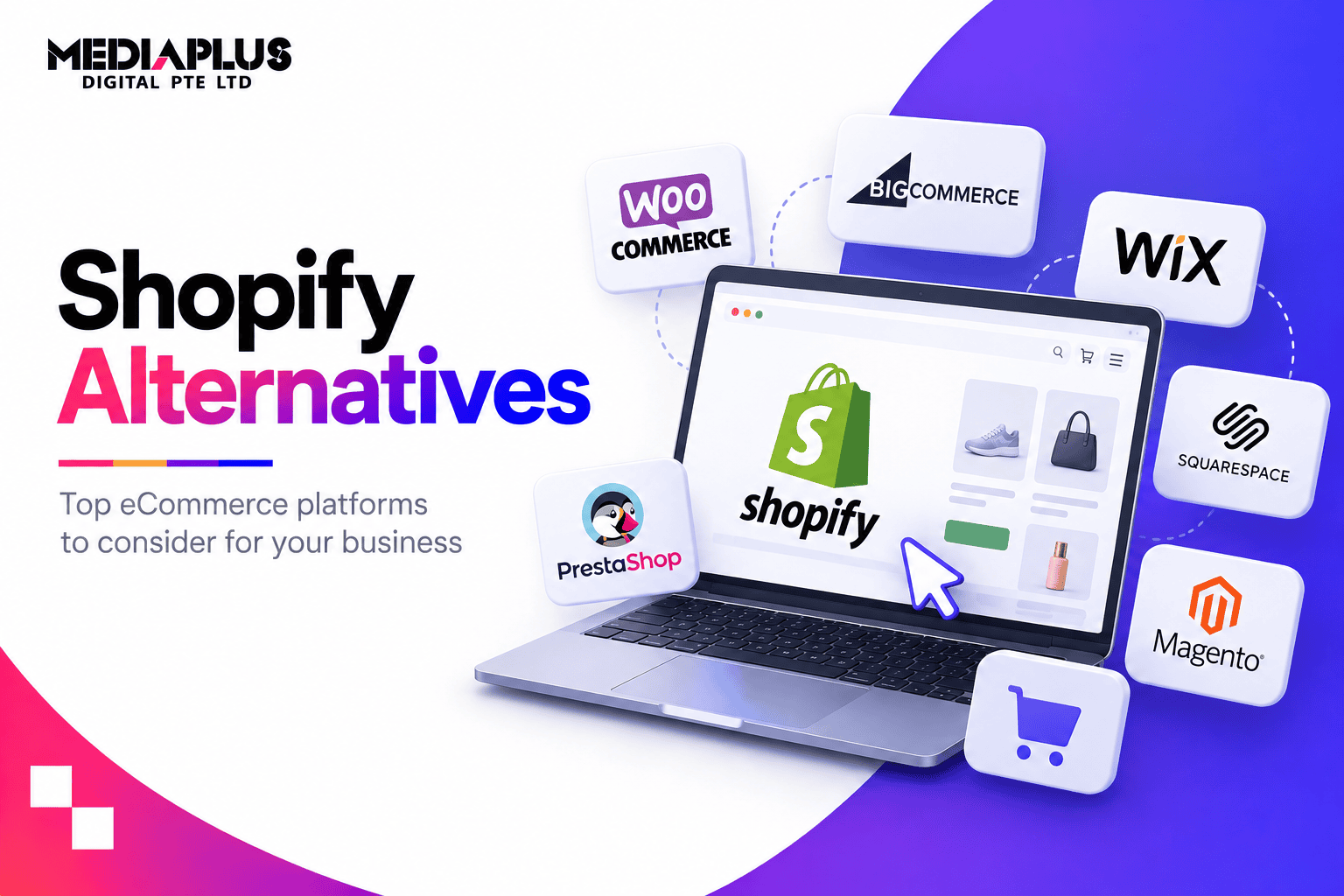
Shopify is the default choice for online stores, and for good reason. But it is not the right fit for everyone: transaction fees on external payment providers, app subscriptions that stack up, limited checkout control on lower plans, and monthly costs that keep running whether you sell or not. If you are evaluating options, here are the strongest Shopify alternatives, what each is actually good at, and how to choose.
Quick answer: The best Shopify alternatives are WooCommerce (free, flexible, you own it), BigCommerce (strong built-in features, no extra transaction fees on its own gateway), Adobe Commerce/Magento (enterprise and complex catalogues), Wix and Squarespace Commerce (simple, small catalogues), Ecwid (add a store to an existing site), headless platforms (developer-led, full control), and marketplaces like Shopee and Lazada (fastest access to buyers). WooCommerce is the most common switch for cost and control; BigCommerce is the closest hosted like-for-like.
Why look for a Shopify alternative
- Transaction fees. Using a payment provider other than Shopify Payments incurs an additional fee on every order.
- App costs. Much of the functionality comes from paid apps, and monthly subscriptions accumulate quickly.
- Checkout control. Deep checkout customisation is reserved for the enterprise tier.
- Ongoing subscription. You pay monthly regardless of sales.
- Ownership. You are on a closed platform, so you cannot move the store elsewhere.
- Content limitations. Blogging and content-led SEO are weaker than a full CMS.
None of these make Shopify a bad platform. They just make it the wrong platform for some businesses.
The 8 best Shopify alternatives
|
Alternative |
Best for |
Trade-off |
|
WooCommerce |
Flexibility, content-led SEO, ownership |
You manage hosting and maintenance |
|
BigCommerce |
Feature-rich hosted store, no extra transaction fees |
Less design freedom than Shopify |
|
Adobe Commerce (Magento) |
Large catalogues, enterprise, B2B |
Expensive, needs developers |
|
Wix eCommerce |
Very small catalogues, simplicity |
Limited at scale |
|
Squarespace Commerce |
Design-led small stores |
Basic commerce features |
|
Ecwid |
Adding a store to an existing site |
Not a full standalone platform |
|
Headless (Medusa, Saleor, commercetools) |
Custom experiences, full control |
Developer-heavy, higher cost |
|
Marketplaces (Shopee, Lazada, Qoo10, Amazon SG) |
Instant access to buyers |
Commission, you do not own the customer |
1. WooCommerce
The most common switch. A free, open-source plugin that turns WordPress into a full store. You own everything, pay no platform fee, and can extend it endlessly. It also inherits WordPress’s content strengths, which matters if you compete on SEO. The trade-off is responsibility: hosting, security, updates, and performance are yours. Best for: content-led stores, businesses wanting ownership and lower recurring costs. See our WooCommerce development services.
2. BigCommerce
The closest hosted like-for-like alternative. More features are built in rather than sold as apps, and it does not charge extra transaction fees on top of your chosen gateway. Strong on multi-channel and B2B. Design flexibility and the app ecosystem are narrower than Shopify’s. Best for: growing stores that want fewer app subscriptions.
3. Adobe Commerce (Magento)
Enterprise-grade, built for large catalogues, complex pricing, multi-store, and serious B2B. Extremely powerful and extremely demanding: it needs real development resource and budget. Best for: large retailers and complex B2B operations.
4. Wix eCommerce
Fine for a handful of products alongside a marketing site. Simple, cheap, and easy. It runs out of room quickly as catalogue and order volume grow. Best for: very small catalogues and side businesses.
5. Squarespace Commerce
Beautiful templates and a tidy editor, suited to design-led brands selling a small range. Commerce features are basic compared with dedicated platforms. Best for: boutique brands and creators.
6. Ecwid
Rather than replacing your site, Ecwid adds a store to whatever you already have. A pragmatic option if your existing website works and you just need to start selling. Best for: adding commerce without a rebuild.
7. Headless commerce
Platforms like Medusa, Saleor, or commercetools separate the storefront from the commerce engine, so you can build any front-end experience you want. Maximum control and performance, at the cost of needing a development team. Best for: brands with specific experience requirements and the resources to build.
8. Marketplaces
In Singapore and the region, Shopee, Lazada, Qoo10, and Amazon SG give you immediate access to a large buyer base with no site to build. You pay commission and you do not own the customer relationship, so most sellers use marketplaces alongside their own store rather than instead of one. Best for: testing demand and generating early sales.
Cost comparison at a glance
|
Platform |
Cost model |
|
Shopify |
Monthly subscription, plus apps, plus fees on external gateways |
|
WooCommerce |
Free plugin; you pay hosting, extensions, and maintenance |
|
BigCommerce |
Monthly subscription, more included, no added transaction fees |
|
Adobe Commerce |
Licence and/or hosting plus substantial development |
|
Wix / Squarespace |
Monthly subscription, limited at scale |
|
Headless |
Development-led, highest upfront cost |
The honest comparison is total cost over three years, including apps, extensions, hosting, payment fees, and the development you will actually need.
What Singapore sellers should also consider
- Payment methods. Whatever you choose must support cards, PayNow, and common wallets. See the best payment gateways in Singapore.
- Local logistics. Check integrations with local couriers for label printing and tracking.
- GST. If you are GST-registered, the platform must handle tax display and reporting correctly.
- Marketplace strategy. Many Singapore brands run their own store plus Shopee and Lazada. Make sure inventory stays in sync.
- PSG grant. Eligible SMEs can claim up to 50% on pre-approved e-commerce solutions, which affects the real cost of a build.
How to choose
- Catalogue size and complexity. Small and simple suits hosted builders; large or complex points to WooCommerce, BigCommerce, or Adobe Commerce.
- Content and SEO ambition. If organic traffic is your growth plan, WooCommerce on WordPress is hard to beat.
- Technical resources. No developer means a hosted platform. An agency or in-house dev opens up WooCommerce and headless.
- Ownership. If being able to move matters, choose open source.
- Three-year total cost, not the monthly headline.
Migrating without losing sales or rankings
- Export products, customers, and orders before you touch anything.
- Keep URL structures where you can, and 301 redirect every changed URL, especially product and category pages.
- Recreate on-page SEO: titles, descriptions, schema, and image alt text.
- Test checkout, payments, tax, and shipping thoroughly before launch.
- Launch at a quiet trading period and monitor Search Console and sales daily for the first weeks.
Frequently asked questions
What is the best alternative to Shopify?
WooCommerce for most businesses wanting flexibility, content-led SEO, and ownership without a platform subscription. BigCommerce is the closest hosted like-for-like if you prefer someone else to manage the infrastructure.
Is WooCommerce cheaper than Shopify?
The plugin is free, so there is no platform subscription, but you pay for hosting, extensions, and maintenance. It is usually cheaper over time, especially at higher volumes, provided you have support to run it.
Why do people leave Shopify?
Most commonly the stacking cost of apps, transaction fees on external payment gateways, limited checkout control below the enterprise tier, and wanting to own their store rather than rent it.
Should I sell on my own store or on Shopee and Lazada?
Most Singapore sellers do both. Marketplaces give instant traffic and are good for proving demand; your own store gives better margins, customer data, and a brand asset you control.
Will moving platforms hurt my SEO?
Not if you plan it. Preserve content, map and redirect every URL, rebuild on-page SEO, and monitor Search Console after launch.
Which platform is best for a small Singapore business just starting out?
If you are testing an idea, a marketplace or a simple hosted store. If you intend to build a brand and rank organically, WooCommerce or Shopify with a proper build, using PSG support where eligible.
Build a store on the right platform
Platform choice shapes your costs, your SEO, and how far you can grow. If you want an honest recommendation and a store built to sell, talk to MediaPlus Digital. Explore our e-commerce website development and WooCommerce development services, with PSG support for eligible SMEs.




