
Most marketing plans fail for the same reason: they are a list of tactics with no argument behind them. A good plan connects what you want to achieve, who you are trying to reach, what you will say, where you will say it, what it costs, and how you will know it worked. This guide gives you a marketing plan template you can copy section by section, with what actually goes in each part and the mistakes that make plans useless.
Quick answer: A marketing plan template should contain: an executive summary, business and market analysis, competitor analysis, target audience and personas, your positioning and unique selling proposition, SMART marketing goals, your strategy and channels, an action plan with owners and dates, a budget, and the KPIs you will measure. Write it in that order, because each section should justify the next. Keep it short enough that people actually read it, and review it quarterly.
What is a marketing plan?
A marketing plan is a written document that sets out what you want to achieve with marketing over a defined period (usually a year), who you are targeting, how you will reach them, what it will cost, and how you will measure success.
It is not the same as a marketing strategy. The strategy is the thinking: who you serve, what you stand for, and why you will win. The plan is the execution: the channels, the calendar, the budget, and the owners. A plan without a strategy is just a list of activities. See our guide to digital marketing strategy.
The marketing plan template
Copy these sections in this order.
1. Executive summary
One page, written last. Cover: what your business does, your main marketing objectives for the period, the core strategy in a sentence or two, the headline budget, and the results you expect. This is the section busy stakeholders will actually read, so make it stand alone.
2. Business summary and current situation
Set the context: what you sell, your current position, what worked and what did not last period, and what has changed. Be honest about weaknesses. A plan built on a flattering picture solves the wrong problems.
3. Market analysis
Cover the market you are competing in: size and growth, the trends shaping it, customer behaviour shifts, and any regulatory or platform changes that affect you. Keep it to what is decision-relevant.
4. SWOT analysis
|
Helpful |
Harmful |
|
|
Internal |
Strengths |
Weaknesses |
|
External |
Opportunities |
Threats |
The point of a SWOT is not the grid, it is the conclusion. End the section with a sentence: given these, here is what we should do more of and less of.
5. Competitor analysis
List your main competitors and, for each: what they offer, their pricing, their positioning, which channels they dominate, and where they are weak. The most valuable output is the gap, the thing customers want that nobody is doing well.
6. Target audience and personas
Define who you are marketing to:
- Demographics and firmographics (age, location, income, or company size, industry, role)
- Goals: what they are trying to achieve
- Pain points: what frustrates them today
- Buying behaviour: how they research and decide, and who else influences the decision
- Where they spend attention: the channels that actually reach them
Two or three well-researched personas beat ten guesses. Map how they buy with a customer journey map.
7. Positioning and unique selling proposition
Write one sentence: for [audience], we are the [category] that [key benefit], because [reason to believe]. If your USP could be copy-pasted onto a competitor’s website, it is not a USP. This section governs every piece of copy you write afterwards.
8. Marketing goals and objectives
Make every goal SMART: specific, measurable, achievable, relevant, and time-bound.
- Weak: “increase brand awareness”
- Strong: “increase organic search traffic by 40% and generate 25 qualified leads per month from organic by Q4”
Tie each goal to a business outcome (revenue, leads, retention), not just an activity.
9. Strategy and channels
For each goal, state the channels you will use and why. Common ones:
|
Channel |
Best for |
|
SEO and content |
Compounding, high-intent traffic over time |
|
Paid search / PPC |
Fast, controllable demand capture |
|
Paid social |
Reach, demand generation, retargeting |
|
Email marketing |
Nurturing and repeat purchases, high ROI |
|
Social media (organic) |
Brand building, community, trust |
|
Website / CRO |
Converting the traffic you already pay for |
|
PR and partnerships |
Credibility and reach |
Justify each choice with your audience research. “Everyone is on TikTok” is not a reason; “our buyers research there” is. Explore SEO, performance marketing, and content marketing.
10. Action plan and calendar
This is where plans usually go vague. For each initiative, record:
|
Initiative |
Channel |
Owner |
Start |
End |
Budget |
Success metric |
|
Example: publish 12 SEO articles |
SEO |
Marketing lead |
Jan |
Dec |
$X |
Organic sessions, leads |
Every line needs a name and a date. Without owners, nothing ships.
11. Budget
Break down where the money goes: paid media, content production, tools and technology, people or agency fees, and a contingency (10 to 15% is sensible). Tie budget lines to goals so you can see what each objective actually costs. See digital marketing pricing.
12. KPIs and measurement
Define upfront how you will judge success, and how often you will check:
|
Level |
Example metrics |
|
Business |
Revenue, leads, customer acquisition cost, ROI |
|
Channel |
Organic traffic, ROAS, email conversion rate |
|
Engagement |
CTR, time on page, follower growth |
Lead with the business metrics. Engagement metrics are diagnostic, not the goal.
13. Risks and assumptions
A short section that ages well: what could derail the plan (budget cuts, platform changes, a competitor move, key-person risk) and what you will do if it happens.
How to use the template
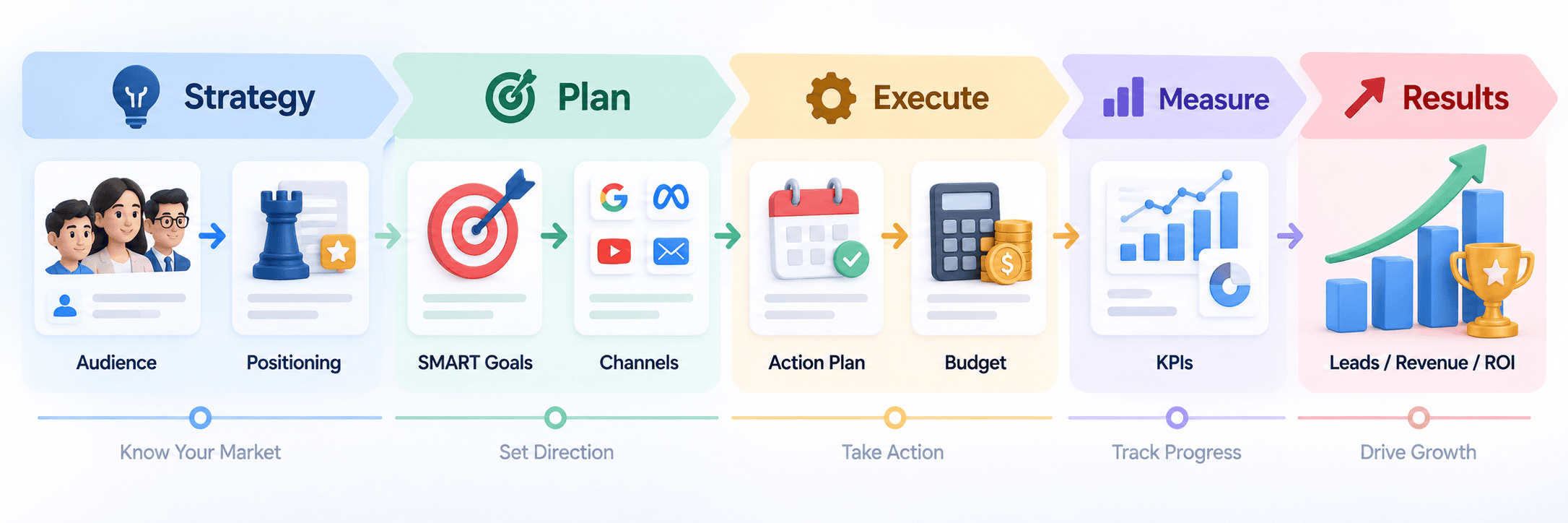
- Write the strategy sections first (audience, positioning, goals). Everything else follows from them.
- Keep it short. A tight 10-page plan that people read beats a 40-page document nobody opens.
- Assign owners and dates to every action.
- Review it quarterly, not annually. Adjust based on what the numbers show.
- Write the executive summary last, once you know what the plan actually says.
Common marketing plan mistakes
- Starting with tactics instead of audience and goals.
- Vague goals with no numbers or deadlines.
- No budget attached to initiatives, so priorities are unclear.
- No owners, so work quietly does not happen.
- Ignoring the competition and the gap in the market.
- Writing it once and never revisiting it.
- Measuring activity (posts published) instead of outcomes (leads, revenue).
Frequently asked questions
What should a marketing plan include?
An executive summary, business and market analysis, SWOT, competitor analysis, target audience and personas, positioning and USP, SMART goals, strategy and channels, an action plan with owners and dates, a budget, KPIs, and risks.
What is the difference between a marketing strategy and a marketing plan?
The strategy is the thinking: who you serve, what you stand for, and why you will win. The plan is the execution: channels, calendar, budget, owners, and metrics. You need the strategy first.
How long should a marketing plan be?
Short enough that people read it. For most small and mid-size businesses, roughly 10 to 15 pages is plenty, plus an action-plan table and budget.
How often should I update my marketing plan?
Write it annually and review it quarterly. Quarterly reviews let you shift budget toward what is working instead of waiting a year to find out.
What are SMART marketing goals?
Goals that are specific, measurable, achievable, relevant, and time-bound, for example “generate 25 qualified leads per month from organic search by Q4”, rather than “grow awareness”.
Do small businesses need a marketing plan?
Yes, and a simple one is enough. When budget is tight, a plan matters more, because it stops you spreading a small budget thinly across channels that were never going to reach your buyers.
Turn the plan into results
A marketing plan is only as good as the execution behind it. If you want help building the plan and running it, talk to MediaPlus Digital. Explore our digital marketing and SEO services, and see our guide to digital marketing strategy, with PSG support for eligible SMEs.




