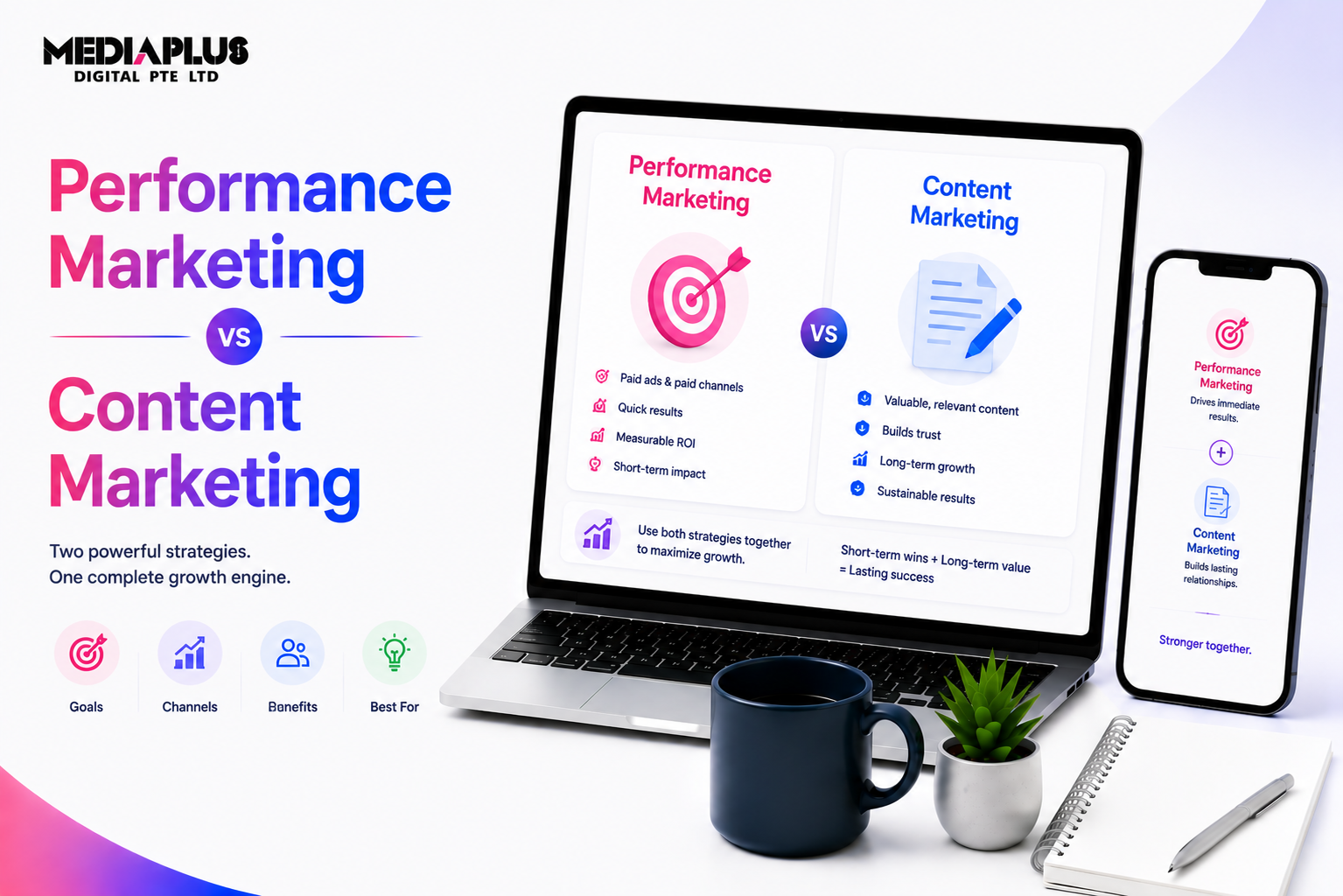
Should you pay for fast results or build an audience that compounds? That is the real question behind “performance marketing vs content marketing.” They are not rivals; they solve different problems at different speeds. This guide explains what each is, how they differ, when to use which, and why the strongest strategies use both.
Quick answer: Performance marketing buys attention and results now, through paid channels like Google and social ads, measured on immediate actions (leads, sales, ROAS). Content marketing earns attention over time, through useful content like blogs, guides, and video, building trust and organic traffic that compounds. Performance gives you speed; content gives you durability. Most businesses need both: performance for quick wins while content builds the long-term base.
What is performance marketing?
Performance marketing is paid marketing where you pay for measurable actions, clicks, leads, or sales, rather than just exposure. It runs on channels like Google Ads, Meta ads, and other paid media, and every dollar is tracked to a result. The appeal is speed and accountability: you can launch today, see leads this week, and judge success on cost per acquisition and return on ad spend. See our performance marketing services.
What is content marketing?
Content marketing is earning attention by publishing genuinely useful content, blog posts, guides, videos, and email, that answers your customers’ questions and builds trust. It does not pay for each click; instead it attracts people through search and sharing, and the value compounds as content keeps working long after it is published. See what content marketing is.
Performance marketing vs content marketing: the differences
|
Factor |
Performance marketing |
Content marketing |
|
How it works |
Buys attention with paid ads |
Earns attention with useful content |
|
Speed |
Immediate results |
Builds over months |
|
Cost model |
Pay per click or action |
Upfront effort, compounds free |
|
Longevity |
Stops when budget stops |
Keeps working over time |
|
Best for |
Fast leads and sales |
Trust, authority, durable traffic |
|
Main metrics |
CPA, ROAS, conversions |
Organic traffic, engagement, leads |
The clearest way to see it: performance marketing is renting attention, content marketing is owning it.
When to use performance marketing
- You need leads or sales quickly.
- You are launching a product or promotion.
- You have a clear offer and a landing page ready to convert.
- You want to test demand fast before investing in content.
- You have budget to sustain the spend.
Performance is the right lever when speed and measurable ROI are the priority. Run it through a Google Ads agency or PPC team.
When to use content marketing
- You want to lower your long-term cost per lead.
- You are building authority and trust in your market.
- Your buyers research before they buy.
- You want organic traffic that keeps compounding.
- You can commit to consistency over several months.
Content is the right lever when you want durable, lower-cost growth. It feeds SEO; see blogging for SEO.
Why the best strategy uses both
Performance and content are not either/or. They reinforce each other:
- Performance gives content a head start. Paid ads promote your best content and drive traffic while SEO builds.
- Content lowers performance costs. Better landing pages and trust-building content improve conversion, so your ads work harder.
- Together they cover the whole funnel. Content attracts and educates at the top; performance captures and converts at the bottom.
A common approach: use performance marketing for immediate leads and revenue, while investing in content so that, over time, more of your growth comes from free organic traffic and your reliance on paid spend falls.
How to measure each
- Performance marketing: cost per lead (CPL), cost per acquisition (CPA), return on ad spend (ROAS), conversion rate.
- Content marketing: organic traffic and rankings, engagement (time on page, shares), leads and assisted conversions, and cost per lead over time.
Judge both on business outcomes, not vanity metrics. Content often assists conversions it does not directly close, so look beyond last click.
Which costs more?
Performance marketing has a lower barrier to start but an ongoing cost: you keep paying for every click. Content marketing costs more upfront in time and effort, but the cost per lead falls as it compounds. Over a long enough horizon, content usually delivers a lower blended cost per lead, which is why mature brands shift more weight to it while keeping performance for speed.
Frequently asked questions
What is the difference between performance marketing and content marketing?
Performance marketing buys immediate results through paid ads, measured on actions like leads and sales. Content marketing earns attention over time through useful content, building trust and organic traffic that compounds.
Which is better, performance or content marketing?
Neither is universally better; they solve different problems. Performance is better for fast, measurable results; content is better for durable, lower-cost long-term growth. Most businesses need both.
Should a small business do performance or content marketing first?
Many SMEs start with performance marketing for quick leads while building content in parallel, so that organic traffic gradually reduces their reliance on paid spend.
Is SEO performance or content marketing?
SEO sits closest to content marketing, since it relies on useful content to rank organically. It is not paid performance marketing, though the two work well together.
Can content marketing replace paid ads?
Over time it can carry more of the load and lower your cost per lead, but it takes months to build. Most businesses keep some paid performance for speed and demand capture.
Get performance and content working together
The winning strategy is not performance vs content; it is both, aligned. If you want paid and organic marketing coordinated into one growth plan, talk to MediaPlus Digital. Explore our digital marketing agency, performance marketing, and SEO services, with PSG support for eligible SMEs.