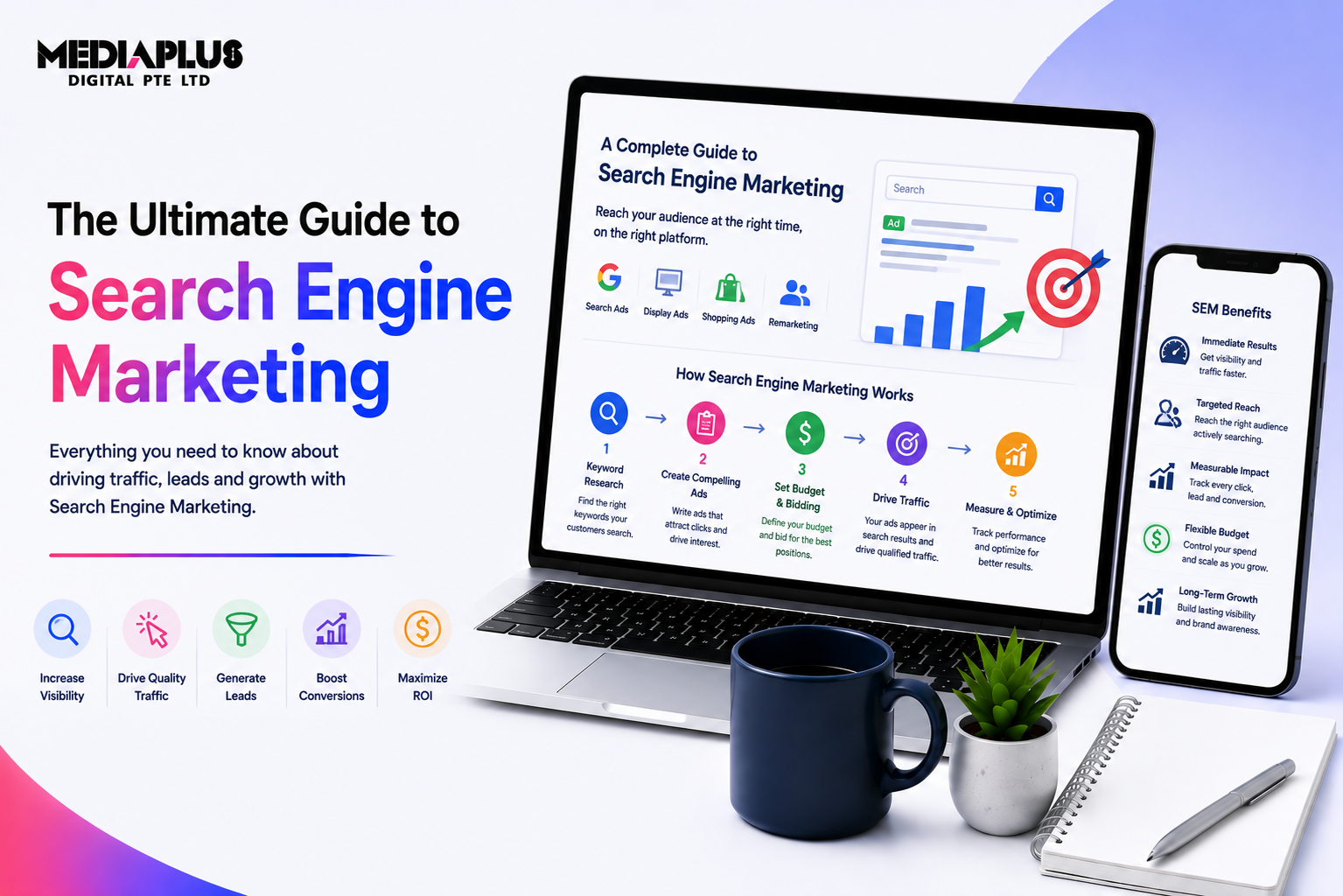
When someone searches Google for exactly what you sell, SEM is how you appear at the top, instantly. It is one of the fastest, most measurable ways to grow, and one of the easiest to waste money on if you get it wrong. This guide covers everything you need to know about search engine marketing: what it is, how the auction works, the components of a campaign, the metrics that matter, and how to run SEM that drives leads without burning budget.
Quick answer: Search Engine Marketing (SEM) is paid advertising that puts your website at the top of search results. You bid on keywords, and through an auction your ads appear when people search those terms, paying only when someone clicks (pay-per-click). SEM delivers immediate, high-intent traffic, and it works best on tight keyword targeting, relevant ads, strong landing pages, and constant optimisation.
What is SEM?
Search Engine Marketing is the practice of promoting a website through paid ads on search engine results pages. You choose the keywords you want to appear for, set a budget, and your ads show at the top of results when people search those terms. Because you reach people at the exact moment they are looking, SEM traffic is high-intent and ready to act. For a deeper primer, see what SEM is.
A note on terms: historically SEM covered both paid and organic search, but today most marketers use SEM to mean paid search specifically, which is how this guide uses it.
SEM vs SEO: how they differ
|
Factor |
SEM (paid) |
SEO (organic) |
|
Visibility |
Bought via ads |
Earned over time |
|
Speed |
Immediate |
Months to build |
|
Cost |
Pay per click |
No cost per click |
|
Longevity |
Stops when budget stops |
Lasts and compounds |
|
Best for |
Fast, measurable demand capture |
Long-term, compounding traffic |
The strongest strategies use both. See SEO vs SEM.
How SEM works: the ad auction
You do not simply pay to be at the top. Every time someone searches, the search engine runs an auction in milliseconds to decide which ads show and in what order. Two things mainly decide your position:
- Your bid: the maximum you are willing to pay for a click.
- Quality Score: how relevant and useful your keyword, ad, and landing page are.
This is why a smaller advertiser with highly relevant ads and a great landing page can outrank a bigger spender and pay less. Better quality means better positions at lower cost. This pay-per-click model is the heart of PPC.
The core components of an SEM campaign
- Keywords and match types: the terms you target, and how tightly (broad, phrase, exact).
- Negative keywords: terms you exclude to stop wasting spend on irrelevant searches.
- Ad copy and extensions: compelling headlines plus sitelinks, callouts, and other extensions that make your ad larger and more clickable.
- Landing pages: fast, relevant pages that match the ad and convert. This is where most budgets are won or lost.
- Bidding strategy: manual or automated bidding toward your goal (clicks, conversions, or ROAS).
- Audience targeting: layering demographics, location, and remarketing on top of keywords.
SEM platforms
- Google Ads is the dominant platform, covering Search, Shopping, Display, and YouTube. Most Singapore businesses start here, often through a Google Ads agency or dedicated PPC services.
- Microsoft Advertising (Bing) reaches a smaller but often lower-cost audience.
Google Ads campaign types
|
Campaign type |
What it does |
Best for |
|
Search |
Text ads on search results |
Capturing high-intent queries |
|
Shopping |
Product listings with image and price |
Ecommerce and retail |
|
Display |
Banner ads across websites |
Awareness and remarketing |
|
Video (YouTube) |
Video ads |
Reach and consideration |
|
Performance Max |
AI-run across all Google channels |
Scaling with good data |
For the full list, see types of Google Ads, and our breakdown of Performance Max and AI Max.
The SEM metrics that matter
|
Metric |
What it tells you |
|
Click-through rate (CTR) |
How compelling your ad is |
|
Cost per click (CPC) |
What each click costs |
|
Quality Score |
Relevance of keyword, ad, and page |
|
Conversion rate |
How well clicks become leads or sales |
|
Cost per acquisition (CPA) |
What each conversion costs |
|
Return on ad spend (ROAS) |
Revenue earned per dollar spent |
Judge SEM on CPA and ROAS, not clicks or impressions.
How to build an SEM campaign, step by step
- Set a clear goal and the metric you will measure it by (leads, sales, ROAS).
- Research keywords with real buying intent, and group them tightly.
- Structure the account into themed campaigns and ad groups.
- Write relevant ads matched to each keyword group, with extensions.
- Build dedicated landing pages that match the ad and convert.
- Set up conversion tracking before you spend a dollar.
- Add negative keywords to protect your budget.
- Launch, then optimise bids, creative, and audiences continuously.
- Report and scale the winners, cut the losers.
How much does SEM cost in Singapore?
SEM has two costs: your media budget (what goes to Google) and, if you use an agency, a management fee.
|
Element |
Typical range |
|
Media budget (ad spend) |
From about S$1,000 / month, scaling with competition |
|
Agency management fee |
From about S$800 – 3,000+ / month |
Costs vary by industry and competition; high-value sectors like legal and finance have higher CPCs. For a full breakdown, see Google Ads cost. Eligible SMEs can offset up to 50% of qualifying costs through the PSG grant.
SEM in the AI era
Search is changing as AI answers and AI Overviews appear above traditional results, and Google pushes more automation through Smart Bidding and Performance Max. Paid search still works, but the smartest brands pair SEM with strong SEO and AI-ready content so they stay visible wherever people search. Automation also means the human job shifts toward strategy, creative, feed quality, and conversion, not manual bid tweaks.
Common SEM mistakes that waste budget
- Sending clicks to your homepage instead of a dedicated landing page
- No conversion tracking, so you cannot tell what works
- Broad keywords with no negative keywords
- Judging success on clicks rather than leads and ROAS
- Ignoring Quality Score and paying more than you should
- Setting and forgetting, with no ongoing optimisation
Frequently asked questions
What is SEM in simple terms?
Paid advertising on search engines. You bid on keywords, your ads appear at the top of results, and you pay per click.
Is SEM the same as Google Ads?
Google Ads is the main platform used for SEM, but SEM also includes other paid-search platforms like Microsoft Advertising.
Is SEM the same as PPC?
Closely related. PPC (pay-per-click) is the pricing model; SEM is the discipline of paid search marketing, usually billed per click.
How much does SEM cost in Singapore?
Most SMEs run a media budget of S$1,000 to 6,000+ per month plus a management fee. PSG can offset up to 50% for eligible SMEs.
How soon does SEM work?
Almost immediately. You can be live and driving clicks within days, with performance improving over the first weeks.
Should I do SEM or SEO?
Both, ideally. SEM captures demand fast while SEO builds compounding, lower-cost traffic over time.
Get SEM working for your business
SEM rewards structure, relevance, and constant optimisation. If you want paid search that drives leads without wasting budget, talk to MediaPlus Digital. Explore our SEM agency, Google Ads, and PPC services, with PSG support for eligible SMEs.