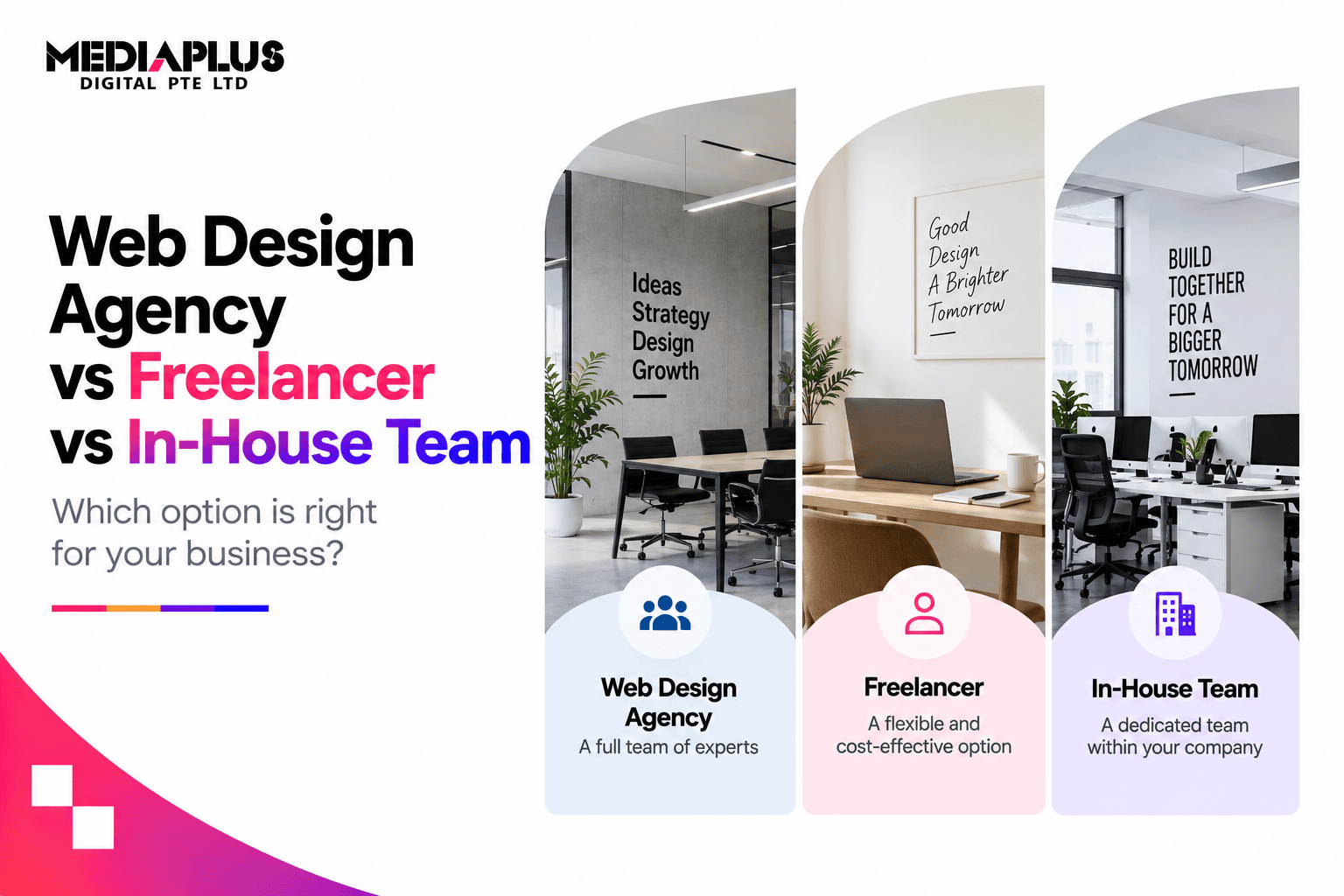
Every business that needs a website faces the same fork in the road: hire an agency, engage a freelancer, or build the capability in-house. Each can work, and each fails in predictable ways. The wrong choice usually shows up months later as a half-finished site, a developer who vanished, or a salaried hire who cannot cover every skill the job needs. This guide compares all three honestly so you can pick the right one for your situation.
Quick answer: Freelancers are cheapest and best for small, well-defined projects, but carry key-person risk and rarely cover every skill. Agencies cost more but give you a full team (design, development, SEO, project management), continuity, and accountability, which suits businesses whose website drives revenue. An in-house team only makes sense at scale, when the workload is constant enough to justify multiple salaries. Many companies run a hybrid: a small internal team for day-to-day, an agency for specialist work.
The three options in short
Freelancer. One independent professional, usually specialising in one area (design or development). You manage them directly.
Agency. A company with a team of specialists across design, development, content, SEO, and project management, working to a contract and a process.
In-house team. Employees on your payroll, dedicated to your business full time.
Side-by-side comparison
|
Freelancer |
Agency |
In-house team |
|
|
Cost |
Lowest |
Mid to high |
Highest (salaries, ongoing) |
|
Range of skills |
Narrow, one or two areas |
Broad, full team |
Depends who you hire |
|
Speed |
Varies, limited capacity |
Fast, parallel workstreams |
Fast once established |
|
Continuity |
Key-person risk |
Team covers absences |
High, unless staff leave |
|
Accountability |
Informal |
Contract, SLA, process |
Direct management |
|
Scalability |
Limited |
Scales up and down |
Slow, requires hiring |
|
Strategic input |
Usually execution only |
Strategy plus execution |
Deep business knowledge |
|
Management effort |
High, you coordinate |
Low, they project-manage |
High, you manage people |
|
Best for |
Small, defined projects |
Business-critical websites |
Constant, high-volume work |
What each really costs
Cost is not just the invoice.
- Freelancer: the lowest rate, but you absorb the coordination. If you need design, development, copy, and SEO, you may end up hiring three or four freelancers and managing them yourself, which quietly becomes a part-time job.
- Agency: a higher project fee, but it includes project management, quality control, and multiple specialists. For a website that generates leads or sales, the higher spend often pays for itself in performance and in not having to babysit the project.
- In-house: the most expensive by far once you count salaries, CPF, equipment, software licences, and management time. A single designer-developer hire is a substantial annual commitment, and one person still cannot cover design, development, SEO, and content well.
In Singapore, the PSG grant can offset up to 50% of the cost of eligible website solutions from pre-approved vendors, which materially changes the maths in favour of using an approved agency. See website development cost in Singapore.
When a freelancer is the right choice
- The project is small and clearly defined (a landing page, a simple brochure site, a specific fix).
- Your budget is tight and the website is not yet central to revenue.
- You have someone internally who can brief and manage the work properly.
- You only need one skill, for example a designer when you already have a developer.
The risks: limited capacity, no cover if they get sick or take another job, variable quality, and often no ongoing support once the project ends. Mitigate by checking a real portfolio, agreeing scope and milestones in writing, and insisting you own the files, accounts, and domain.
When an agency is the right choice
- Your website is business-critical, driving leads or sales.
- You need more than one discipline: design, development, content, SEO, and analytics working together.
- You want accountability and continuity, not a single point of failure.
- You need it done properly and on time, without managing it yourself.
- You want ongoing support: maintenance, security, and improvements after launch.
The risks: higher cost, and quality varies between agencies. Mitigate by checking case studies with real results, asking who actually does the work, and getting scope, timeline, and ownership in the contract. See our guide to choosing a web design agency.
When in-house makes sense
- You have constant, high-volume work that would keep several people busy year-round.
- Deep product or domain knowledge is essential and hard to transfer.
- You need immediate, everyday responsiveness and full control.
- You can afford the salaries and the management overhead.
The risks: high fixed cost, skill gaps (one person rarely covers design, development, SEO, and content), slow hiring, and exposure when someone resigns. Most small and mid-size businesses do not have enough sustained work to justify it.
The hybrid approach
The most common setup in practice: a small in-house team handling day-to-day content, campaigns, and quick updates, with an agency for specialist work such as builds, redesigns, SEO, and paid media. You get institutional knowledge and responsiveness internally, plus specialist depth without carrying every skill on payroll.
How to decide: five questions
- How important is the website to revenue? The more it matters, the more accountability you should buy.
- How many skills does the job need? More than two usually points to an agency.
- Who will manage the work? No internal manager means a freelancer will struggle.
- Is the work ongoing or one-off? Constant work leans in-house or a retainer; one-off leans agency or freelancer.
- What happens if the person disappears? If that would be a crisis, avoid single-person dependency.
Common mistakes
- Choosing on price alone, then paying twice when the work has to be redone.
- Hiring one freelancer for everything, design, development, copy, and SEO, and getting one of them done well.
- Not agreeing ownership of the site files, domain, hosting, and analytics accounts upfront.
- Hiring in-house too early, before the workload justifies a salary.
- No written scope, which is the root of most disputes.
- Ignoring post-launch support, so the site slowly decays after go-live.
Frequently asked questions
Is a freelancer cheaper than an agency?
Usually yes on the invoice. But if you need several skills, you may hire several freelancers and manage them yourself, and the total cost plus your time can approach agency pricing without the accountability.
When should I use a web design agency instead of a freelancer?
When the website is business-critical, needs multiple disciplines, or you need guaranteed continuity, project management, and ongoing support after launch.
Is it worth building an in-house web team?
Only if you have enough constant work to keep multiple specialists busy. For most SMEs the fixed cost and skill gaps outweigh the control you gain.
Can I combine an agency with an in-house team?
Yes, and many businesses do. Keep day-to-day updates and campaigns internal, and use an agency for builds, redesigns, and specialist work like SEO and paid media.
What should I always agree in writing?
Scope, timeline, milestones, cost, who does the work, post-launch support, and ownership of the site files, domain, hosting, and analytics accounts.
Does the PSG grant apply to agencies?
Eligible Singapore SMEs can claim up to 50% for pre-approved solutions from pre-approved vendors, which typically means working with an approved agency rather than a freelancer.
Get the right team on your website
If you want a team that covers design, development, SEO, and support under one contract, talk to MediaPlus Digital. Explore our web design services in Singapore and website maintenance, with PSG support for eligible SMEs.