
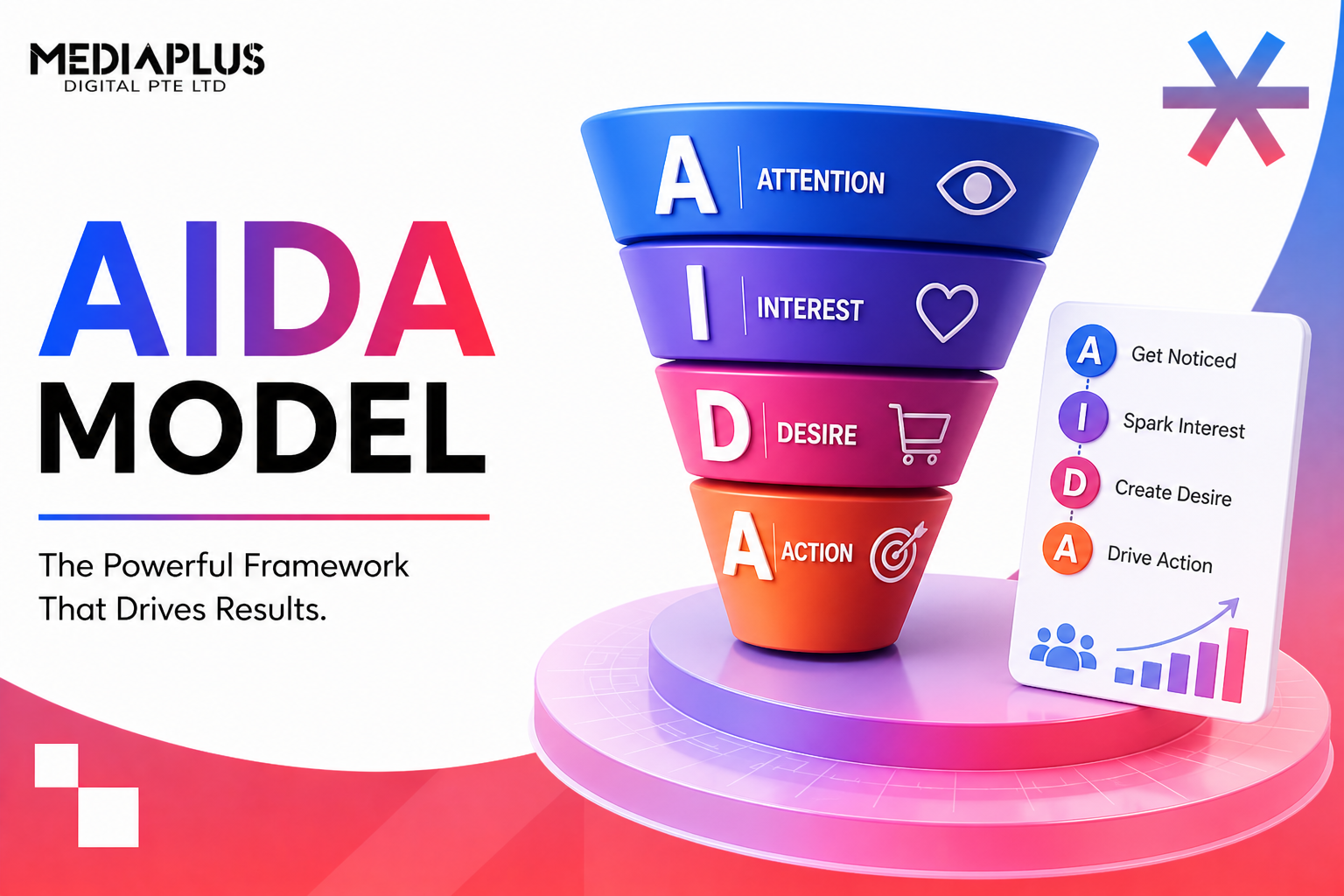
Every customer moves through a journey before they buy, from first noticing a brand to finally taking action. The AIDA model maps that journey in four simple stages: Attention, Interest, Desire, Action. It is one of the oldest and most useful frameworks in marketing, and it still shapes how modern campaigns are built. This guide explains what AIDA stands for, each stage, how to apply it in digital marketing, and its limits.
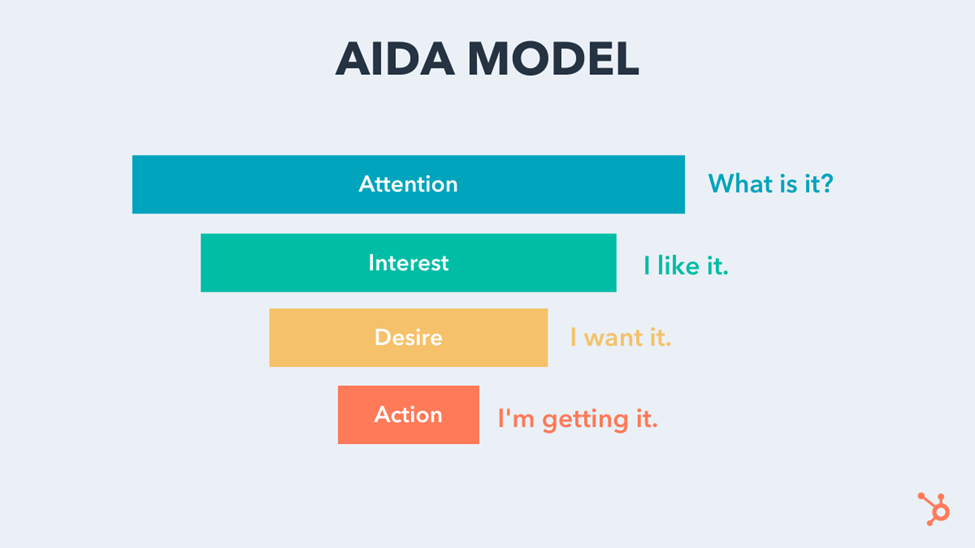
Quick answer: AIDA stands for Attention, Interest, Desire and Action. It describes the four stages a customer goes through before buying: first you grab their Attention, then build Interest, create Desire for your product, and finally prompt Action. Marketers use it to plan content and campaigns that guide people from awareness to purchase.
What is the AIDA model?
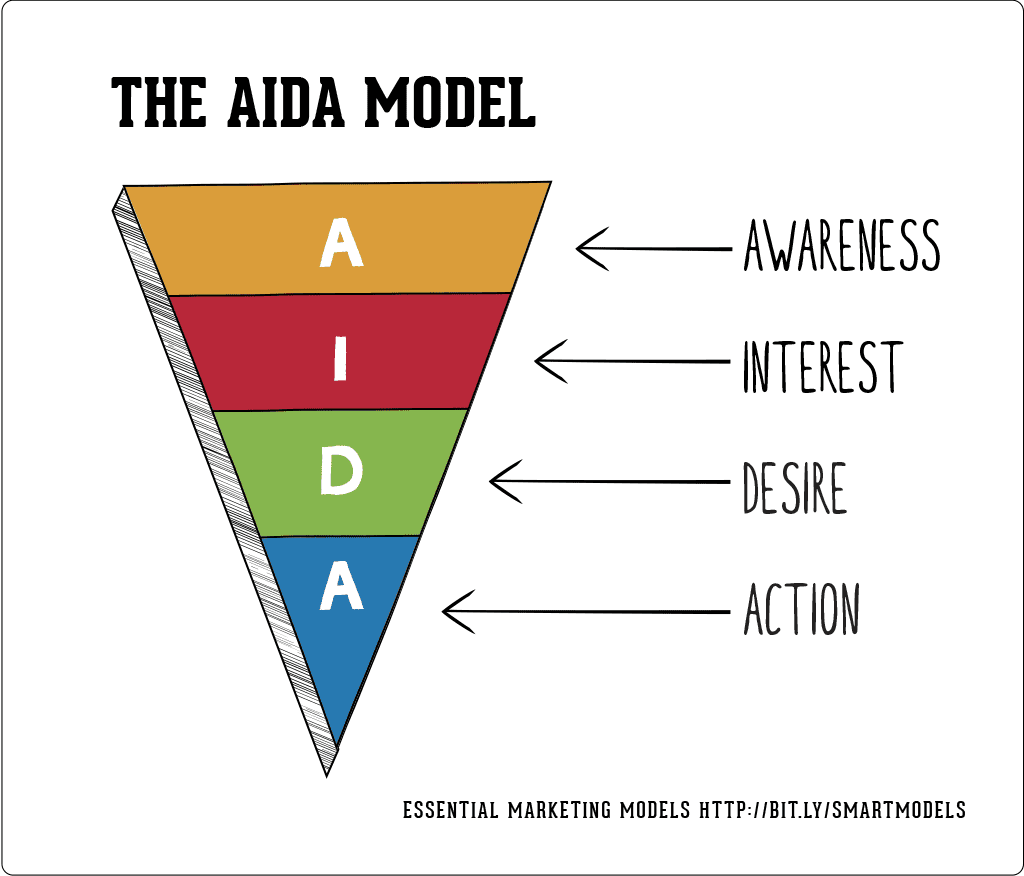
The AIDA model is a classic marketing framework that describes the stages a consumer passes through on the way to a purchase. Pictured as a funnel, it starts wide with many people becoming aware of you, and narrows as they move toward buying. It helps marketers make sure every piece of content or advertising has a job: to move someone to the next stage.
What does AIDA stand for?
|
Stage |
Goal |
What it does |
Example tactics and channels |
|
Attention |
Get noticed |
Make the audience aware you exist |
SEO, ads, social, eye-catching headlines |
|
Interest |
Earn engagement |
Show you are relevant to their need |
Useful content, blogs, videos, email |
|
Desire |
Build wanting |
Make them want your solution |
Benefits, reviews, case studies, retargeting |
|
Action |
Prompt the step |
Get them to buy or enquire |
Clear CTAs, landing pages, offers |
Attention
The first job is to get noticed in a crowded market. Someone cannot buy from you if they do not know you exist. In digital marketing, you earn attention through SEO, paid ads, social content and strong headlines that stop the scroll.
Interest
Once you have attention, you have seconds to make it relevant. Interest is about showing the audience that you understand their problem and can help. Useful blog content, videos, and clear messaging keep them engaged rather than bouncing.
Desire
Interest turns into desire when people move from “this is relevant” to “I want this”. You build desire by highlighting benefits (not just features), showing social proof like reviews and case studies, and using retargeting to stay top of mind. This is where trust does the heavy lifting.
Action
Finally, you prompt the step you want: buy, enquire, book or sign up. This needs a clear, single call to action and a frictionless path, usually a fast, focused landing page. A great campaign can still fail here if the action is unclear or the page is slow. Strong conversion optimisation matters most at this stage.
The extended model: Retention
Modern marketers often add a fifth stage, Retention, because winning a customer is only the start. Keeping them, through great service, email and loyalty, drives repeat sales, which are far cheaper than new ones. Some versions also add Conviction (AIDCA) between Desire and Action, the moment a customer becomes convinced.
How to apply AIDA in digital marketing
Map your channels and content to each stage:
- Attention: run SEO, paid search and social ads to get in front of the right people.
- Interest: publish helpful content and nurture with email so they engage.
- Desire: use reviews, case studies and retargeting to build preference.
- Action: send them to a focused landing page with one clear CTA.
- Retention: follow up with email, offers and service to keep them.
The point is not to do everything at once, but to make sure you have something working at each stage, with no gaps in the funnel.
A real-world example
Imagine a Singapore skincare brand. It runs Instagram and search ads to grab Attention, publishes skincare guides and short videos to build Interest, shares before-and-after results and reviews to create Desire, then drives shoppers to a clean product page with a limited-time offer to prompt Action. Afterwards, it emails tips and restock reminders for Retention.
Criticisms and limitations of AIDA
AIDA is a simplification. Real customer journeys are not always linear, people loop back, skip stages, or are influenced by many touchpoints at once. It also focuses on the sale more than the ongoing relationship, which is why the Retention stage was added. Treat AIDA as a helpful planning lens, not a rigid rule.
Why the AIDA model still matters
Despite its age, AIDA endures because it captures a simple truth: you cannot rush someone to buy without first earning attention, interest and desire. It keeps marketers focused on the customer’s mindset at each stage, and it maps neatly onto the modern marketing funnel and channels.
Frequently asked questions
What does AIDA stand for?
Attention, Interest, Desire and Action, the four stages a customer moves through before buying.
What is the AIDA model used for?
Planning marketing and advertising so each piece of content moves the audience closer to a purchase, from awareness to action.
Is AIDA still relevant in 2026?
Yes. Journeys are less linear now, but AIDA remains a useful lens for structuring campaigns and content across the funnel.
What is the difference between AIDA and AIDAR?
AIDAR adds a fifth stage, Retention, to reflect the importance of keeping customers, not just winning them.
How do I apply AIDA to digital marketing?
Use SEO and ads for Attention, content and email for Interest, reviews and retargeting for Desire, and clear CTAs and landing pages for Action.
Put the AIDA model to work
AIDA is only useful when your marketing actually covers every stage of the journey. If you want a strategy that grabs attention and turns it into customers, talk to MediaPlus Digital. Explore our digital marketing, SEO and performance marketing services, with PSG support for eligible SMEs.




