

Quick answer
For most Singapore businesses the choice comes down to four platforms:
- Shopify if you want to sell quickly and not manage infrastructure. From S$29 a month on annual billing.
- WooCommerce if you already run WordPress, publish a lot of content, and want control over the stack. The software is free, the hosting and extensions are not.
- Shopline or EasyStore if you sell across Shopee, Lazada, TikTok and social channels as well as your own site, and want a platform built for this region.
- Adobe Commerce or a headless build if you have complex catalogues, multiple brands or B2B pricing rules, and a development team to match.
All prices below were checked against the vendors’ own pricing pages in September 2026. Currency matters more than most comparison articles admit: Shopify and Squarespace bill Singapore customers in SGD, BigCommerce bills in USD, and Shopify Plus is quoted in USD even on the Singapore page.
What is an eCommerce CMS?
A content management system lets non-developers publish and edit a website. An eCommerce CMS adds the parts a shop needs: products and variants, inventory, cart, checkout, payments, shipping rules, tax, orders, customer accounts and discounts.
Three architectures exist, and the pricing model follows from them:
|
Type |
How it works |
Examples |
You pay for |
|
Hosted SaaS |
Vendor runs everything, you rent access |
Shopify, BigCommerce, Wix, Squarespace, Shopline, EasyStore |
A monthly plan, plus payment and sometimes transaction fees |
|
Self-hosted open source |
You install and host the software |
WooCommerce, PrestaShop, OpenCart, Magento Open Source |
Hosting, development, maintenance, extensions |
|
Headless |
Content and commerce sit behind APIs, the storefront is built separately |
Hydrogen, Medusa, Saleor, commercetools |
Development time, plus infrastructure or a platform fee |
A note on the previous version of this article: Hygraph and Strapi were listed as eCommerce CMS platforms. They are headless content systems and neither provides cart, checkout, payments or order management. They have been replaced below by options that actually sell things.
Comparison table
|
Platform |
Type |
Entry price |
Currency for SG buyers |
Transaction fee if you skip their payments |
Best for |
|
Shopify |
SaaS |
S$29/mo annual, S$39/mo monthly |
SGD (Plus quoted in USD) |
2% Basic, 1% Grow, 0.6% Advanced, 0.2% Plus |
Most SME stores, fast launch |
|
WooCommerce |
Open source |
Free software, hosting US$25 to US$350/mo |
Depends on host |
None from WooCommerce |
Content-heavy stores, full control |
|
BigCommerce |
SaaS |
US$29/mo annual, US$39/mo monthly |
USD |
2% Core, 1% Growth, 0.6% Scale, 0% Performance |
Mid-market with complex catalogues |
|
Shopline |
SaaS |
S$39/mo Starter |
SGD |
2% Starter, 0.8% Essential, 0.6% Premium |
Multi-channel selling in SEA |
|
EasyStore |
SaaS |
S$61/mo monthly, S$49/mo annual |
SGD |
0% on all plans |
Omnichannel SMEs in SG and MY |
|
Wix |
SaaS |
Core plan, about US$29.77/mo annual |
Varies by location, SG GST applies |
Payment processing only |
Small catalogues, simple stores |
|
Squarespace |
SaaS |
Basic S$30/mo, Core S$45/mo |
SGD |
2% on Basic, 0% on Core and above |
Design-led brands, small catalogues |
|
Magento Open Source |
Open source |
Free |
Hosting and dev costs |
None |
Teams with developers, complex needs |
|
Adobe Commerce |
Licensed |
No published price, sized by GMV |
Quoted |
None |
Enterprise, multi-brand, B2B |
|
PrestaShop |
Open source |
Free |
Hosting and dev costs |
None |
European-style self-hosted stores |
Prices checked 15 and 16 September 2026 on each vendor’s own pricing page. Vendors change plans often, so confirm before you commit.
The platforms in detail
1. Shopify
Plans (Singapore, SGD): Basic S$39 a month billed monthly or S$29 billed yearly, Grow S$132 or S$99, Advanced S$531 or S$399, Plus from US$2,300 a month.
Shopify renamed its middle tiers, so older comparisons quoting “Basic, Shopify, Advanced” at US$29 to US$299 are describing a price list that no longer exists. Plus is contracted, starting around US$2,250 a month on a one-year term or US$2,100 on three years, with additional expansion stores priced separately.
Payments. Shopify Payments in Singapore charges 3.2% + S$0.50 online on Basic, falling to 2.9% + S$0.50 on Plus, with lower in-person rates. If you use any other gateway, Shopify adds its own fee on top: 2% on Basic down to 0.2% on Plus.
The PayNow catch. Shopify Payments in Singapore does not support PayNow. Supported methods are Visa, Mastercard, Amex, UnionPay, Apple Pay, Google Pay and Shop Pay. To offer PayNow you route through Stripe (1.3% for PayNow) or HitPay (0.65% + S$0.30 above S$100), and then you also pay Shopify’s third-party transaction fee. For a store where a meaningful share of customers prefer PayNow, that stacking changes the maths on which plan is cheapest.
Choose it if you want to launch in weeks, sell across channels, and spend your time on marketing rather than server updates. More detail in Shopify pricing in Singapore and Shopify Plus benefits.

2. WooCommerce
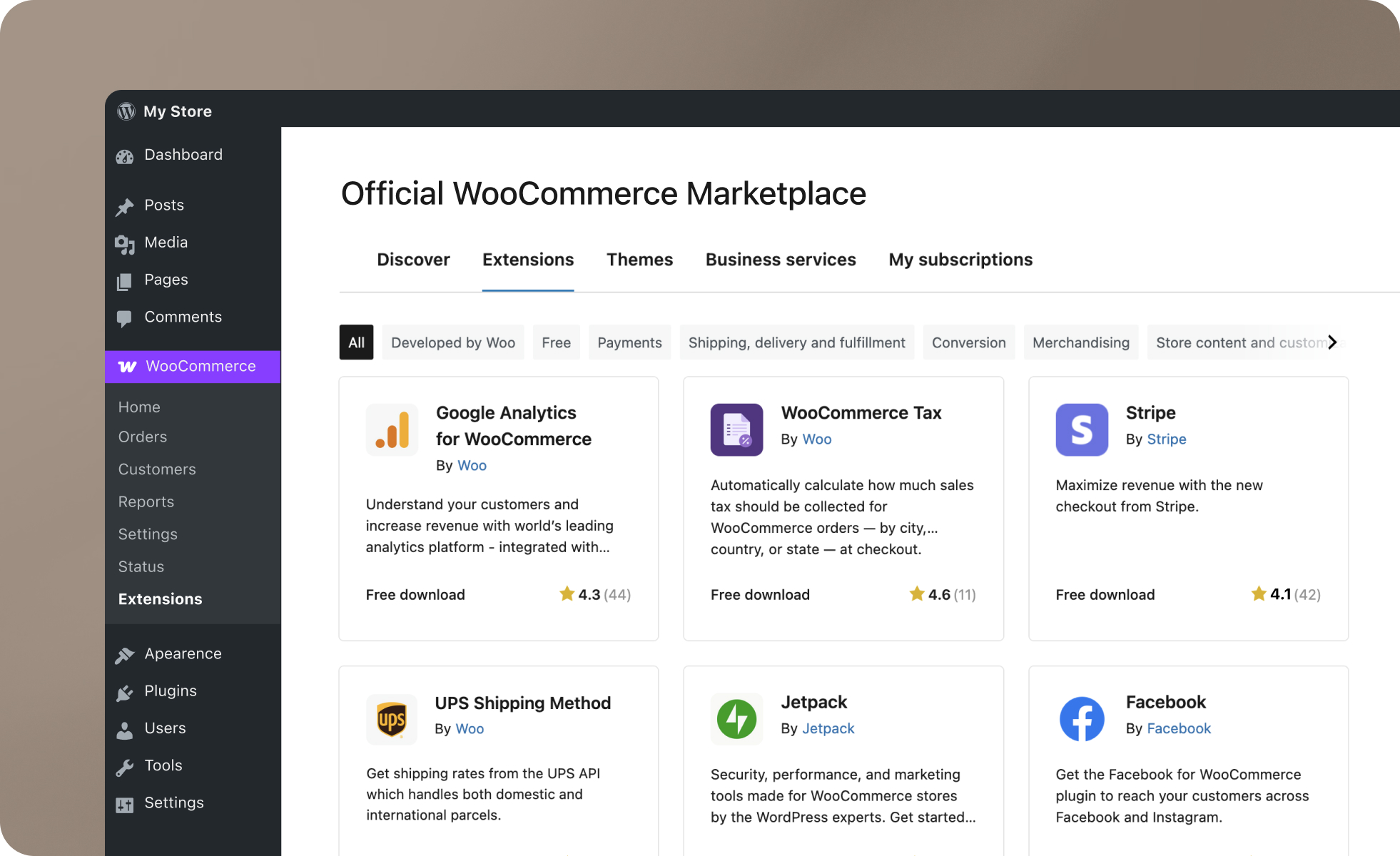
Price: the plugin is free and open source, with daily commits to the repository. WooCommerce’s own pricing page puts realistic running costs at US$25 to US$350 a month for hosting and US$29 to US$299 a year per paid extension, with no revenue share or platform fee.
That last point is the real argument for WooCommerce: as revenue grows, the platform does not take a cut. The counter-argument is that everything is yours to maintain, from PHP updates to plugin conflicts.
Payments in Singapore. WooPayments is available here, charging 3.40% + S$0.50 on domestic cards, plus 1.50% for international cards and 2.00% for currency conversion, with 9% GST applied to fees unless you supply a valid GST ID. WooPayments does not list PayNow, so most Singapore stores add Stripe or HitPay for it.
Choose it if you publish content seriously, want the SEO flexibility of WordPress, and have someone responsible for maintenance. See WooCommerce development in Singapore and our Shopify vs WooCommerce vs Magento comparison.
3. BigCommerce
Plans (USD, even for Singapore buyers): Core US$39 a month monthly or US$29 annual, Growth US$105 or US$79, Scale US$399 or US$299, Performance from US$1,499 a month billed annually.
BigCommerce renamed every tier (Standard became Core, Plus became Growth, Pro became Scale, Enterprise became Performance) and attached GMV caps: US$30,000 trailing twelve months on Core, US$100,000 on Growth, and US$33,333 a month on Scale with a 0.9% overage charge. Reports place the change on 1 June 2026, though we could not find a vendor announcement confirming the date.
There is also an Open Payment Provider fee of 2% on Core, 1% on Growth, 0.6% on Scale and 0% on Performance for orders that do not run through an embedded processor.
Choose it if you need deep catalogue and multi-storefront features without going open source, and you are comfortable being billed in USD. The old “US$29.95 to US$249.95” range quoted in most comparison articles no longer matches any tier.

4. Shopline
Plans (SGD): Starter S$39 a month, Essential S$109, Premium S$369, Enterprise on request, with annual billing advertised as saving up to 17%.
Shopline is built for this region, with a strong multi-channel story across marketplaces, social selling and physical retail. Shopline Payments charges 3.20% + S$0.50 online on Starter, down to 2.80% on Premium, and 2.60% + S$0.30 in person. Skipping Shopline Payments costs 2% on Starter, 0.8% on Essential and 0.6% on Premium. A native app builder is available as an add-on from S$1,360 a month.
Choose it if your sales are spread across Shopee, Lazada, TikTok Shop, Instagram and a physical counter, and you want them in one back office.
5. EasyStore
Plans (SGD): Standard from S$61 a month monthly or S$49 on annual billing, Business from S$124 or S$99, Growth from S$256 or S$199, Success from S$359 or S$299. Longer commitments lower the monthly rate further.
The differentiator is the fee structure: EasyStore advertises 0% transaction fees on all plans. It is strong in Singapore and Malaysia and leans hard into omnichannel selling, which suits SMEs running a shop, a few marketplaces and social channels together.
6. Wix
Plans: Light, Core, Business and Business Elite, displayed at about US$17.77, US$29.77, US$39.77 and US$159.77 a month on annual billing, with Wix stating that prices and currency vary by location. GST applies for Singapore customers without a tax ID. We could not confirm the SGD table from outside Singapore, so check the price on your own screen.
Ecommerce starts at Core (basic), with Business and Business Elite adding standard and advanced commerce features. The Light plan has no ecommerce at all, which catches people out.
Choose it if the catalogue is small, the brand is simple, and you want to build it yourself. See best website builders.
7. Squarespace
Plans (Singapore, SGD): Basic S$30 a month or S$264 a year, Core S$45 or S$372, Advanced S$64 or S$528. Squarespace has retired the old Business and Commerce plan names, so the “US$12 to US$26” figures still quoted around the web are two naming generations out of date.
Transaction fees matter here: commerce sales carry 2% on Basic and 0% on Core and above, while digital products carry 7%, 5%, 1% and 0% across the tiers.
Choose it if design quality matters more than commerce depth and you sell a handful of products or digital goods.
9. Adobe Commerce
Adobe does not publish prices. Licensing is per base package and sized by GMV, average order value and order limits set in the sales order, so the only real number comes from a quote. Any article quoting a fixed monthly figure, including the “US$1,988 a month” that appeared in the previous version of this page, is repeating a third-party estimate rather than an Adobe price.
Worth knowing: Adobe now offers Commerce as a Cloud Service alongside the older platform-as-a-service product, plus Commerce Optimizer, so “Adobe Commerce” covers more than one product when you request a quote.
10. PrestaShop and OpenCart
Both are free and open source. PrestaShop is the more actively maintained of the two, with 9.1.5 and 8.2.8 both released in August 2026 across two supported branches. OpenCart released 4.1.0.4 and 3.0.5.1 in August 2026 after a long quiet period, with commits continuing in September.
Choose either only if you have development support and a specific reason, such as an existing store or a developer who knows the stack. For a new Singapore store, the SaaS options above involve less risk.

Headless, if you actually need it
Headless separates the storefront from the commerce engine. It buys flexibility and costs development time. It is the right answer for large catalogues, several brands or markets on one backend, or an existing app that needs a commerce API. It is the wrong answer for a store with 40 products.
- Shopify Hydrogen and Oxygen: React storefront framework with edge hosting, included at no extra charge on paid Shopify plans. The most practical route if you already sell on Shopify.
- Medusa: open source commerce framework you can self-host free. Medusa Cloud starts at US$29 a month for Develop, US$99 for Launch and US$299 for Scale, with no GMV-based pricing.
- Saleor: open source under BSD-3-Clause, actively developed.
- commercetools: enterprise, order-based pricing, quote only.
More on the tradeoffs in headless CMS for ecommerce and headless CMS vs WordPress.
What the market actually uses
Published market share figures disagree because they measure different things.
W3Techs, updated daily and checked 16 September 2026, measures share of sites where the system is detected: WooCommerce at 47.8% of all ecommerce systems, Shopify at 32.1%, PrestaShop 2.8%, OpenCart 1.9%, Adobe Commerce 1.6% and BigCommerce 0.6%.
Store Leads, in a report dated 11 September 2026, counts live stores: 13,795,914 across 100 platforms, with WooCommerce at 4,056,316 and Shopify at 3,077,514, followed by custom carts at 1,701,737 and Wix at 973,807.
The pattern holds either way. WooCommerce leads on installed base, Shopify leads on revenue-generating stores, and everything else is a distant third. That is a reason to check hiring and support availability, not a reason to pick a platform.
Choosing: five questions that settle it
- Who maintains it? No in-house developer means SaaS. Open source without a maintenance plan turns into an unpatched site within a year.
- How do your customers pay? If PayNow is important, price the full stack, including Shopify’s third-party fee if you are on Shopify.
- Where else do you sell? Marketplace and social selling favour Shopline or EasyStore. A single-channel brand store favours Shopify.
- How complex is the catalogue? Variants, bundles, B2B price lists and multi-currency push you towards BigCommerce, Adobe Commerce or headless.
- What is the five-year cost? Add plan fees, payment fees, transaction fees, apps and extensions, plus development. A cheap plan with a 2% transaction fee is not cheap at S$100,000 a month in sales.
Our cost of ecommerce website development in Singapore guide covers the build side, and migrating to Shopify or WooCommerce covers moving an existing store without losing rankings.
PSG. Singapore SMEs can claim up to 50% support on pre-approved ecommerce solutions under the Productivity Solutions Grant, capped at S$30,000 per company per financial year. The package has to be pre-scoped by a pre-approved vendor, so check the catalogue before you choose a platform. See PSG grant for ecommerce.
Frequently asked questions
What is the best eCommerce CMS for a small business in Singapore?
Shopify for most, because the running cost is predictable and the setup work is small. EasyStore or Shopline if you sell across marketplaces and social as well. WooCommerce if content and SEO are central to how you acquire customers.
Is Shopify a CMS?
Yes, in the practical sense. It manages products, pages, blog content and navigation, with commerce built in rather than added on.
Which platform is cheapest?
Software cost and total cost are different questions. WooCommerce, Magento Open Source, PrestaShop and OpenCart are free to license but carry hosting, development and maintenance. A S$29 a month Shopify plan with a 2% third-party transaction fee can cost more than a self-hosted store once volume grows.
Can I accept PayNow on these platforms?
Yes, through Stripe (1.3% for PayNow) or HitPay (0.65% + S$0.30 above S$100, 0.9% below). Shopify Payments in Singapore does not include PayNow, so on Shopify you also pay the third-party transaction fee for your plan.
Do I have to charge GST?
GST registration depends on your turnover, not your platform. What differs by platform is how easily you can configure tax-inclusive pricing and GST invoices, which is worth testing before you commit.
Should I go headless?
Only with a clear reason: multiple brands or markets on one backend, a large catalogue, or an app that needs the same commerce data. Otherwise it adds development cost without adding sales.
How long does it take to launch a store?
On SaaS with a theme, two to six weeks once products, photography and copy are ready. Custom design and integrations add time. Our ecommerce website launch checklist covers what must be done before going live.
Can I move platforms later?
Yes, and people do. Plan the URL structure and redirects before migrating, or you lose rankings along with the old platform. See our guide to SEO safe migration.
Getting help with the build
MediaPlus Digital builds stores on Shopify, WooCommerce and custom stacks for Singapore businesses, with 13 years in market, a team of 60 and more than 1,800 projects delivered.
If you are still deciding, we will tell you when a S$39 a month plan is enough, because paying for a platform you do not need is the most common mistake on this list. See our ecommerce website development services or Shopify website design and development.
Pricing verified September 2026 from each vendor’s own pricing page. Plans, fees and currencies change, so confirm on the vendor site before committing.




