
ChatGPT Ads became available to Singapore businesses on 23 September 2026, when OpenAI opened the channel across seven Asian markets. You can open a self-serve account, bill in Singapore dollars, and launch a campaign today. The minimum daily budget is SGD 4.00.
That is the short version. The longer version matters more, because ChatGPT Ads do not work like the platforms you already run. There are no keywords. There is no age or interest targeting. The ad unit gives you 50 characters for a title and 100 for the body. And the thing most Singapore advertisers get wrong: buying ads does not put your brand inside ChatGPT’s answer. It puts a labelled ad underneath it.
This guide covers what ChatGPT Ads are, what they look like, what they cost here, and then a step by step setup for a first campaign.
Note on dates. ChatGPT Ads is changing month to month. Everything below was checked in October 2026. Confirm availability, specs and minimums in Ads Manager before you commit a budget.
What are ChatGPT Ads?
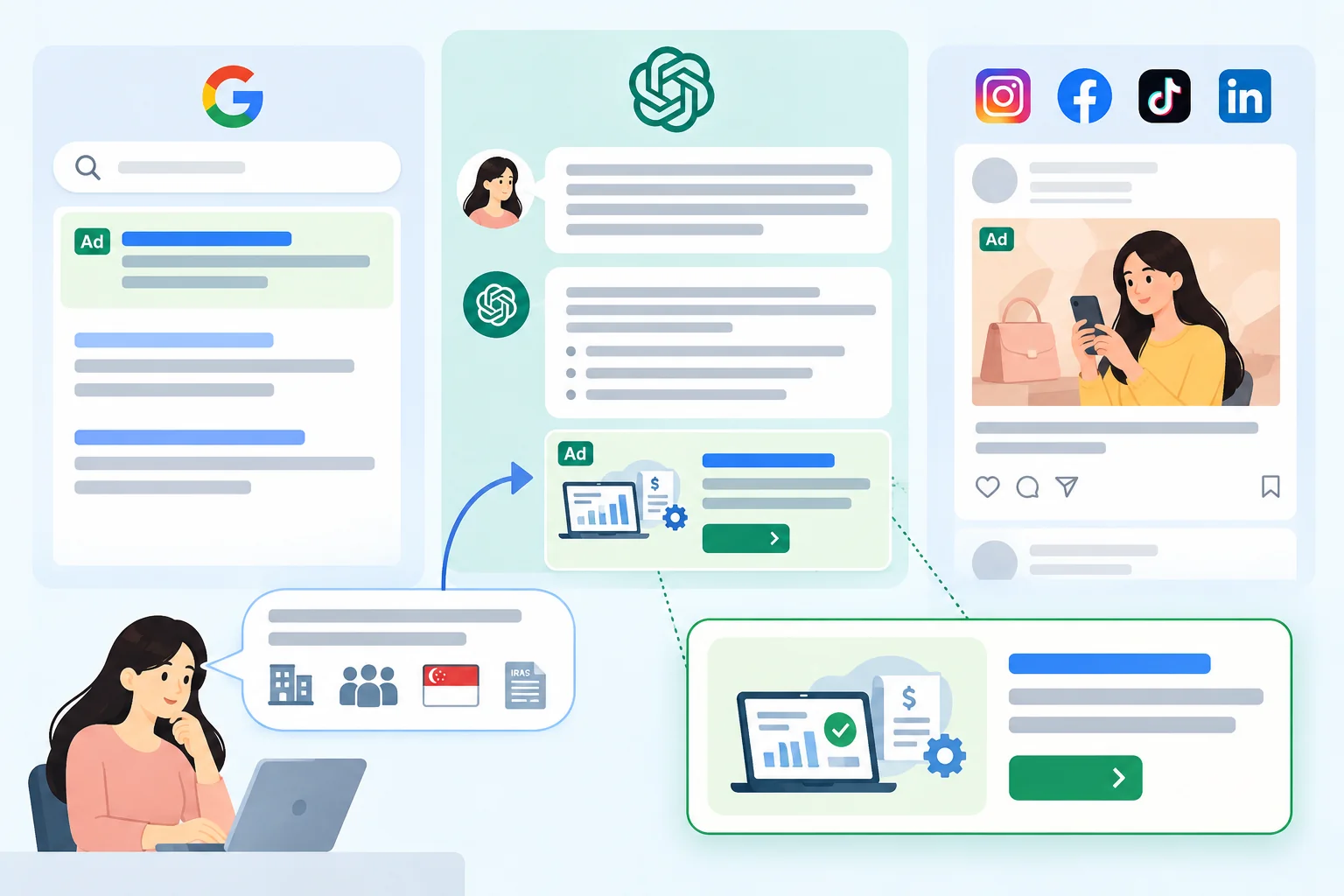
ChatGPT Ads are paid placements that appear below ChatGPT’s answer inside a conversation. A user asks something, ChatGPT replies as normal, and a labelled ad can appear beneath the reply.
The difference from the channels you know is the trigger. Google Search ads match a short query someone typed. Social ads interrupt a feed. A ChatGPT ad is matched to the context of a conversation, which is usually longer and more specific than a search query.
Someone asking “which accounting software handles PayNow reconciliation and IRAS-ready reports for a 10-person Pte Ltd” has told ChatGPT far more than someone typing “accounting software” into Google. That is the appeal of the channel, and it is also why your ad copy and landing page have to carry more detail than usual. If you are new to paid search generally, start with what PPC is before this.
What does a ChatGPT ad look like?
One format, five parts: your advertiser name, your favicon or logo, a title, a short body, a destination URL, and a single square image.
|
Element |
Limit |
OpenAI’s recommendation |
|
Title |
Up to 50 characters |
16 to 24 characters |
|
Body copy |
Up to 100 characters |
32 to 48 characters |
|
Image |
Square, minimum 256 x 256px, up to 1200 x 1200px, JPG, PNG or WEBP |
Simple, relevant, consistent with the copy |
|
Advertiser name and favicon |
Pulled from your account |
Use a recognisable mark |
|
Destination URL |
Your landing page |
Must match what the ad promises |
Those recommended ranges are tighter than the hard limits for a reason. The ad sits in a reading flow, not a results page. A 50-character title that fills the box reads like a banner. A 20-character title reads like part of the page.
Check the current specs in Ads Manager before briefing a designer, since OpenAI has changed the unit more than once this year.
Where do ads appear, and who sees them?
Ads appear below the answer, visually separated and labelled. They are not written into the answer.
Not every ChatGPT user sees them:
|
ChatGPT plan |
Sees ads? |
|
Free |
Yes |
|
Go |
Yes |
|
Plus |
No |
|
Pro |
No |
|
Business, Enterprise, Edu |
No |
|
Users identified as under 18 |
No |
This has a direct consequence for B2B advertisers in Singapore, and it is worth saying plainly: the senior people you want to reach are disproportionately on Plus, Pro or a company Enterprise seat. They will not see your ad. You can still reach researchers, analysts and owner-operators on Free and Go, but do not model this channel as a way to reach a CFO.
Ads are also excluded from Temporary Chats and from conversations on sensitive topics, including health, mental health and politics.
Are ChatGPT Ads available in Singapore?
Yes, since 23 September 2026. Here is how the rollout reached us:
|
Date |
Markets opened |
|
Early 2026 |
US testing on Free and Go plans, managed deals only |
|
5 May 2026 |
Self-serve Ads Manager opens to US advertisers |
|
April to August 2026 |
Canada, Australia, New Zealand, UK, Japan, South Korea, India, Mexico, Brazil |
|
31 August 2026 |
31 European markets, plus Middle East and North Africa |
|
16 September 2026 |
UAE, Saudi Arabia, Israel, Turkey |
|
23 September 2026 |
Singapore, Indonesia, Malaysia, Philippines, Thailand, Vietnam, Taiwan |
Singapore had self-serve access from day one rather than managed-only access. OpenAI put the total at more than 60 markets at the time of the announcement. Country lists change month to month, so check OpenAI’s own list rather than a blog’s count.
One practical catch: new self-serve accounts may be limited to advertising in their home country until identity verification clears and a spending threshold is met. If you are a Singapore entity planning a regional campaign, open the account early.
How does targeting work if there are no keywords?
This is the part that trips up experienced Google Ads managers. You do not buy keywords. You give the system context hints, and it decides which conversations your ad fits.
What you can control:
- Location. Country code, plus region, city and area IDs where they exist. You can combine inclusions and exclusions, up to 2,500 IDs total. Singapore is a city-state, so sub-country targeting has little practical use here even where the option exists.
- Context hints. Free-form descriptions of the situations where your product helps. Up to 2,000 per ad group. They are hints, not match types, so none of them guarantees placement in a specific conversation.
- Platform. ChatGPT on iOS, on Android, or on web.
- Custom audiences. Upload email addresses, phone numbers, SHA-256 hashes of either, or GAID, as a UTF-8 CSV. Inclusion lists and bid multipliers need at least 25,000 matched users. Exclusion lists have no minimum.
What you cannot control: age, gender and interest targeting are not available.
That 25,000 match floor rules out custom audiences for most Singapore SMEs. If your CRM holds 3,000 contacts, you can exclude them from seeing the ad, but you cannot target them.
Do ads change what ChatGPT says?
No, and this is the single most commercially important fact on this page.
OpenAI’s stated position is that ads do not influence ChatGPT’s responses, that advertisers get no access to private conversations, and that ads are labelled and displayed separately from the answer.
So if a prospect asks ChatGPT “who are the best web design agencies in Singapore”, your ad budget has no bearing on the names in the reply. Appearing in the answer itself is an earned outcome, which is the whole discipline of generative engine optimisation. We cover the mechanics of it in how to get your Singapore business cited in ChatGPT, Gemini and Perplexity, and the difference from classic search in GEO vs SEO.
Ads buy the slot beneath the answer. Content and credibility buy the answer.
How much do ChatGPT Ads cost in Singapore?
|
What |
Figure |
|
Minimum daily budget |
SGD 4.00 per campaign on an SGD billing account |
|
Billing currency |
SGD, fixed at account creation and not changeable afterwards |
|
Reach objective |
Bought on CPM, default maximum bid around US$60 |
|
Clicks objective |
Bought on CPC, OpenAI suggests a starting maximum bid of US$3 to US$5 |
|
Daily spend behaviour |
Daily budget is a seven-day average; a single day can reach twice the figure, a week will not exceed seven times it |
A few readings of that table.
The SGD 4.00 floor is real but misleading. It lets you open an account without a budget conversation, and it will not buy enough data to judge anything. Figures circulating online about a US$25 daily minimum are US account figures and do not apply to an SGD account.
The CPC guidance of US$3 to US$5 is roughly S$4 to S$6.50 per click. Compare that against your current Google Ads cost per click before you assume this channel is cheap. Our breakdown of Google Ads pricing in Singapore gives you the benchmark to compare against.
What ChatGPT Ads cannot do yet in Singapore
Worth knowing before you plan, rather than after:
- No age, gender or interest targeting.
- Custom audiences need 25,000 matched users, which most local SMEs cannot reach.
- App install measurement is thin here. Third-party app attribution partners launched with coverage for the US, Canada, Australia, New Zealand, UK, Japan and South Korea. The seven new Asian markets were not included at launch. If you are advertising a mobile app from Singapore, check attribution support with your measurement partner before committing budget.
- Sensitive categories are excluded. Clinics, mental health services and anything political will find little or no inventory.
- Reporting is aggregated. You will not get the query-level detail you are used to in Google Ads, because there are no queries.
How to run ChatGPT Ads in Singapore
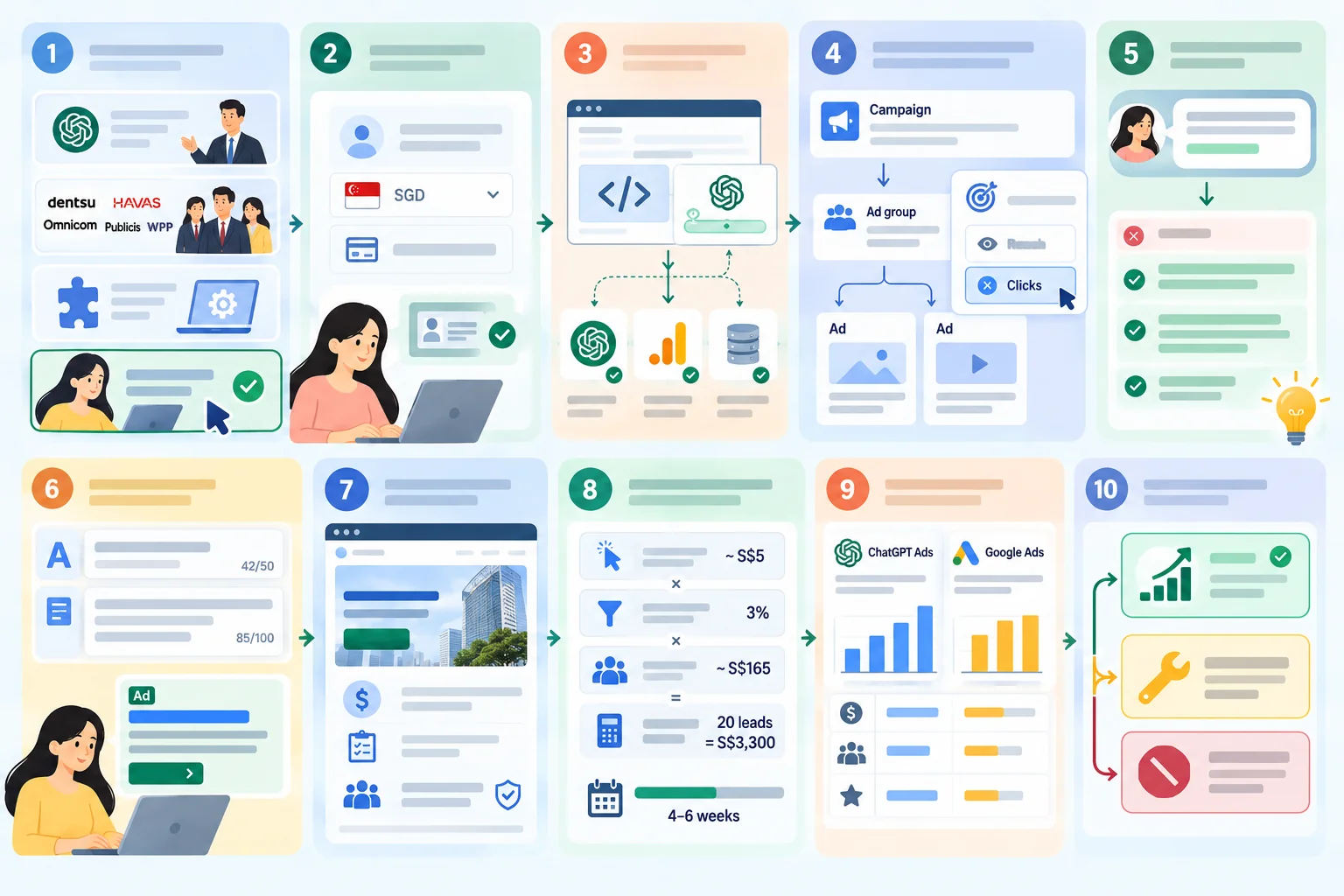
Ten steps, in the order you should actually do them.
Step 1: Choose how you buy
Four routes exist. Most Singapore SMEs want the fourth.
|
Route |
Who it suits |
|
OpenAI Ads Solutions team |
Large advertisers with complex budgets needing direct support |
|
Agency holding companies (dentsu, Havas Media, Omnicom Media, Publicis Groupe, WPP) |
Brands already buying media through one of those groups |
|
Technology partners |
Advertisers running through an integrated platform |
|
Self-serve Ads Manager |
Eligible businesses running their own campaigns |
For self-serve, the legal entity that advertises and gets billed must be based in an available country. A Singapore-registered company qualifies.
Step 2: Open and verify the account
Create the advertiser account, set billing to SGD, and complete identity verification. Remember that the currency locks at creation, and that an unverified account may be restricted to Singapore-only delivery.
Do this before you need it. Verification is not instant, and you do not want it sitting between you and a campaign launch date.
Step 3: Install measurement before you launch, not after
OpenAI provides a measurement pixel and a Conversions API, similar in principle to Meta’s. The conversions endpoint now returns attributed events beyond your campaign goal, so you can see actions you did not optimise for.
Get three things working first: the pixel firing on your site, your conversion events defined and tested, and GA4 set up properly so you can compare this channel against the others on the same definitions. Launching without this is how advertisers end up arguing about whether a channel worked instead of knowing.
Step 4: Build the campaign
The structure has three levels. Campaign holds the objective, budget, dates and targeting. Ad group holds your context hints. Ad holds the creative.
Pick the objective deliberately:
- Reach, bought on CPM, if you are introducing a category nobody is searching for yet.
- Clicks, bought on CPC, if you want traffic and leads.
For a first Singapore test, use Clicks. CPM buys you impressions you cannot act on.
Step 5: Write context hints that describe situations
A hint is not a keyword. It describes a circumstance where your product is the answer. Specific beats broad, and broad hints waste money.
|
Weak hint |
Stronger hint |
|
aircon servicing |
Deciding how often to service an aircon in an HDB flat and what a chemical wash costs |
|
accounting software |
Choosing accounting software for a new Singapore Pte Ltd that needs PayNow reconciliation |
|
web design |
Planning a company website rebuild and working out what to prepare before briefing an agency |
|
corporate gifts |
Sourcing branded corporate gifts in Singapore for a year-end client appreciation event |
Pull these from real sources: sales call recordings, WhatsApp enquiries, the questions in your inbox, and the “People also ask” box on Google for your service terms. Your own sales team is the best input here, because they hear the actual phrasing.
Step 6: Write the creative inside 50 and 100 characters
Tight limits reward plain writing. State the value in the title. Add something new in the body rather than restating the title.
|
Title (under 50) |
Body (under 100) |
|
Websites for Singapore SMEs |
Fixed scope, fixed price, live in 6 weeks. See recent builds. |
|
PayNow-ready bookkeeping |
Monthly accounts and IRAS filing for Pte Ltds under 20 staff. |
|
Aircon chemical wash, HDB |
Transparent per-unit pricing. Same-week slots across the island. |
What fails: generic brand slogans, anything requiring the reader to already know who you are, and claims your landing page does not immediately back up.
Step 7: Send clicks to a page that answers the question
Someone arriving from a detailed conversation expects detail. A homepage will lose them.
The page should state how pricing works even if you do not publish a figure, say who the service is and is not for, show what happens next, and give a reason to trust you. Our landing page optimisation guide covers the structure, what a landing page is covers the basics, and if you want it built for you, that is our landing page design service.
One addition specific to this channel: answer the question the conversation was about, high on the page, in plain language. The visitor was mid-research, not mid-purchase.
Step 8: Set a budget that can actually produce a verdict
Ignore the SGD 4.00 floor. Work backwards instead. If a click costs around S$5 and your landing page converts at 3%, a lead costs roughly S$165. Decide how many leads you need to see before you trust the number, then fund that. Twenty leads at that maths is about S$3,300.
Run it time-boxed, four to six weeks, against one service you already know performs in Google Ads. That gives you a fair comparison instead of a vague impression. Our Google Ads strategy guide explains how to structure the comparison.
Step 9: Read the results honestly
Compare cost per lead and lead quality against the Google Ads campaign you benchmarked, on the same conversion definitions. Expect fewer, longer-considered leads rather than volume.
Judge lead quality separately from cost. A channel that brings fewer but better-informed enquiries can beat a cheaper one, and cost per lead alone will not show you that. If the leads are good but the volume is small, that is a reason to keep a small budget running, not a reason to stop.
Step 10: Scale, fix, or stop
Three honest outcomes. Scale if cost per lead is competitive and quality holds. Fix the hints and the landing page if clicks arrive but nobody converts, since that is usually a message-match problem rather than a channel problem. Stop and revisit next quarter if neither works, because this platform is still changing fast enough that a verdict in October may not hold in March.
ChatGPT Ads vs Google Ads
|
ChatGPT Ads |
Google Search Ads |
|
|
Available in Singapore |
Yes, since 23 Sep 2026 |
Yes |
|
Trigger |
Conversation context |
Keywords |
|
Position |
Below an AI-written answer |
Above and below results |
|
User mindset |
Researching, comparing, following up |
Looking for a result to click |
|
Targeting |
Context hints, location, platform, custom audiences |
Keywords, audiences, locations, schedules, demographics |
|
Audience limit |
Free and Go users, 18+ |
Everyone |
|
Measurement |
Pixel and Conversions API |
Mature tracking plus GA4 |
|
Benchmarks available |
Very few |
Extensive |
|
Role |
Additional channel, worth testing |
Core demand capture |
ChatGPT Ads adds to Google Ads rather than replacing it. Search still captures the people who already know what they want. If you are weighing where budget should sit overall, SEO vs PPC and Google Ads vs Facebook Ads are the two comparisons worth reading first, and types of Google Ads covers what you may already be underusing.
How ads and AI search visibility work together
|
Earned AI visibility (GEO) |
ChatGPT Ads |
|
|
Where you appear |
Inside the answer, as a cited source |
Below the answer, labelled sponsored |
|
Cost model |
Content and optimisation work |
Per impression or per click |
|
Longevity |
Builds and persists |
Stops when spend stops |
|
Trust signal |
High, because it is earned |
Clearly marked as advertising |
Because ads do not influence the answer, these are two separate problems with two separate solutions. The strongest position is to hold both: named in the answer, and present in the slot beneath it.
Earning the citation side involves clear factual pages, consistent business information across the web, structured data, reviews and mentions on sources the models trust. Start with an AI search readiness audit, and if you want the technical entry point, llms.txt is where most sites begin. We do this work as AI SEO services, and if you are shortlisting vendors, we have also mapped the GEO agencies in Singapore.
Compliance notes for Singapore advertisers
Two areas need checking before you write a brief.
Financial services. Under the Online Criminal Harms Act, the Singapore Police Force has directed Facebook, Instagram and TikTok to block financial-services advertising from advertisers who are not licensed by MAS or another applicable Singapore authority, and to verify advertiser identity against government-issued records. Those platforms have until 31 January 2027 to comply, and non-compliance is a criminal offence. The directive does not currently name ChatGPT, but it shows where the expectation is heading, so licensed status and creative review should be settled before you plan a campaign in this sector.
Political content. OpenAI does not permit political advertising, and ads are excluded from political conversations. Singapore has its own rules on top of that. Paid online election advertising is reserved for candidates, election agents and authorised persons, requires written authorisation from a candidate or election agent from Nomination Day, and must be declared to the Returning Officer. Treat anything adjacent to this as off limits.
Health and mental health are excluded by OpenAI’s own policy, so clinics and health products will find little inventory regardless of local rules.
Mistakes to avoid
- Treating hints like keywords. Short, broad hints burn budget on irrelevant conversations.
- Filling the character limits. The recommended ranges are shorter than the maximums because the ad sits in a reading flow.
- Sending traffic to the homepage. The visitor arrived with a specific question.
- Launching before the pixel works. You will not be able to judge the channel.
- Budgeting at the SGD 4.00 floor and concluding the channel does not work.
- Assuming B2B decision-makers will see it. Most are on ad-free plans.
- Buying ads and expecting to appear in the answer. Those are different problems.
- Moving budget out of Google Ads before you have any Singapore performance data.
Frequently asked questions
Are ChatGPT Ads available in Singapore?
Yes. OpenAI opened ChatGPT Ads to Singapore on 23 September 2026, alongside Indonesia, Malaysia, the Philippines, Thailand, Vietnam and Taiwan. Singapore businesses can use the self-serve Ads Manager, billed in Singapore dollars.
How much do ChatGPT Ads cost in Singapore?
The minimum daily budget is SGD 4.00 per campaign on an SGD billing account. You buy on CPM through the Reach objective, where the default maximum bid is around US$60, or on CPC through the Clicks objective, where OpenAI suggests a starting maximum bid of US$3 to US$5. A realistic test budget is several thousand dollars over four to six weeks, not the minimum.
Where do ChatGPT ads appear?
Below ChatGPT’s answer, labelled as sponsored and visually separated from the response. They do not appear in Temporary Chats or in conversations about sensitive topics.
Do ChatGPT ads change ChatGPT’s answers?
No. OpenAI states that ads do not influence its responses and that advertisers receive no access to private conversations. Appearing inside the answer requires earned AI search visibility, not ad spend.
Who sees ChatGPT ads?
Users on the Free and Go plans who are 18 or over. Plus, Pro, Business, Enterprise and Edu plans are ad-free.
What does a ChatGPT ad look like?
Your advertiser name and favicon, a title of up to 50 characters, body copy of up to 100 characters, a destination URL, and one square image between 256 x 256 and 1200 x 1200 pixels in JPG, PNG or WEBP. OpenAI recommends a title of 16 to 24 characters and copy of 32 to 48.
How is targeting different from Google Ads?
There are no keywords. You supply context hints describing the situations where your product is relevant, up to 2,000 per ad group, and the system matches your ad to conversations. You can also target by location and platform, and upload custom audiences, though inclusion lists need at least 25,000 matched users. Age, gender and interest targeting are not available.
Can I advertise health or financial services on ChatGPT?
Health and mental health conversations are excluded from ad placement, so inventory will be minimal. Financial services should expect licensing and compliance checks, and Singapore regulates promotions from entities not licensed by MAS. Review OpenAI’s ad policies and take local advice before planning either.
Should I move budget from Google Ads to ChatGPT Ads?
Not before you have local performance data. Run ChatGPT Ads as an additional, time-boxed test against one proven Google Ads campaign, compare cost per lead and lead quality on the same definitions, then decide.
Running ChatGPT Ads, and earning the answer above them
ChatGPT Ads is live in Singapore, the barrier to opening an account is low, and almost nobody here has local benchmarks yet. That is a reasonable argument for testing early, provided you test properly: real budget, working measurement, one service, a fixed window.
The other half is the part ads cannot buy. Being named in ChatGPT’s actual answer is earned, and it keeps working when the spend stops.
If you want help with either, talk to MediaPlus Digital about our AI SEO and GEO services, our Google Ads management, or conversion rate optimisation for the landing pages these campaigns depend on. If your current pages are not converting the traffic you already pay for, start with how to increase your website conversion rate.




