
Most small businesses do not have a marketing budget so much as whatever is left after everything else. The good news is that some of the highest-return advertising available to a small business in Singapore costs nothing but time, and the paid options that work do not need thousands a month to start. This guide covers what you can realistically do at three budget levels, which channels suit which businesses, and the cheap tactics that quietly waste money.
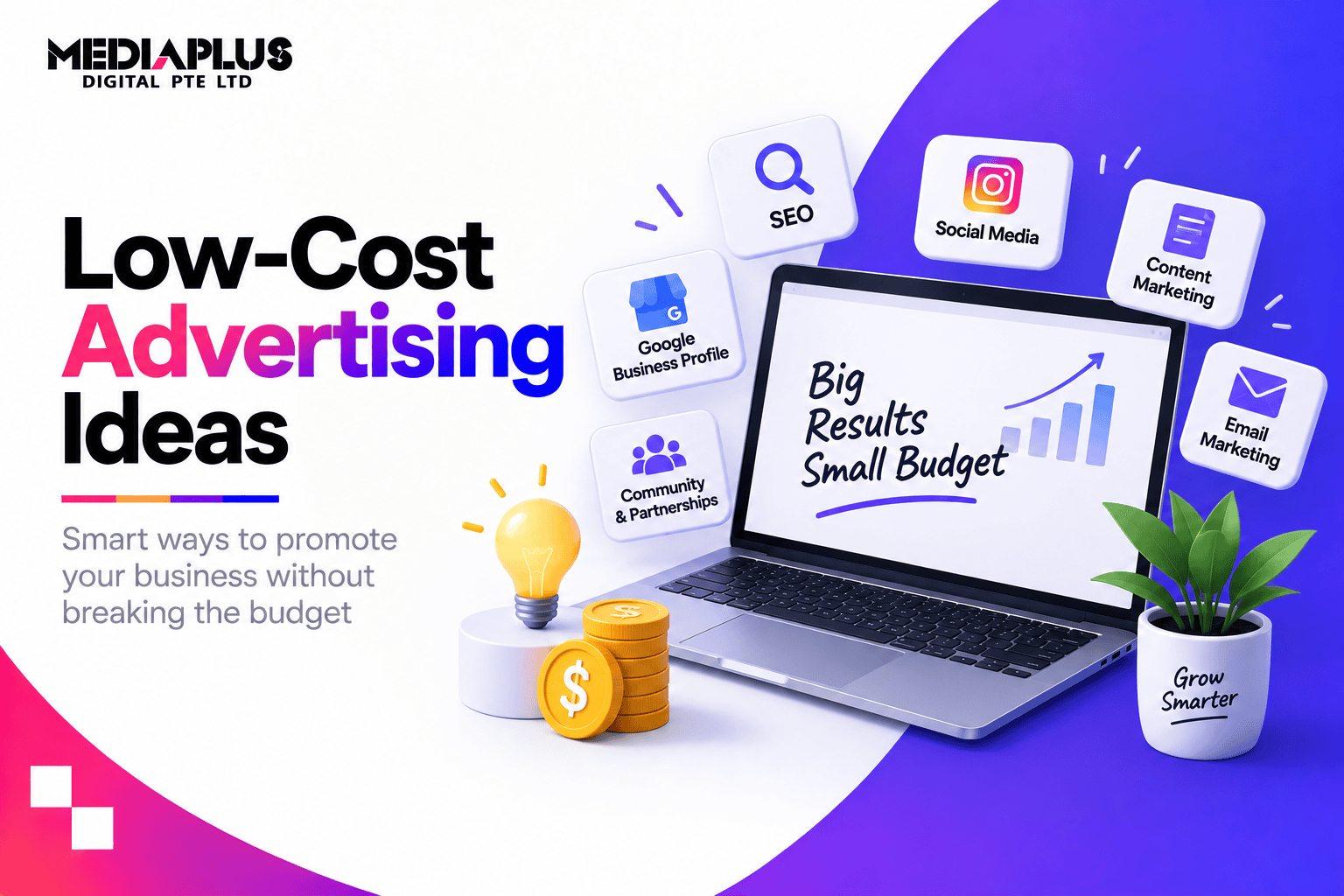
Quick answer: The cheapest advertising that actually works for small businesses is a fully optimised Google Business Profile, local SEO, consistent organic social, customer reviews, referrals, email marketing, and community or partner marketing. These cost time rather than money. Once you can spend, small, tightly targeted budgets on Google Search or Meta ads (from a few hundred dollars a month) usually beat broad, unfocused campaigns. In Singapore, eligible SMEs can also claim up to 50% of qualifying digital marketing costs through the PSG grant, which effectively halves the price of getting started properly.
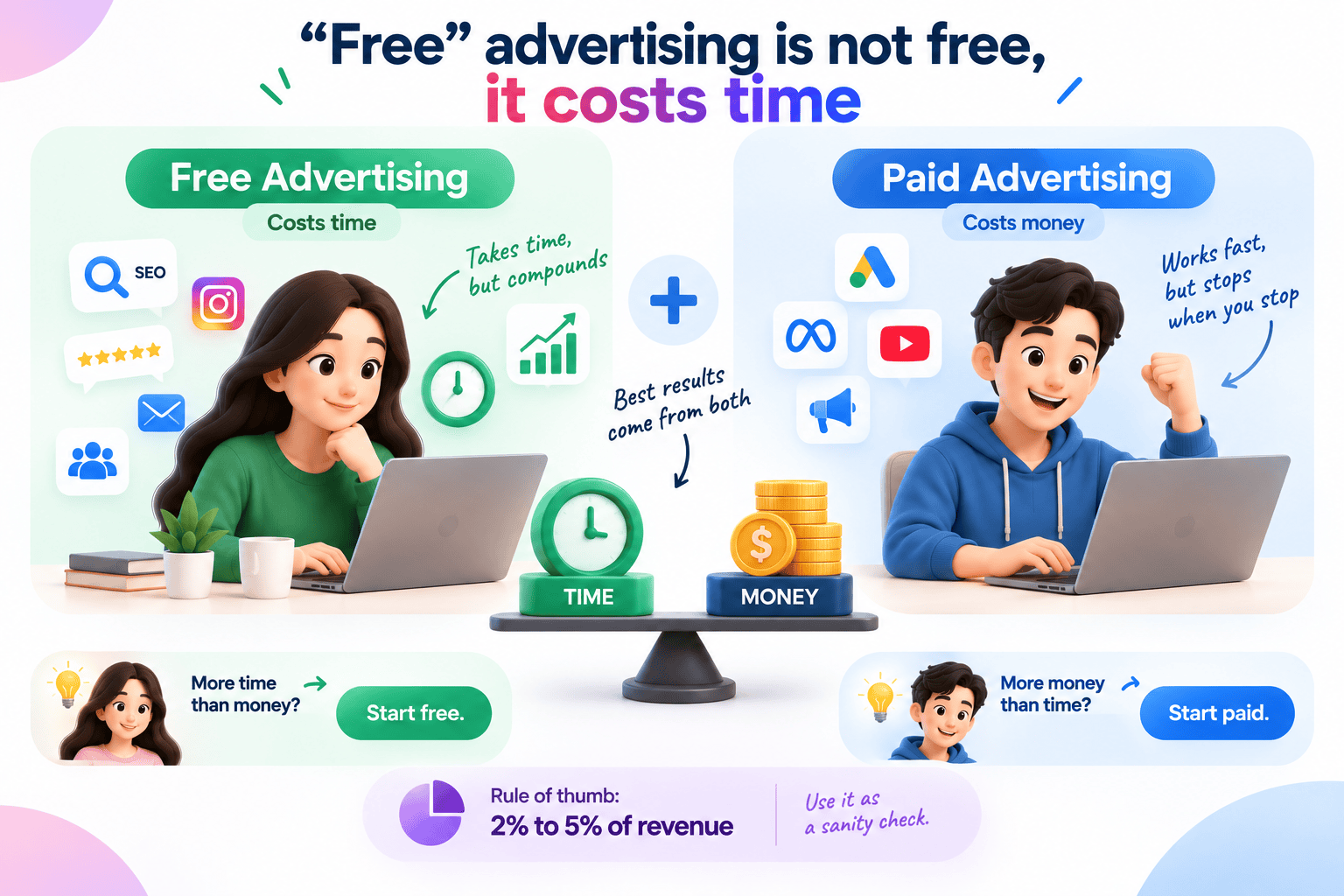
“Free” advertising is not free, it costs time
Worth saying up front, because it changes how you choose. Free tactics (SEO, organic social, referrals) cost hours and take months to compound. Paid tactics cost money and work immediately but stop the moment you stop paying.
Most small businesses need both: free channels building an asset that keeps working, and a small paid budget generating enquiries while that asset grows. If you have more time than money, start free. If you have more money than time, start paid, but do not skip the free foundations.
A common rule of thumb is to put roughly 2 to 5% of revenue into marketing, with newer businesses needing considerably more to get traction. Use it as a sanity check, not a law.
What you can do at each budget level
|
Budget |
What is realistic |
Expect results in |
|
S$0 |
Google Business Profile, local SEO, organic social, reviews, referrals, email, communities, partnerships |
2 to 6 months, then compounds |
|
Under S$500/month |
The above, plus a small, tightly targeted Google Search or Meta campaign, and basic tools |
2 to 6 weeks for first enquiries |
|
S$500 to S$1,500/month |
A properly structured paid campaign on one or two channels, plus retargeting and a landing page |
Faster, more predictable lead flow |
The mistake is spreading S$300 across five channels. At small budgets, concentration beats coverage every time.
The 12 cheapest advertising ideas that work
1. Claim and max out your Google Business Profile (free)
For any business serving local customers, this is the single highest-return free thing you can do. It puts you in Google Maps and the local pack when someone nearby searches for what you sell.
Do it properly: complete every field, pick the right categories, add real photos, list services and hours, and post updates. Then ask every happy customer for a review, because review count and quality strongly influence who shows up first. See our Google Business Profile setup service.
2. Local SEO (free to low cost)
If you serve a specific area, ranking for “near me” and location searches brings in people ready to buy. The basics: consistent name, address and phone details everywhere, location-relevant pages, local directory listings, and reviews. See our guide to local SEO.
3. Ask for reviews, systematically (free)
Reviews are advertising that customers write for you. Most businesses just never ask. Build asking into your process: after delivery, at invoicing, or with a QR code at the counter. Reply to every review, good or bad, because how you handle criticism is public.
4. Organic social media (free)
Pick one or two platforms where your customers actually are rather than trying to be everywhere. For a cafe or retail shop, Instagram and TikTok. For B2B services, LinkedIn. Post consistently, show the work and the people behind it, and reply to comments and DMs quickly. Short video reaches far further than static posts right now.
5. Content and SEO on your own site (free to low cost)
Answering the questions your customers ask brings in people searching for exactly that. It is slow, then it compounds, and unlike ads it keeps working after you stop. Start with the five questions you answer most often on the phone. See blogging for SEO and our SEO services.
6. Email marketing (free to very cheap)
The highest-ROI channel most small businesses ignore. You already have customers; collecting their emails and sending something genuinely useful once or twice a month costs almost nothing and drives repeat business. Most email tools are free at small list sizes.
7. Referrals, asked for properly (free)
Word of mouth is the best advertising there is, and most businesses leave it to chance. Ask at the right moment, when a customer has just told you they are happy. Make it easy, with a link or card they can pass on. A small thank-you incentive helps, but the ask matters more than the reward.
8. Partnerships with complementary businesses (free)
Find businesses serving the same customers without competing with you: a renovation firm and an interior designer, a gym and a physiotherapist, a wedding photographer and a florist. Cross-refer, bundle offers, or share each other’s audiences. It costs nothing and both sides gain.
9. Communities and groups (free)
Facebook groups, Telegram groups, LinkedIn communities, industry forums, and estate or neighbourhood groups. Be useful first, promotional almost never. A reputation for helpful answers generates enquiries that no ad could buy at the same price.
10. Customer photos and user-generated content (free)
Encourage customers to tag you, then repost with credit. It is free content, and it is more persuasive than anything you produce yourself because it comes from a real buyer. See our guide to user-generated content.
11. Small, tightly targeted paid search (from a few hundred a month)
When you are ready to pay, Google Search ads on a handful of high-intent keywords beat almost everything else for immediate enquiries, because you reach people actively looking to buy right now.
Keep it narrow: a small keyword list, tight match types, negative keywords to block waste, a specific service area, and a landing page that matches the ad. A focused S$400 campaign will usually outperform a scattered S$1,200 one. See Google Ads pricing in Singapore.
12. Retargeting (cheap, and usually underrated)
Advertising to people who already visited your website is far cheaper than reaching strangers, because the audience is small and already interested. For most small businesses this is the best value paid advertising available, and it can run on a very modest budget.
Which channel suits your business
|
Business type |
Start with |
|
F&B, retail, salon |
Google Business Profile, reviews, Instagram and TikTok, local SEO |
|
Home services (aircon, renovation, cleaning) |
Google Business Profile, reviews, Google Search ads, local SEO |
|
Professional services (accounting, legal, consulting) |
SEO content, LinkedIn, referrals, partnerships |
|
B2B |
LinkedIn, content, email, industry communities, partnerships |
|
E-commerce |
Organic social and short video, email, retargeting, marketplaces |
Use the PSG grant to stretch the budget
This is the part most Singapore SMEs overlook. Eligible businesses can claim up to 50% of the cost of pre-approved digital marketing and website solutions through the Productivity Solutions Grant. That does not fund your ad spend, but it can halve the cost of the website, e-commerce setup, or digital marketing package underneath it, which is often the real barrier. See our digital marketing PSG grant guide.
Cheap tactics that waste money
Not everything cheap is worth doing:
- Buying followers or likes. Fake audiences never buy, and they damage your engagement rate.
- Boosting posts with no targeting or goal. The easiest way to spend a small budget on nothing.
- Paid directory listings nobody uses. Free relevant ones are fine; paid low-quality ones are not.
- Cheap mass flyer drops with no offer and no way to track response.
- Bidding on broad keywords like “marketing” or “renovation” with a small budget. You will pay for clicks that were never going to convert.
- Spreading a tiny budget across five platforms so none gets enough data to work.
- Bulk backlink packages. They range from useless to actively harmful.
Make sure cheap does not mean untracked
Low budget makes measurement more important, not less, because you cannot afford waste.
- Set up analytics and conversion tracking before you spend anything. See our GA4 setup guide.
- Ask every enquiry how they found you. For small businesses this simple question often beats the analytics.
- Use a separate phone number or WhatsApp link per channel if you can.
- Judge on enquiries and sales, not likes and impressions.
- Give it enough time. Free channels need months; paid needs a few weeks of data before you judge.
A simple 90-day plan on a small budget
- Weeks 1 to 2: Claim and complete your Google Business Profile. Set up analytics. Start asking every customer for a review.
- Weeks 3 to 4: Fix the basics on your website: what you do, where you serve, and an obvious way to contact you. Pick one social platform and start posting consistently.
- Weeks 5 to 8: Publish content answering your five most common customer questions. Start collecting emails. Approach two complementary businesses about cross-referral.
- Weeks 9 to 12: Add a small, tightly targeted Google Search campaign and retargeting. Measure enquiries by source and put more into whatever worked.
Frequently asked questions
What is the cheapest way to advertise a small business?
A fully optimised Google Business Profile plus systematically asking for reviews. Both are free, and for local businesses they usually generate more enquiries than any other free tactic.
Can I advertise with no budget at all?
Yes, but it costs time instead. Google Business Profile, local SEO, organic social, reviews, referrals, email, and partnerships are all free and effective, though they take months to build momentum.
How much should a small business spend on advertising?
A common rule of thumb is 2 to 5% of revenue, and considerably more for newer businesses trying to gain traction. In practice, start with what you can sustain for six months rather than a big one-off push.
Is a small Google Ads budget worth it?
Yes, if it is tightly focused. A narrow campaign on a few high-intent keywords with negative keywords and a matching landing page can generate enquiries on a few hundred dollars a month. A broad campaign at that budget will not.
What is the best free advertising for a local Singapore business?
Google Business Profile combined with reviews and local SEO, because it puts you in front of people searching nearby with immediate intent.
Does the PSG grant cover advertising?
It supports pre-approved digital marketing and website solutions at up to 50%, not your ongoing ad spend. It is most useful for reducing the cost of the website or marketing setup underneath your advertising.
How long before cheap advertising starts working?
Paid search can produce enquiries within weeks. Free channels like SEO, content, and organic social typically take two to six months, then keep compounding.
Get more from a small marketing budget
Small budgets punish spread and reward focus. If you want help deciding where your first dollars should go, talk to MediaPlus Digital. Explore our digital marketing, local SEO, and Google Ads services, with PSG support of up to 50% for eligible SMEs.




