
Singapore social commerce will cross SGD 3.5 billion in 2026 (Statista), and more than 85% of Singaporeans on the internet are active on social media (DataReportal 2026). Put those two facts together and you get a market where shoppers buy without ever leaving the app, comments turn into orders mid-livestream, and a single TikTok creator can take a SKU from unknown to sold out in 48 hours.
Here is the part most local brands miss. Adyen found that 39% of Singaporeans have already shopped through social media, yet only 26% of Singapore businesses invested in the channel in 2025. That gap is the opportunity. Demand is here; supply is not. The brands that build a proper social commerce engine now will own shelf space that their competitors have not even shown up for.
This is no longer a nice-to-have next to your website. It is a primary channel with its own strategy, content engine, measurement, and legal review. This playbook covers what works, what does not, and how to set it up without burning budget on the wrong platform.
What Counts as Social Commerce in 2026
Three distinct things sit under the same banner, and treating them as one strategy is the most common Singapore mistake.
- Native social commerce: customers discover, browse, and check out without leaving the app. TikTok Shop, Instagram Checkout, Facebook Shops, Shopee Live (technically a marketplace, but it lives inside Shopee’s social layer). The whole point, as both BigCommerce and Adyen stress, is that removing the jump to an external site removes the friction that kills conversion.
- Conversational commerce: the conversation is the storefront. WhatsApp Business, Telegram channels, Instagram DMs, Messenger. The buyer asks, the seller closes. This is huge in Singapore F&B, fashion resale, and beauty.
- Social-assisted commerce: discovery happens on social, conversion happens on your own site. Instagram link-in-bio to Shopify, TikTok bio link to a landing page, Pinterest pin to a product page. Most measurable, but it also leaks the most intent at the handoff.
You will probably run all three. The mix should be a deliberate choice, not the default outcome of whichever platform your social manager likes best.
The Singapore Market in Numbers
|
Metric |
Value |
Source |
|
SG social commerce market (2026) |
SGD 3.5B+ |
Statista |
|
SG internet users active on social |
85%+ |
DataReportal 2026 |
|
Singaporeans who have shopped via social |
39% |
Adyen |
|
SG businesses that invested in social commerce (2025) |
Only 26% |
Adyen |
|
Monthly time on TikTok per SG user |
~34 hours |
DataReportal 2026 |
|
Live commerce conversion vs static pages |
Up to 10x higher |
DHL APAC |
|
Mobile share of SG e-commerce |
77.58% |
Statista 2025 |
|
Buyers who watched a livestream before purchase |
60%+ |
McKinsey APAC 2025 |
Two numbers deserve a second look. Mobile drives more than three quarters of local e-commerce, so every storefront and checkout has to be built thumb-first. And with only a quarter of local businesses actively investing, the competitive barrier is still low. That will not last.
Platform-by-Platform: What Actually Works in Singapore
TikTok Shop
TikTok Shop has the steepest growth and the steepest learning curve. Singapore shoppers spend around 34 hours a month in the app, more than on any other social platform. The categories that work hardest: beauty, fashion, supplements, snacks, home, toys.
What works:
- Creator-led short videos through the affiliate program. Pay 5 to 15% commission and let creators do the selling.
- TikTok LIVE shopping during peak windows (12 to 2pm and 8 to 11pm SG time). Conversion runs 5 to 8x higher than static videos.
- Promo windows tied to platform events: 3.3, 6.6, 9.9, 11.11, 12.12.
- Native checkout. Even a 10-second redirect off TikTok loses roughly 30% of intent.
What does not:
- Polished brand ads that look like Instagram. TikTok rewards raw, vertical, native content.
- Driving traffic off-platform. The algorithm suppresses link-out behaviour.
- Price-led campaigns with no story. Singaporean TikTok shoppers buy the emotion, then justify with the price.
Realistic CAC range: SGD 6 to SGD 25. ROAS targets: 1.8x to 4.5x once mature, 1x to 2x in the first 60 days. To scale winning organic clips with paid spend, treat it as a proper media buy through a social media advertising setup rather than boosting posts at random.

Shopee Live (and Lazada Live)
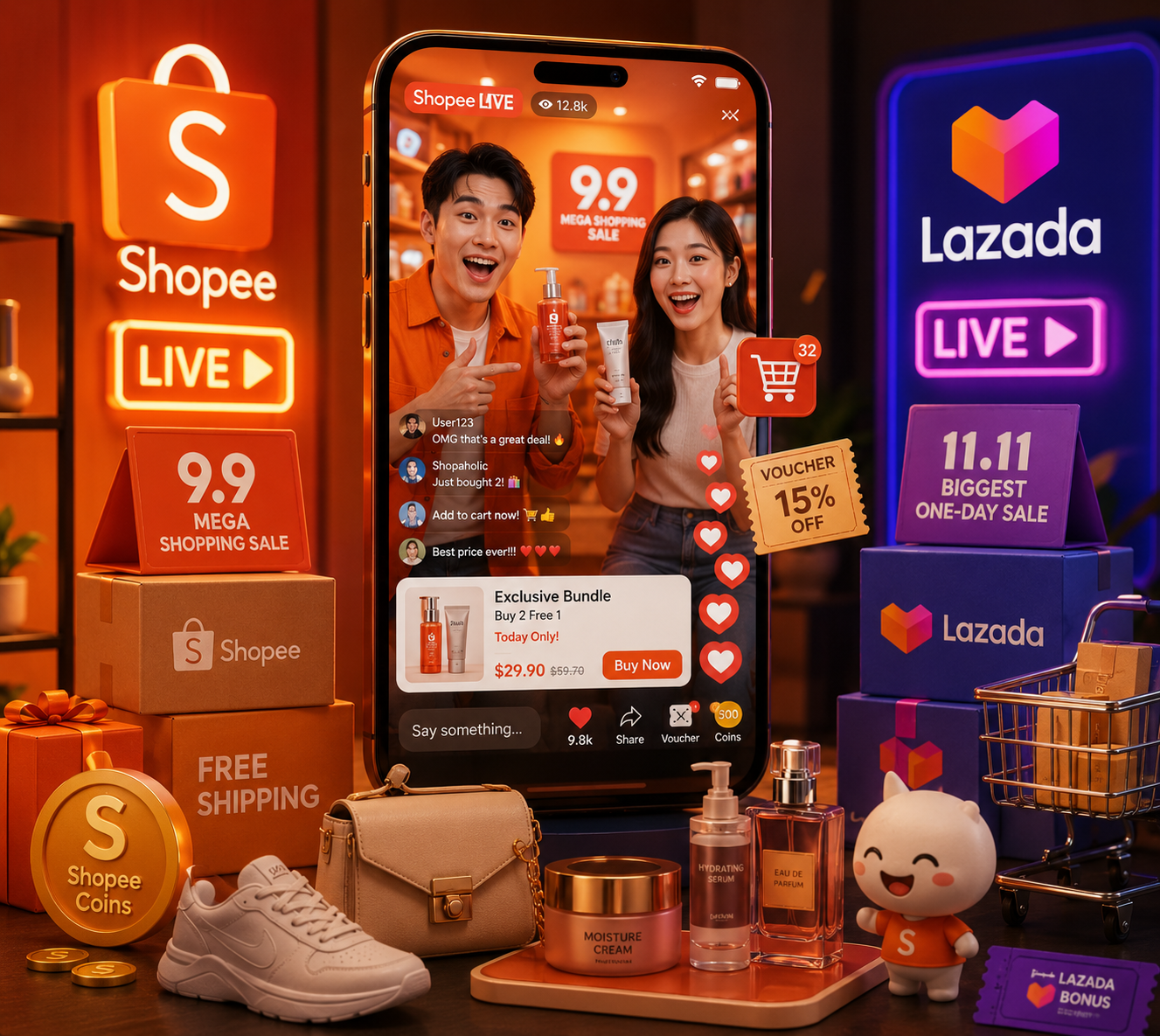
Shopee is the largest marketplace in the region, and Shopee Live is its answer to TikTok Shop. Conversion during Shopee Live sessions averages up to 10x higher than static product pages (DHL APAC). The audience here is more deal-led than TikTok’s.
What works:
- Daily live sessions of 60 to 120 minutes in the 8 to 11pm window.
- Mega-sale tie-ins (9.9, 11.11, 12.12) with in-app vouchers stacked on seller vouchers.
- Bundle deals shown live: buy 2 get 1 free, today only, on this stream.
- Bilingual hosts (English and Mandarin) reaching both audiences in one session.
- Shopee Coins gamification, so loyal buyers spend Coins in the live for an instant discount.
Watch out: Shopee margins get thin once commission, fulfilment, and voucher costs stack up. Run unit economics weekly. Do not assume volume offsets margin compression.
Instagram Shopping
Instagram is the home of premium D2C in Singapore. Beauty, fashion, jewellery, lifestyle, and F&B launches all start here. Instagram Checkout is now stable, but most local brands still use Instagram as discovery plus DM-led commerce, with checkout on Shopify or WhatsApp.
What works:
- Reels-first. Static feed posts are now mostly brand hygiene; Reels drive the sales.
- Product tagging on Reels and Stories. Tap-to-shop cuts friction.
- Creator collaborations through Instagram Collabs, posted to both audiences at once.
- DM-to-Shopify funnels: the buyer sees a Reel, DMs a question, the brand replies with a checkout link.
- UGC reposts with permission. Singapore shoppers trust real customers over brand content, which is exactly the social proof effect BigCommerce highlights as a top conversion driver.
Watch out: organic reach is brutal. Plan to put at least half your Instagram budget behind paid amplification of your best organic posts.

Facebook Shops and Marketplace
Facebook is the platform local strategists love to dismiss and end up using anyway. Two surfaces: Facebook Shops (catalogue-driven, in-app checkout, mostly underwhelming for brands) and Facebook Marketplace (peer-to-peer, excellent for second-hand furniture, electronics, and baby goods).
Where Facebook still wins:
- Marketplace for high-value second-hand: condo furniture flips, electronics resale, vehicle parts.
- Niche community groups (F&B, parenting, photography). Sponsored posts inside these groups beat newsfeed ads.
- Messenger commerce for the 40-plus demographic who prefer Messenger to WhatsApp.
- Retargeting that pulls warm Instagram and site audiences more cheaply than Instagram itself, especially when paired with a display and retargeting layer.
WhatsApp and Telegram
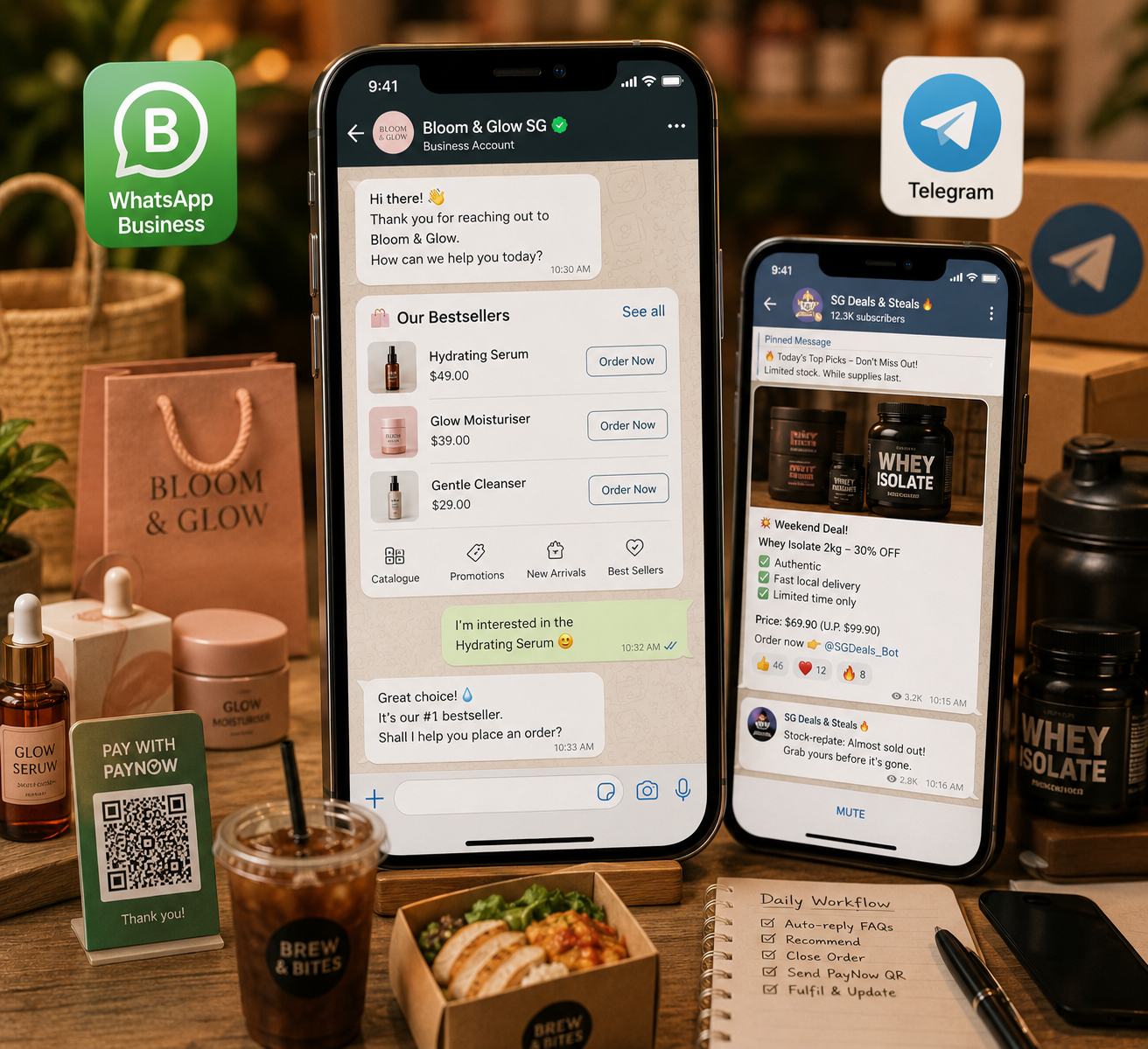
Conversational commerce is one of the most under-rated Singapore channels because it never shows up in any platform’s public GMV figure. WhatsApp Business dominates F&B, beauty, fashion resale, tuition, and home services. Telegram dominates group buys, deal channels, and supplement resale.
Practical setup:
- WhatsApp Business catalogue of 30 to 50 products, with prices and Order Now CTAs.
- Click-to-WhatsApp ads on Meta. CPL of SGD 1.50 to SGD 5 for warm Singapore audiences.
- Auto-responders for FAQs, then a human handoff to close.
- Telegram broadcast channel for evergreen offers, with a separate group for community and UGC.
- Payment by PayNow QR sent straight into the chat. No friction.
A solo F&B brand can run six-figure annual revenue through WhatsApp alone in Singapore. Underestimate this channel at your peril.
YouTube Shopping and Pinterest
YouTube Shopping is slowly becoming useful for reviews, unboxings, and long-form tutorials. Pinterest stays niche but punches above its weight in home decor, weddings, crafts, and parenting. Neither belongs in your top three priorities, but both deserve a slice of attention if your category fits.
The Live Commerce Edge
Live commerce conversion runs up to 10x higher than static product pages in Singapore (DHL APAC). The reason is simple: a 90-minute live session compresses discovery, demonstration, social proof, urgency, and checkout into one continuous moment. A static product page needs ten visits to do the same job.
Three formats that work:
- Daily host-led: a brand spokesperson goes live five times a week at the same time. Builds appointment viewing. Best for fashion and beauty.
- Event-driven: monthly mega-lives tied to product drops or platform sales. Best for premium, limited-edition items.
- Affiliate creator lives: paid creators run their own lives with your products. More reach, lower margin, less control.
Singapore-specific notes: bilingual hosts (English and Mandarin, or English and Malay) meaningfully widen reach. Schedule around 8 to 11pm on weekdays and 12 to 3pm on weekends. Always offer PayNow even when the platform default is card.
Payments and Checkout: The Hidden Conversion Lever
Adyen puts it bluntly: payment methods, checkout speed, and fraud protection decide whether a shopper converts or abandons. Singapore consumers say the same thing about what pulls them to social buying in the first place: speed (48%), better deals (43%), and the convenience of shopping across stores in one place (38%).
Translate that into build decisions:
- Offer PayNow everywhere. It is the fastest, most trusted local option and removes the card-entry step that leaks mobile conversions.
- Keep checkout native wherever the platform allows it. Every redirect is a chance to lose the sale, and mobile cart abandonment already sits near 86% (BigCommerce).
- Put trust signals at the point of sale. Visible reviews, ratings, and a clear return policy reduce hesitation right when the buyer is deciding.
- Guard against fraud without adding friction. Chargebacks and fake orders quietly erode the margins you fought for on Shopee and TikTok.
When conversion depends this heavily on the store and checkout experience, the storefront cannot be an afterthought. That is where an e-commerce website build tuned for speed, mobile, and local payments pays for itself.
Content Strategy: What to Actually Post
The content stack that works for Singapore social commerce in 2026 is not glossy brand video. It is a layered mix.
|
Type |
Cadence |
Goal |
|
Native creator UGC |
Daily, repurposed |
Discovery and trust |
|
Brand Reels (raw, vertical) |
3 to 5x weekly |
Algorithm reach |
|
Live commerce session |
3 to 7x weekly |
Direct conversion |
|
Product carousels (IG, FB) |
2 to 3x weekly |
Catalogue awareness |
|
Behind-the-scenes Stories |
Daily |
Para-social trust |
|
Customer reviews and unboxings |
As received |
Social proof |
|
Branded storytelling clips |
2 to 3x weekly |
Brand love |
The brands winning right now run their content engine like a newsroom: a structured editorial calendar, daily standups, and real-time response to trending audio and topical moments. BigCommerce makes the same point another way, that platform-native content beats one identical post copied across every channel.
PDPA, GST, and Other Singapore-Specific Bits
Selling through social does not exempt you from Singapore consumer law, the Personal Data Protection Act (PDPA), or GST registration once your annual taxable turnover crosses SGD 1 million. A few items that catch sellers out:
- PDPA consent: collecting WhatsApp numbers off Instagram or TikTok for marketing needs explicit opt-in. A “DM us” CTA is not consent.
- GST: register once revenue across all channels is on track to exceed SGD 1M in any 12-month period. Most platforms now provide consolidated GST reports.
- Consumer protection: refund and exchange policies must be shown on every storefront, including livestreams. The Lemon Law and the Consumer Protection (Fair Trading) Act apply.
- Health products: HSA-regulated categories (cosmetics, supplements, health devices) need approval before sale, even on social. Enforcement has tightened.
- Food products: SFA registration applies to imported foods sold socially.
- Alcohol and tobacco: HSA and customs rules apply, and TikTok Shop and Shopee both block these categories for SG sellers.
Measurement: The Metrics That Actually Matter
Attribution in social commerce is messy because customers move freely between TikTok discovery, Instagram comparison, WhatsApp questions, and Shopify or Shopee checkout. Stop assigning credit to one platform and start tracking the right combined metrics.
|
Metric |
Why it matters |
Healthy SG range |
|
ROAS (per platform) |
Per-channel efficiency |
2.5x to 6x mature |
|
Blended ROAS (all channels) |
True business efficiency |
3x to 5x |
|
Cost per messaged conversation |
Conversational commerce volume |
SGD 1.50 to SGD 5 |
|
Live commerce close rate |
Share of viewers who buy |
5 to 12% |
|
Content velocity |
Posts shipped per week |
20 to 40 across formats |
|
Repeat purchase rate |
Whether the channel builds equity |
20 to 40% in 90 days |
|
Average order value |
Per-platform AOV trend |
TikTok SGD 30 to 80; Shopee SGD 25 to 60; IG/Shopify SGD 60 to 200 |
If you already run paid search and display, fold social commerce into the same reporting so you can compare it honestly against your other performance marketing channels rather than judging it in isolation.
A 90-Day Setup Playbook
Starting from zero, run this sequence rather than launching everything at once.
- Weeks 1 to 2: pick one primary platform by category. TikTok Shop for fashion and beauty, Shopee Live for value-led, Instagram for premium D2C, WhatsApp for F&B and services.
- Weeks 3 to 4: set up the storefront properly. Catalogue, payments (PayNow included), fulfilment SLA, return policy, PDPA consent flow, GST handling.
- Weeks 5 to 6: produce the first 30 pieces of native content. Test live commerce twice.
- Weeks 7 to 8: layer paid amplification onto your top organic posts. Begin creator outreach.
- Weeks 9 to 10: add WhatsApp or Messenger as the conversational layer. Wire up auto-responders plus a human handoff.
- Weeks 11 to 12: review unit economics. Decide whether to add a second platform or double down on the first.
Where Social Commerce Goes Next in Singapore
Three trends to watch into late 2026 and 2027. AI agents inside chat will close more orders than human sellers in conversational commerce. Live commerce will split into vertical formats (beauty live, F&B live, second-hand live) instead of generalist sessions. And the line between social media and marketplace will keep blurring as TikTok Shop, Shopee, Lazada, and Instagram absorb each other’s features. Brands that treat this as one connected channel will compound. Brands that keep running each platform as a silo will fall behind.
Frequently Asked Questions
What is social commerce, and how is it different from e-commerce?
Social commerce lets people discover and buy inside a social app, often without visiting a separate website. Traditional e-commerce sends shoppers to a standalone store. The advantage of social commerce is fewer steps between seeing a product and paying for it, which reduces drop-off.
Which social commerce platform is best in Singapore?
It depends on your category. TikTok Shop suits beauty, fashion, and impulse buys; Shopee Live suits value-led and deal-driven products; Instagram suits premium D2C; WhatsApp suits F&B and services. Most brands start with one, prove it, then add a second.
How much does it cost to start selling on social in Singapore?
You can start lean. Expect a customer acquisition cost of roughly SGD 6 to SGD 25 on TikTok, and click-to-WhatsApp leads from SGD 1.50 to SGD 5. The bigger investment is content and live sessions, not ad spend.
Do I need to register for GST or worry about PDPA?
Yes. GST registration applies once your total taxable turnover is set to exceed SGD 1 million in a 12-month period. PDPA requires explicit opt-in before you market to phone numbers or emails collected through social.
Is live commerce really worth it?
For the right categories, yes. Live sessions convert up to 10x better than static product pages in Singapore because they combine demonstration, social proof, urgency, and checkout in one moment.
Build Your Social Commerce Engine
Demand is already here. The brands that win in 2026 are the ones that show up with a real system: the right platform, a content engine, native checkout, and honest measurement.
If you want help planning, building, or scaling a social commerce engine in Singapore, from paid media and content to the storefront itself, talk to the MediaPlus team about social media advertising and our e-commerce website build service, or get in touch for a tailored plan.