
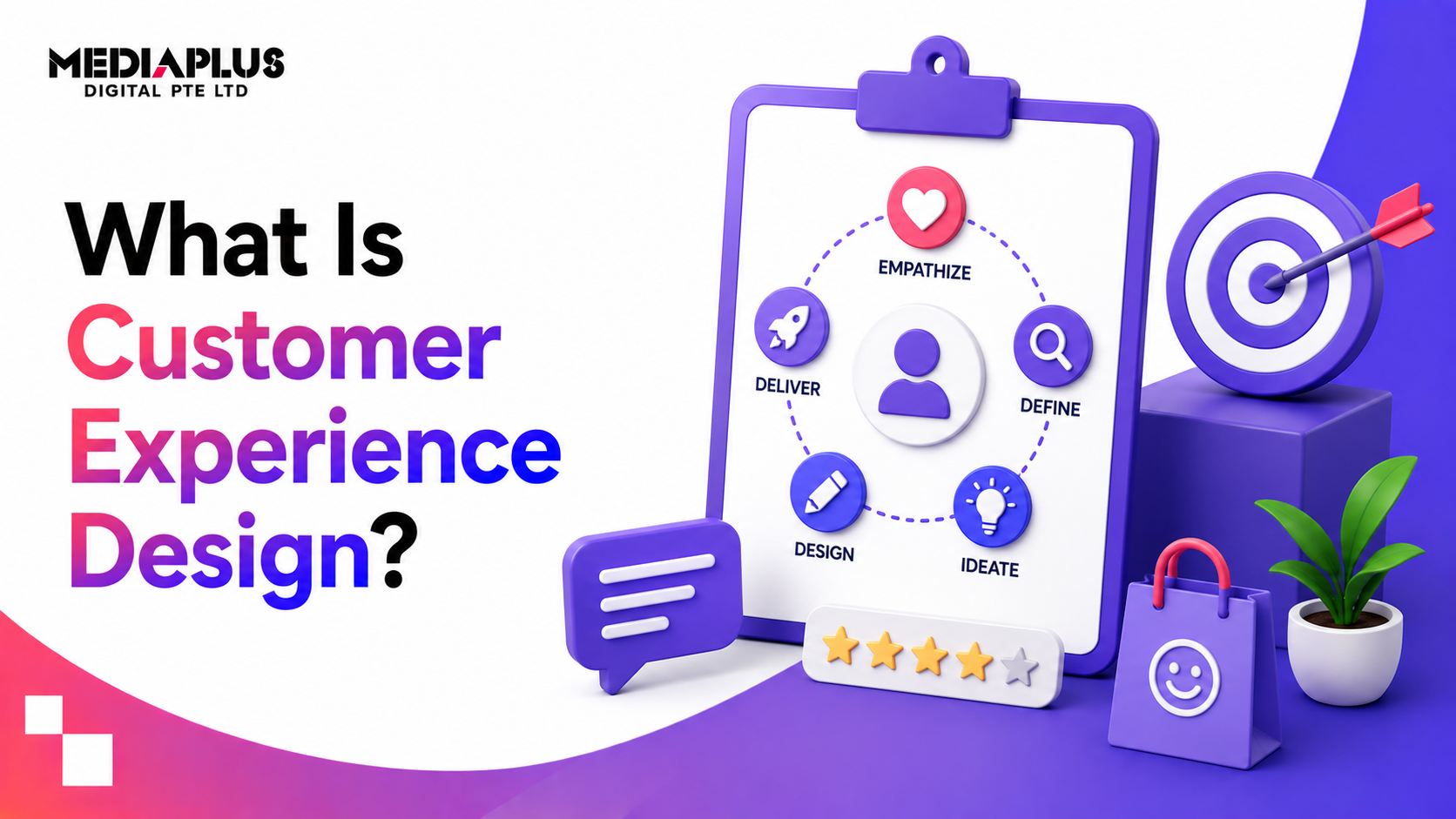
Every business already delivers a customer experience, whether it designed one or not. The question is whether that experience is intentional and consistent, or accidental and full of friction. Customer experience design (CX design) is the discipline of shaping every interaction a person has with your brand on purpose, so it is easy, coherent, and worth coming back to. This guide explains what CX design is, how it differs from UX, and exactly how to design a customer experience step by step.
Quick answer: Customer experience design is the practice of intentionally shaping every interaction a customer has with a brand, across marketing, product, sales, support, and service, so the whole journey feels easy, consistent, and positive. It is broader than UX (which focuses on a single product or interface) because it covers the entire relationship, online and offline. You design it by understanding customers, mapping their journey, fixing friction, and measuring the result. Better CX drives loyalty, spend, and referrals.
What is customer experience design?
Customer experience design is the discipline of intentionally shaping and improving every interaction a person has with a brand, from the first ad they see to the support call they make three years later. Rather than treating each touchpoint in isolation, CX design looks at the full journey from the customer’s point of view and connects the dots across marketing, product, sales, and service into one coherent experience.
The goal is not just satisfaction; it is to make the experience easy, consistent, and emotionally positive at every step, so customers stay, spend more, and recommend you. Every business delivers an experience whether or not it plans one. CX design is the decision to plan it deliberately.

Customer experience design vs UX design
These two are related but not the same, and confusing them leads to gaps.
|
UX Design |
CX Design |
|
|
Scope |
A single product, app, or interface |
The entire brand relationship |
|
Focus |
Usability of one digital experience |
Every touchpoint, online and offline |
|
Example |
How easy the checkout page is to use |
The whole journey from ad to delivery to support |
|
Owner |
Designers, product team |
Cross-functional (marketing, product, sales, service) |
UX is a crucial part of CX, but CX is the wider picture. A brand can have a beautiful app (good UX) and still deliver a poor experience (bad CX) if delivery is late, support is unhelpful, or the message on the website does not match reality. See our guides to UI vs UX and UX in web development.
Why customer experience design matters
Experience is now a primary reason people choose, stay with, or leave a brand:
- It drives loyalty and retention. Customers who have consistently good experiences come back and forgive the occasional slip.
- It lifts spend. Satisfied customers buy more often and trade up.
- It reduces churn. A single bad experience is enough to send many customers to a competitor.
- It fuels word of mouth. Great experiences get recommended; poor ones get complained about, publicly.
- It differentiates. When products and prices look similar, experience is often the deciding factor.
In a competitive market like Singapore, where customers have plenty of choice and high expectations, experience is frequently what separates the brands that grow from the ones that stall.
The three levels of customer experience
CX design works at three levels, and strong experiences get all three right:
- The interaction level: each individual touchpoint (a page, a message, a call). Is this single moment clear and easy?
- The journey level: the connected sequence of touchpoints toward a goal (researching, buying, onboarding). Does the journey flow without friction or repetition?
- The relationship level: the whole ongoing relationship over time. Does the brand stay consistent and keep earning trust across every journey?
Fixing one great touchpoint does not save a broken journey. CX design zooms out to the whole.
How to design a customer experience (step by step)
This is the part most guides skip. Here is a practical process you can actually run.
1. Set your CX principles
Start from your brand promise. Define a few clear principles for the experience you want to deliver (for example “make it effortless”, “be honest about timing”, “sound human”). These guide every decision that follows.
2. Understand your customers
Build research-backed customer personas: who they are, their goals, their frustrations, and what they expect. Base these on real data (interviews, surveys, support tickets, analytics), not assumptions.
3. Map the customer journey
Map every stage and touchpoint a customer moves through, from awareness to purchase to post-sale, and mark what they are trying to do and where they hit friction. A customer journey map makes the gaps and pain points visible.
4. Build empathy maps
For key moments, capture what the customer is saying, thinking, doing, and feeling. This shifts the team from “what we deliver” to “how it actually feels” to receive it, which is where real improvements come from.
5. Fix the friction
Prioritise the biggest pain points and redesign them: simplify steps, remove dead ends, fix inconsistent messaging, speed up responses. Small friction removed at high-traffic moments often delivers the biggest gains. This is closely tied to conversion rate optimisation.
6. Align the whole organisation
CX breaks when teams work in silos. Make sure marketing, product, sales, and support share the same view of the journey and deliver a consistent experience across every channel.
7. Measure and iterate
CX design is never finished. Track the right metrics, learn where the experience still falls short, and keep improving. Treat it as an ongoing loop, not a one-off project.
Key principles of effective CX design
- Human-centred: start from real customer needs and emotions, not internal convenience.
- Consistent across touchpoints: the experience should feel like one brand everywhere, online and off.
- Emotionally aware: people remember how you made them feel, so design for trust and reassurance, not just function.
- Effortless: remove effort at every step. Lower customer effort is one of the strongest predictors of loyalty.
- Aligned with business goals: balance customer needs with measurable outcomes so CX earns its investment.
- Accessible and inclusive: design for all users, including those with disabilities (WCAG), so no one is left out.
How to measure customer experience
You cannot improve what you do not measure. Track a mix across three categories:
|
Category |
Metrics |
What they tell you |
|
Emotional |
NPS, CSAT, CES |
How customers feel and how loyal they are |
|
Behavioural |
Task success rate, repeat visits, time to value |
What customers actually do |
|
Business |
Retention, customer lifetime value, conversion rate |
The commercial impact of CX |
- NPS (Net Promoter Score): likelihood to recommend.
- CSAT (Customer Satisfaction): satisfaction with a specific interaction.
- CES (Customer Effort Score): how easy it was to get something done.
No single number tells the whole story. Read them together and watch the trend.
Customer experience trends for 2026
CX design is being reshaped by a few clear shifts:
- AI-driven personalisation: using data and AI to tailor experiences in real time, while keeping a human in the loop for anything sensitive.
- AI-assisted service with human oversight: chatbots and assistants handle volume; people handle the complex and emotional.
- Omnichannel consistency: customers move across web, app, social, messaging, and in-store and expect the experience to carry over.
- Conversational interfaces: messaging and voice becoming primary ways customers interact.
- Accessibility and inclusivity treated as standard, not optional.
The through-line: use technology to reduce effort and add relevance, without losing the human touch.
Common CX design mistakes
- Designing touchpoints in isolation, so the overall journey still feels disjointed.
- Working in silos, where marketing, product, and support deliver inconsistent experiences.
- Guessing instead of researching, basing design on assumptions rather than real customer data.
- Automating without clarity, where bots frustrate instead of help.
- Measuring nothing, so you cannot tell if the experience is improving.
- Treating CX as a one-off project rather than an ongoing discipline.
Frequently asked questions
What is customer experience design in simple terms?
It is the practice of intentionally designing every interaction a customer has with your brand, across marketing, product, sales, and support, so the whole journey is easy, consistent, and positive.
What is the difference between CX and UX design?
UX design focuses on the usability of a single product or interface. CX design covers the entire brand relationship, every touchpoint online and offline. UX is one important part of the wider CX.
How do you design a customer experience?
Set your CX principles, research customers and build personas, map the customer journey, create empathy maps, fix the biggest friction points, align teams around one consistent experience, and measure and iterate continuously.
How do you measure customer experience?
With a mix of emotional metrics (NPS, CSAT, CES), behavioural metrics (task success, repeat visits, time to value), and business metrics (retention, customer lifetime value, conversion). Read them together and track the trend.
Why is customer experience design important?
Because experience now drives loyalty, spend, and referrals. Consistently good experiences keep customers and grow their value, while a single bad one can send them to a competitor, especially in a choice-rich market like Singapore.
Design experiences customers come back for
Customer experience design turns scattered, accidental interactions into a journey customers trust and repeat. If you want to design experiences that keep customers coming back, talk to MediaPlus Digital. Explore our web design and conversion rate optimisation services, and see our guide to the customer journey map, with PSG support for eligible SMEs.




