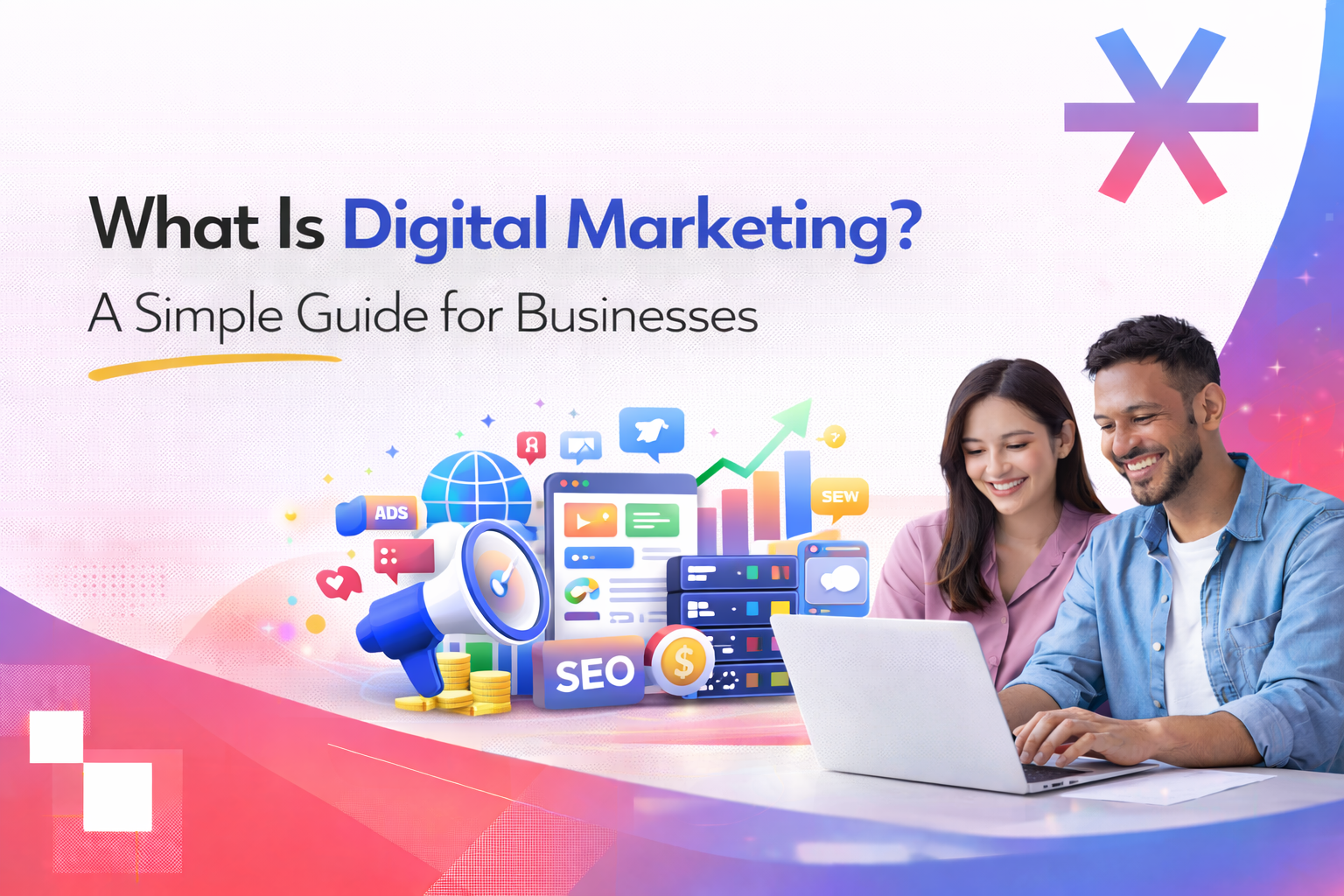
Digital marketing is how businesses reach customers where they already spend their time: on Google, social media, email, and their phones. It has largely replaced the guesswork of traditional advertising with channels you can target precisely and measure to the dollar. This guide explains what digital marketing is, the main channels, how it works, the metrics that matter, and how to get started.
Quick answer: Digital marketing is the promotion of a business through online channels such as search engines, social media, email, websites, and paid ads. It works by reaching people at each stage of their journey, from discovering a need to becoming a loyal customer, and its big advantage over traditional marketing is precise targeting and measurable results.
What is digital marketing?
Digital marketing is any marketing that uses the internet and digital devices to connect with customers. That includes ranking on Google, running ads, posting on social media, sending emails, and publishing content. Instead of broadcasting to everyone and hoping, digital marketing lets you reach a defined audience, track exactly what they do, and improve based on real data.
It covers both organic channels (which earn attention over time, like SEO and content) and paid channels (which buy attention instantly, like Google and social ads). Most businesses use a mix.
How digital marketing works
Digital marketing follows the customer journey. People move through stages, and different channels serve each:
- Awareness: they discover you through search, social, or content.
- Consideration: they research and compare, reading your content and reviews.
- Decision: they act on a clear offer, often via a landing page or ad.
- Loyalty: they come back and refer others, nurtured by email and retargeting.
Good digital marketing meets people at each stage with the right message, then measures which channels and messages actually drive results.
Types of digital marketing channels
|
Channel |
What it is |
Organic or paid |
|
SEO |
Ranking on Google’s organic results |
Organic |
|
Content marketing |
Blogs, guides, and videos that attract and help |
Organic |
|
Social media marketing |
Building an audience on social platforms |
Organic |
|
Email marketing |
Nurturing subscribers and customers |
Organic (owned) |
|
Search ads (SEM/PPC) |
Paid ads on search results |
Paid |
|
Social and display ads |
Paid ads on social and websites |
Paid |
|
Video marketing |
YouTube and short-form video |
Both |
|
Influencer marketing |
Creators promoting your brand |
Paid |
The core organic engines are SEO and content; the core paid engines are SEM and social ads. See our Google Ads and social media ads services.
Digital marketing vs traditional marketing
|
Factor |
Digital marketing |
Traditional marketing |
|
Reach |
Global and targeted |
Broad, less targeted |
|
Cost |
Flexible, scalable |
Often high and fixed |
|
Targeting |
Precise (audience, intent) |
Limited |
|
Measurement |
Fully measurable |
Hard to measure |
|
Interaction |
Two-way, real-time |
One-way |
Digital does not fully replace traditional for every brand, but for most SMEs it delivers more reach and accountability per dollar.
The benefits of digital marketing
- Reach the right people, by audience, interest, location, and intent.
- Measure everything, so you know what works and what to cut.
- Scale up or down with your budget and results.
- Lower cost per lead than most traditional channels over time.
- Two-way relationships, through comments, messages, and email.
Key digital marketing metrics
|
Metric |
What it tells you |
|
Traffic and sources |
How many visitors, and from where |
|
Conversion rate |
How many visitors take action |
|
Cost per lead / acquisition (CPL/CPA) |
What each lead or customer costs |
|
Return on ad spend (ROAS) |
Revenue per dollar of ad spend |
|
Customer lifetime value (LTV) |
Long-term value of a customer |
|
Retention and repeat rate |
How well you keep customers |
Judge digital marketing on leads, revenue, and ROI, not likes and impressions. Because customers often touch several channels before converting, look at assisted conversions and multi-touch attribution, not last click alone.
Tools and platforms
You do not need every tool, but a basic stack helps:
- Analytics: Google Analytics 4 and Google Search Console (free) to measure traffic and rankings.
- SEO tools: Ahrefs, Semrush, or SE Ranking for keywords, competitors, and audits.
- Ad platforms: Google Ads and Meta Ads Manager for paid campaigns.
- Email and automation: Mailchimp, HubSpot, or similar for nurturing.
- A CMS: WordPress or Shopify to run your site and content.
How to get started with digital marketing
- Set a clear goal, such as more leads, sales, or bookings.
- Know your audience and where they spend time online.
- Get your website right: fast, mobile-first, and built to convert.
- Choose the channels that fit your goal and budget, not all of them at once.
- Create useful content and set up tracking before you spend.
- Launch, measure, and optimise based on real data.
- Scale what works and cut what does not.
See our guide to building a digital marketing strategy and a content cluster strategy.
In-house vs agency
Small teams often start in-house with the basics, then bring in an agency as they scale or need specialist skills (technical SEO, paid media, creative). An agency gives you a team, tools, and experience without hiring every role. A full-service partner also keeps channels coordinated, so your SEO, ads, and content pull in the same direction. Eligible SMEs can offset up to 50% of qualifying digital marketing costs through the PSG grant.
Digital marketing trends for 2026
- AI and automation across content, targeting, and reporting.
- AI search and GEO: buyers research through ChatGPT and AI Overviews, so being cited there matters.
- Video-first content on short-form platforms.
- First-party data and privacy, as third-party cookies fade.
- Authenticity, with real, human content winning trust over polished ads.
Frequently asked questions
What is digital marketing in simple terms?
It is promoting your business online, through search, social, email, content, and ads, to reach customers where they already are, with targeting and measurement traditional marketing cannot match.
What are the main types of digital marketing?
SEO, content marketing, social media, email, search ads (SEM/PPC), social and display ads, video, and influencer marketing. Most businesses use a mix of organic and paid.
How much does digital marketing cost in Singapore?
It varies with channels and scope. SMEs often start from around S$1,000 to S$3,000 per month per channel, plus ad budget. PSG can offset up to 50% for eligible SMEs.
Is digital marketing better than traditional marketing?
For most SMEs, yes, because it is more targeted, measurable, and scalable per dollar. Some brands still blend both, but digital usually delivers more accountability.
How long before digital marketing works?
Paid channels can produce leads within weeks; SEO and content compound over 3 to 6 months. A balanced plan gives you quick wins while the long-term base builds.
Should I do digital marketing in-house or hire an agency?
Start in-house with the basics if you can. Bring in an agency when you need specialist skills, more capacity, or channels coordinated into one strategy.
Grow your business with digital marketing
Digital marketing rewards businesses that reach the right people and measure what works. If you want SEO, ads, and content working together toward leads and revenue, talk to MediaPlus Digital. Explore our digital marketing agency in Singapore and performance marketing services, with PSG support for eligible SMEs.