
Quick answer
What is the key difference between digital marketing for B2B and B2C companies? Who makes the decision, and how long it takes.
- B2C marketing persuades one person, or a household, to buy for themselves. Decisions are faster, more emotional and often made in a single session, so marketing aims at reach, attention and removing friction at checkout.
- B2B marketing influences a group of people buying on behalf of an organisation. Decisions take months, involve several stakeholders and a lot of independent research, so marketing aims at being known and trusted before the buyer is ready, then making it easy to shortlist you.
Everything else, from channels to content to metrics, follows from that difference.
B2B vs B2C at a glance
|
B2B digital marketing |
B2C digital marketing |
|
|
Who buys |
A buying group across several functions |
An individual or household |
|
Decision drivers |
Risk, return on investment, fit with existing systems, peer proof |
Price, convenience, desire, social proof, brand feeling |
|
Sales cycle |
Months |
Minutes to weeks |
|
Order value |
Usually high, often recurring contracts |
Usually lower, higher volume |
|
Research |
Deep, mostly self-directed before talking to sales |
Shorter, heavily influenced by reviews and social content |
|
Where the sale closes |
Sales conversation, proposal, procurement |
Website checkout, app or store |
|
Content |
Guides, case studies, comparisons, pricing logic, webinars |
Short video, product pages, reviews, offers, creators |
|
Core digital channels |
SEO, Google Ads, LinkedIn, email nurture, website |
Social ads, Google Shopping and Search, marketplaces, influencers, email and SMS |
|
Main metrics |
Qualified leads, pipeline, win rate, cost per opportunity |
ROAS, conversion rate, average order value, repeat purchase |
|
Role of the website |
Evidence base and lead capture |
Store or booking engine |
How B2B buyers decide in 2026
B2B buying has changed faster than most B2B marketing. Current research points the same way from several angles.
Buyers prefer to research without sales. Gartner’s survey of 646 B2B buyers, run in August and September 2025, found 67% prefer a rep-free buying experience, up from 61% the year before. In the same study, 69% noticed inconsistencies between what a supplier’s website said and what its sellers told them, and 73% actively avoid suppliers who send irrelevant outreach.
The shortlist is formed before first contact. The 6sense 2025 Buyer Experience Report, based on nearly 4,000 responses across North America, APAC and EMEA, found:
- Buyers make first contact with sellers at about 61% of the way through their journey
- Buyers initiate 79% of engagements
- The vendor contacted first wins about 8 in 10 deals
- Buyers evaluate an average of 5.1 vendors
- Average buying cycles were 10.1 months, down from 11.3 in 2024
More people are involved. Gartner reports buying groups ranging from five to 16 people across as many as four functions. Forrester’s State of Business Buying 2026, drawing on a survey of nearly 18,000 business buyers, reports an average of 13 internal stakeholders and nine external participants influencing decisions, with procurement acting as a decision-maker in 53% of purchases.
AI is now part of the research. Forrester found 94% of business buyers used AI during their buying process. Gartner found 69% of buyers want to validate AI-generated insights with a sales rep.
What this means for B2B marketing: most of the decision happens on your website, in search results, in AI answers and in peer conversations you never see. If your site cannot answer a buying group’s questions on its own, you are unlikely to be the vendor they contact first.
The 95-5 rule, and how to use it properly
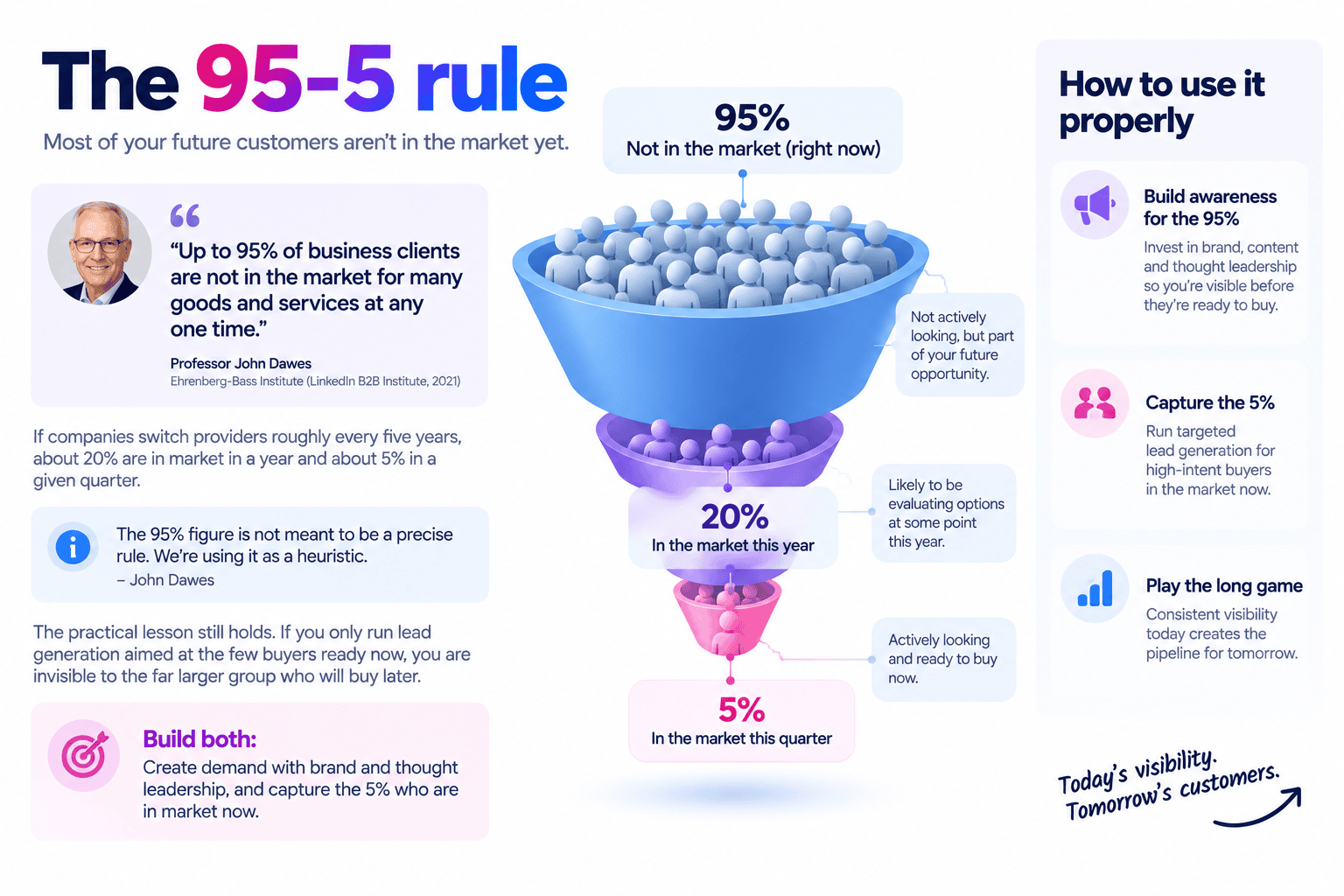
Professor John Dawes of the Ehrenberg-Bass Institute, writing for the LinkedIn B2B Institute in 2021, argued that “up to 95% of business clients are not in the market for many goods and services at any one time.” His reasoning: if companies switch providers roughly every five years, about 20% are in market in a year and about 5% in a given quarter.
Dawes is explicit that “The 95% figure is not meant to be a precise rule. We’re using it as a heuristic.” The practical lesson still holds. If you only run lead generation aimed at the few buyers ready now, you are invisible to the far larger group who will buy later.
How B2C buyers decide
Consumer decisions are shorter but far from simple.
Google’s research with The Behavioural Architects, Decoding Decisions: Making sense of the messy middle, observed 310 purchase journeys across 31 categories, then ran purchase simulations with 31,000 UK shoppers. It found shoppers loop between exploring and evaluating options, and that applying well-known behavioural biases (social proof, scarcity, authority, the power of free, speed and category heuristics) could shift preference dramatically. In one test, a second-choice shampoo brand with all six biases applied took 90% of preference away from shoppers’ first choice.
What this means for B2C marketing: the brand that is present and persuasive at the moment of comparison often wins, even against a stronger favourite. Reviews, delivery speed, clear pricing and a frictionless checkout are marketing, not operations.
Singapore consumers online
- Online share of retail: SingStat estimated that 16.4% of Singapore’s June 2026 retail sales were made online, rising to 19.5% excluding motor vehicles, and 64.9% for computer and telecoms equipment.
- Social media time: We Are Social’s Digital 2026 Singapore report found people spend an average of 17 hours a week on social platforms and use 7.4 platforms a month.
- Discovery: social ads are now the third most common source of brand discovery in Singapore, after search engines and word of mouth.
- Messaging: WhatsApp is the most-used app, with four in five people using it monthly.
- AI: more than a third of Singaporeans use ChatGPT each month.
Brand vs activation: different budget splits
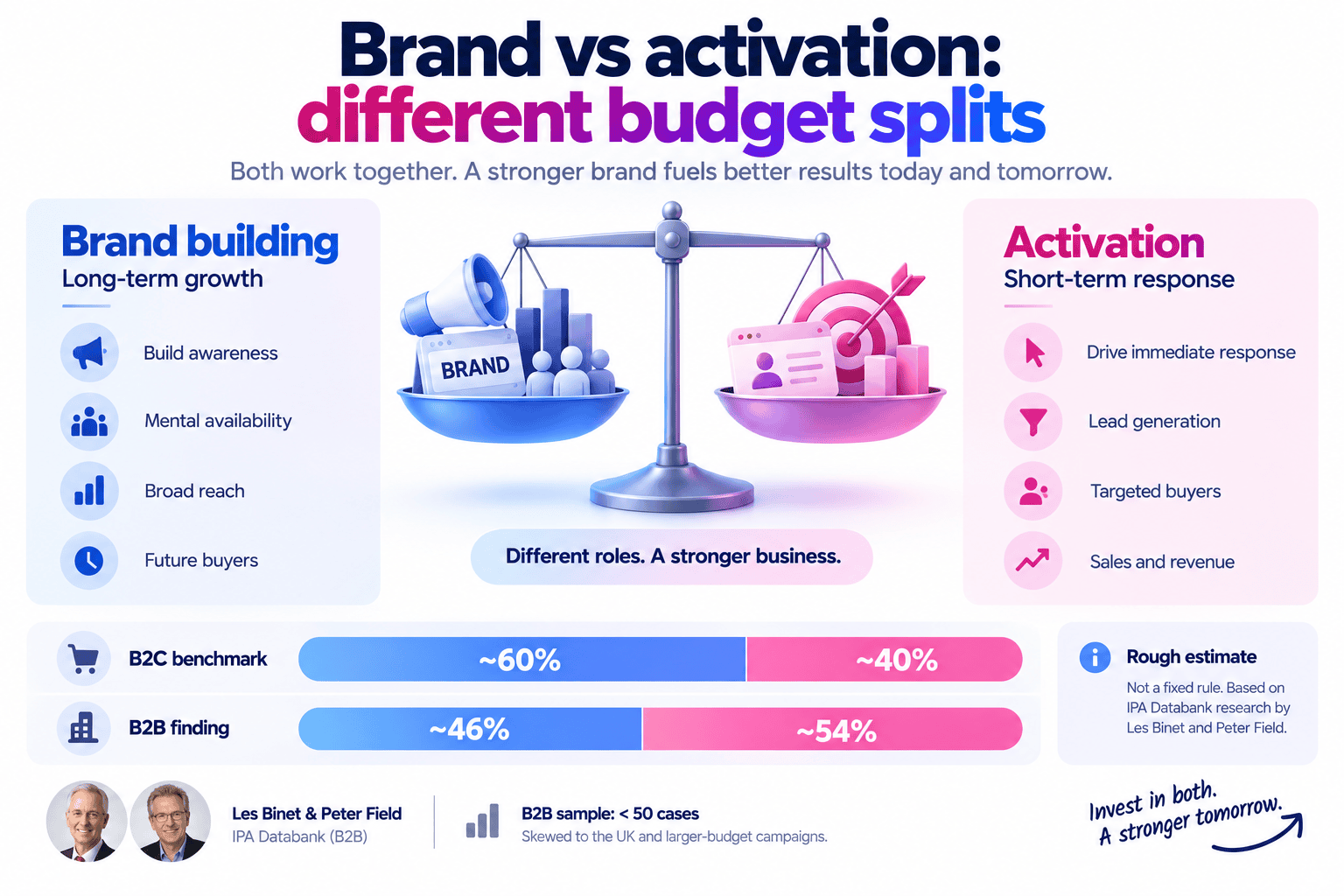
Les Binet and Peter Field’s analysis for the LinkedIn B2B Institute, using the IPA Databank, is the most cited source on this:
|
Brand building |
Activation (short-term response) |
|
|
B2C benchmark |
Around 60% |
Around 40% |
|
B2B finding |
Around 46% |
Around 54% |
The authors add important caveats. The B2B sample was fewer than 50 cases, skewed to the UK and to campaigns with relatively big budgets, and they say the ratio “should not be followed too precisely” because the sample “only allows us to give a rough estimate.”
The takeaway is not an exact ratio. It is that B2B companies spending almost everything on lead generation are likely under-investing in the brand familiarity that decides who gets shortlisted.
Channels: what works for each in Singapore
Ad reach figures below are from DataReportal’s Digital 2026 Singapore report, published November 2025.
|
Channel |
B2B role |
B2C role |
|
SEO |
Captures problem, comparison and vendor searches during long research. Often the highest-value B2B channel over time |
Captures product and local searches, category pages, reviews |
|
Google Search Ads |
High-intent service and solution keywords, high CPC, needs tight targeting |
Product, promotion and brand keywords, plus Shopping ads |
|
|
Targeting by job title, company and industry. LinkedIn reported 5.10 million registered members in Singapore, which counts registrations rather than active users |
Limited, mainly employer branding |
|
YouTube |
Explainers, demos, webinars, thought leadership. Ad reach of 5.33 million |
Brand video, product demos, creators |
|
Facebook and Instagram |
Retargeting, SME decision-makers, events. Facebook ad reach 3.80 million, Instagram 3.35 million |
Core prospecting and retargeting, catalogue ads |
|
TikTok |
Niche use for employer brand or SME audiences |
Discovery, creators, TikTok Shop. Ad reach of 3.80 million adults |
|
|
Nurture over months, account-based sequences, newsletters |
Offers, abandoned carts, loyalty |
|
|
Follow-up and account management |
Customer service, order updates, broadcast offers |
|
AI search |
Being cited when buyers ask assistants to compare vendors |
Product recommendations and comparisons |
Deeper guides: LinkedIn Ads for B2B, B2B SEO, WhatsApp Business marketing and types of B2B marketing.
Content: what each audience needs
B2B content has to arm a buying group. Different people ask different questions: finance asks about cost and return, IT asks about integration and security, operations asks about implementation, and the end user asks whether it will make their job easier.
- Case studies with numbers and named industries
- Comparison pages, including honest “us vs them” content
- Pricing logic, even if exact prices are quoted per project
- Implementation timelines and what the client must provide
- Security, compliance and PDPA documentation
- Webinars, guides and tools that solve a real problem
B2C content has to create desire and remove doubt quickly.
- Short-form video showing the product in use
- Reviews, ratings and user-generated content
- Clear product pages with delivery times and returns policy
- Offers, bundles and limited-time promotions
- Creator and influencer content
- Social proof at the point of purchase
Gartner’s finding that 69% of B2B buyers see inconsistencies between supplier websites and sellers is a warning for B2B content: make the website say what sales will say.
The website does different jobs
|
B2B website |
B2C website |
|
|
Main job |
Build confidence and capture qualified enquiries |
Sell, or book, as fast as possible |
|
Key pages |
Solutions by industry, case studies, about and team, resources, contact |
Category and product pages, cart, checkout, reviews |
|
Conversion |
Enquiry form, consultation, demo, download |
Purchase, booking, add to cart |
|
Friction |
Some qualification is useful |
Every extra step costs sales |
|
Success looks like |
Fewer, better leads |
More transactions at a healthy margin |
More detail in B2B website design vs B2C.
Metrics that matter
|
B2B |
B2C |
|
Marketing and sales qualified leads |
Conversion rate |
|
Cost per qualified lead and per opportunity |
Return on ad spend (ROAS) |
|
Pipeline value created |
Average order value |
|
Win rate and sales cycle length |
Customer acquisition cost |
|
Customer acquisition cost payback |
Repeat purchase rate and lifetime value |
|
Share of branded search over time |
Cart abandonment rate |
|
Organic visibility for problem and comparison searches |
Revenue by channel |
The most common B2B reporting mistake is optimising for lead volume. A campaign that produces 200 unqualified form fills looks better on a dashboard than one that produces eight real opportunities, and it is worse for the business. Salesforce’s State of Sales report, surveying 4,050 sales professionals including 100 in Singapore, found 69% agree measurable ROI now matters more to customers than a year earlier, and 57% say customers take longer to decide.
Budget planning
B2B – Budget for a long cycle. Results from a campaign started this quarter may close next year. – Protect always-on activity (SEO, thought leadership, brand presence on LinkedIn) rather than cutting it when leads dip. – Connect ad platforms to CRM stages, so bidding optimises towards qualified leads, not form fills.
B2C – Budget around seasonality: 11.11, 12.12, Black Friday, Christmas, Chinese New Year and payday cycles. – Put spend behind creative testing; creative fatigue arrives faster in consumer feeds. – Track contribution margin, not just ROAS, especially with delivery and discount costs.
Businesses that are both
Many Singapore companies sell to businesses and consumers: a food supplier with a retail range, an aircon company serving homes and offices, a furniture brand with corporate projects.
- Separate the journeys. Different landing pages, forms, ad campaigns and email lists for each audience.
- Keep one brand. The same promise, expressed with different proof.
- Split reporting. Blended metrics hide which side is profitable.
- Use the B2C side as proof for B2B. Consumer reviews and volumes can reassure business buyers, and vice versa.
The Singapore context
Most businesses here are SMEs. SingStat data for 2025 shows 369,500 of Singapore’s 371,000 enterprises were SMEs, around 99.6%, employing roughly 2.49 million of 3.60 million workers. For B2B marketers selling to SMEs, that means buyers are often owners or small teams who research online and decide faster than enterprise buying groups.
Grants are changing. Enterprise Singapore has announced that the Productivity Solutions Grant (PSG), the Enterprise Development Grant and the Market Readiness Assistance grant cease on 29 September 2026. From 30 September 2026, business grant support moves to the EDGE Grant, which offers up to 70% support for SMEs and up to 50% for non-SMEs, with levels differing by activity and a cap of S$100,000 a year across all activities. Check the specific activity on Enterprise Singapore’s EDGE Grant page before planning a digital marketing or website project around it.
Common mistakes
In B2B
- Treating every form fill as a lead
- Running only bottom-of-funnel ads to the small share of buyers in market now
- A website that only makes sense after a sales call
- No case studies, or case studies with no numbers
- Hiding everything behind a contact form, when buyers want to research alone first
In B2C
- Chasing ROAS while ignoring margin and repeat purchas
- Running the same creative for months
- Slow mobile checkout
- Ignoring reviews and user-generated content
- Relying on one platform for all acquisition
Frequently asked questions
What is the key difference between digital marketing for B2B and B2C companies?
B2B marketing influences a group of people making a considered, higher-risk decision over months, so it prioritises trust, education and being known before the buyer is ready. B2C marketing persuades individuals making faster, more emotional decisions, so it prioritises reach, desire and a frictionless purchase.
Is B2B marketing harder than B2C?
It is slower and harder to attribute, because the journey is long and involves several people. B2C is faster to test but often more competitive for attention and more price-sensitive.
Which channels are best for B2B in Singapore?
Usually SEO, Google Search Ads, LinkedIn and email, supported by a website with strong case studies. See our guide to B2B digital marketing in Singapore.
Which channels are best for B2C?
Social advertising on Meta and TikTok, Google Search and Shopping, marketplaces, creators and email. See what is B2C digital marketing.
Does social media work for B2B?
Yes, but differently. LinkedIn is the main B2B platform for targeting by role and company, and Meta is useful for retargeting and reaching SME owners. Expect fewer, higher-value conversions.
How long is a B2B sales cycle?
It varies by deal size and industry. The 6sense 2025 report put the average buying cycle at 10.1 months for its B2B technology buyer sample. SME purchases are usually much shorter.
Should B2B companies spend on brand awareness?
Yes. Research by Binet and Field suggests B2B effectiveness peaks with around 46% of budget in brand building, while noting the estimate is rough. With most business buyers out of market at any given time, being remembered when they return matters.
Can one agency handle both B2B and B2C?
Yes, if it runs them as separate strategies with separate metrics. Ask for case studies from both sides. For B2B specialists, see our list of B2B marketing agencies in Singapore.
Build the right strategy for your buyers
MediaPlus Digital runs SEO, Google Ads, social advertising and websites for both B2B and B2C businesses in Singapore, with 13 years in market, a team of 60 and more than 1,800 projects delivered. Our B2B work includes a recruitment client that moved 12 of 40 target keywords into the top 10 within five months, and an industrial products client whose organic conversions rose 108% in six months.
See our SEO services, SEM services and social media advertising.
Research figures verified September 2026 against the original publishers: Gartner, 6sense, Forrester, Ehrenberg-Bass Institute and LinkedIn B2B Institute, IPA, Google, SingStat, DataReportal, We Are Social, Salesforce and Enterprise Singapore.




