
You’ve decided your business needs regular content: service pages that explain what you do, articles that answer buyers’ questions, case studies that prove it. Now you have to decide who writes it. In Singapore the three usual answers are a content agency, a freelance writer, or someone on your own payroll.
The wrong pick rarely shows up as bad writing. It shows up six months later as a blog that stopped at post nine, a writer who left with your only copy of the keyword plan, or 40 articles that read well but never rank. This guide compares the three on the things that decide those outcomes, with Singapore salary data, a scoring table and a set of scenarios you can match your business to.
If you’re still deciding whether content is worth doing at all, start with our explainer on what content marketing is. This article assumes you’ve decided, and now need to staff it.
The short answer
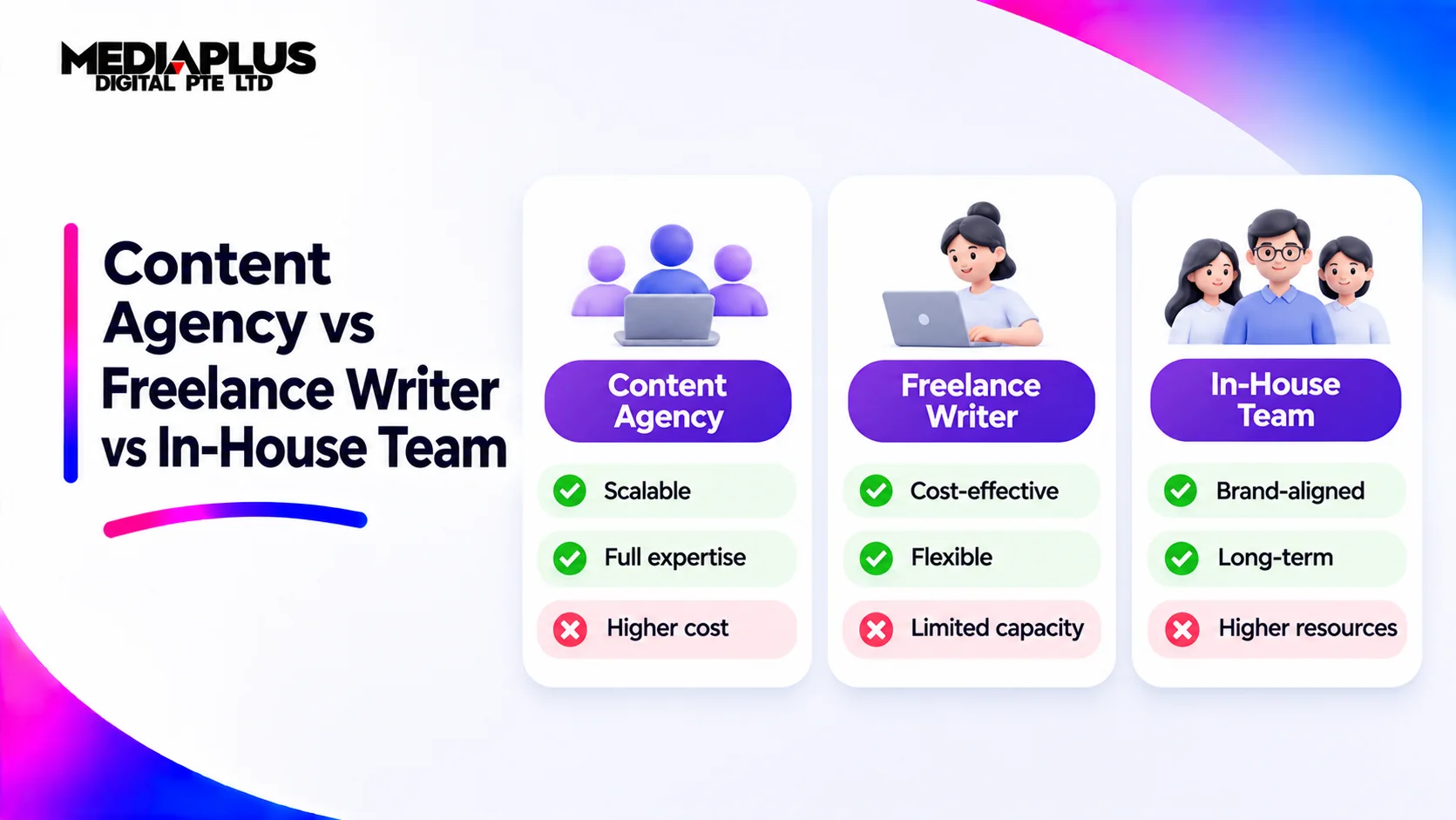
- Pick a freelance writer when you need a few pieces a month, you (or someone on your team) can handle the keyword plan and editing, and the topic isn’t regulated.
- Pick a content agency when you want strategy, SEO, writing, editing and publishing handled as one job, you need steady volume, or your content has to pass specialist or compliance review.
- Pick an in-house team when content is a core, daily part of how you sell, you publish enough to keep a full-time person busy, and you can afford a salary that MOM data puts at a median of S$6,669 a month for a content writer.
- Most growing SMEs end up hybrid: an in-house owner who knows the business, with an agency or freelancers doing the writing and SEO work.
Side-by-side comparison
| Factor | Freelance writer | Content agency | In-house team |
|---|---|---|---|
| How you pay | Per word, per article or per hour | Monthly retainer or project fee | Monthly salary plus CPF and overheads |
| Typical commitment | Per piece, cancel any time | 3 to 12 month contract, usually | Employment contract with notice period |
| Speed to first article | Days, if they’re free | One to three weeks (onboarding, strategy first) | One to three months (hiring and onboarding) |
| Knowledge of your business | Starts low, grows if you keep the same person | Starts low, captured in briefs and style guides | Highest, they sit with your sales team |
| SEO skill | Varies a lot by person | Usually built in (keyword research, mapping, on-page) | Depends on who you hire |
| Review process | Usually you are the editor | Editor plus specialist review built into the workflow | You design it yourself |
| Continuity if someone leaves | Low: one person, one point of failure | Higher: the team and documents stay | Low to medium: notice period, then a gap |
| Your management time | High | Low to medium | Medium (you manage a person) |
| Scales up quickly | Hard, one person has a capacity limit | Easier, the agency adds writers | Slow, you have to hire |
What each option really costs in Singapore
In-house: use MOM’s numbers, then add the extras
The Ministry of Manpower’s Occupational Wages 2025 survey (June 2025 data, full-time resident employees, published on data.gov.sg) lists these monthly gross wages, which exclude bonuses:
| Occupation (MOM title) | 25th percentile | Median | 75th percentile |
|---|---|---|---|
| Content writer | S$4,460 | S$6,669 | S$9,225 |
| Technical writer | S$4,750 | S$6,039 | S$7,424 |
| Digital marketing professional | S$4,165 | S$5,623 | S$7,754 |
| Marketing manager | S$6,773 | S$10,069 | S$15,600 |
A salary is not the full cost. Here is a worked example for one content writer at the median, aged 55 or below:
- Gross wage: S$6,669 a month.
- Employer CPF: 17% for employees aged 55 and below, on wages up to the Ordinary Wage ceiling of S$8,000 from 1 January 2026. That’s about S$1,134.
- Skills Development Levy: 0.25% of wages, capped at S$11.25 per employee a month.
- Monthly total before bonus: roughly S$7,814, or about S$93,800 a year.
- Then add: any annual wage supplement or bonus (excluded from MOM’s figures), SEO and writing tools, a laptop, leave cover, and the time you spend hiring and training.
One writer also can’t do everything. A content writer at the median is rarely also your keyword researcher, technical SEO and designer. If you need those skills in-house, you’re looking at a second hire, or at buying them from outside anyway.
Freelancer: compare quotes on the same unit
Freelance writers in Singapore quote per word, per article or per hour, and there’s no official rate survey we’d trust to give you a fair number. So instead of a benchmark, normalise every quote you get:
- Convert to cost per finished article at your normal length (say 1,500 words), including one round of revisions.
- Ask what’s included. Keyword research? Meta titles and descriptions? Uploading to WordPress? Images? Each one you have to do yourself is a cost.
- Add your own time. Briefing, editing, fact-checking and publishing often take two to four hours per article when the writer only writes. Price that at your hourly cost.
A cheap per-word rate can turn into the most expensive option once you count the owner’s evenings spent fixing drafts.
Agency: what the retainer should cover
An agency retainer usually bundles work you’d otherwise buy separately: a content strategy and keyword map, briefs, writing, editing, specialist review, on-page SEO, publishing and reporting. When you compare an agency quote with a freelancer’s, compare it with the freelancer plus the strategy, SEO and editing hours you’d be doing yourself. Ask every agency for a sample month of deliverables in writing, so you know exactly what a “content package” means.
How the three compare, factor by factor
Speed
A freelancer with free capacity can turn an article around in a few days. Agencies spend the first two or three weeks on onboarding, research and a content plan, then move faster than one person can once it’s running, because several writers can work in parallel. In-house is fastest day to day (no briefing back and forth) but slowest to start, since hiring in Singapore commonly takes weeks before the person’s first day, and they’ll still need a month to learn your products.
Subject expertise
This is where most outsourced content falls down. A generalist writer can make anything readable but can’t tell your buyer something new about, say, industrial adhesives or HDB renovation permits. Good options solve this differently:
- Freelancer: hire one who has written for your industry before, and ask for samples on similar topics.
- Agency: check they interview your staff and use specialist reviewers, not just writers. Ask who checks technical accuracy.
- In-house: expertise builds naturally because they sit beside your sales and operations people.
Google’s guidance on creating helpful, reliable content asks whether content shows first-hand experience and expertise. Our guide to E-E-A-T and topical authority explains how to show that on the page, whoever writes it.
SEO skill
Writing well and writing to rank are different skills. Content that ranks starts with a keyword map (one page per search intent, no two pages fighting for the same term), then internal links, headings and titles that match how people search. If your writer doesn’t do this, someone else has to. Our posts on keyword mapping and content clusters show what that planning involves. In 2026 it also means writing so that AI search tools can quote you, which we cover in how to get cited in AI Overviews.
Review process
Every piece should pass at least three checks before publishing: facts, brand voice and search basics. Regulated businesses need a fourth, the compliance sign-off. With a freelancer you usually do all of these yourself. An agency should run the first three and route the fourth to your compliance person. In-house, you have to design the process and make sure someone other than the writer reads every piece.
Continuity
A freelancer who gets a full-time job, or an in-house writer who resigns, takes your context with them. Protect yourself whichever option you pick: keep the keyword map, style guide, briefs and every source file in a shared drive you own, not in the writer’s personal account.
Management time
As a rough planning figure, a freelancer arrangement takes the most of your time because you’re the strategist and editor. An agency takes the least once it’s running, though you still need to approve plans and review drafts. In-house needs time for one-to-ones, goal setting and reviewing work, like any other employee.
PDPA and IP ownership
Two Singapore rules matter here.
Copyright. Under the Copyright Act 2021, the default is that the author of a written work owns the copyright, unless the work was made by an employee in the course of their employment, in which case the employer owns it. So in practice:
- In-house writer: you normally own what they write for you as part of their job.
- Freelancer or agency: without a written assignment, the writer (or the agency) may keep the copyright and you only get permission to use it. Put an assignment clause in the contract.
IPOS also notes that the Act gives creators a right to be identified as the author when their work is used publicly, even if they don’t own the copyright, unless they agree otherwise. If you publish ghost-written articles under your own name or a staff byline, get that agreement in writing too.
Personal data. If your writer gets access to customer data (testimonials, case study interviews, CRM exports, enquiry forms), they may be acting as your data intermediary under the PDPA. PDPC’s Guide to Managing Data Intermediaries makes clear that your organisation keeps responsibility for that data. The intermediary has to protect it, not keep it longer than needed, and tell you without undue delay if there’s a breach. PDPC also publishes a guide to data protection clauses you can adapt. For the website side, see our PDPA compliance checklist for websites.
Scoring table
Scores are out of 5 (5 = best for a typical Singapore SME). Weight the rows that matter most to you, then add up the columns.
| Factor | Freelance writer | Content agency | In-house team | Your weight (1 to 3) |
|---|---|---|---|---|
| Low monthly cost at small volume | 5 | 3 | 1 | |
| Cost per article at high volume | 3 | 3 | 4 | |
| Speed to start | 4 | 3 | 1 | |
| Subject expertise | 2 | 3 | 5 | |
| SEO skill | 2 | 5 | 3 | |
| Review and quality control | 2 | 4 | 3 | |
| Continuity | 1 | 4 | 3 | |
| Low management time for you | 1 | 4 | 3 | |
| Scaling up or down | 2 | 5 | 1 | |
| IP and PDPA paperwork | 2 | 4 | 5 |
How to use it: multiply each score by your weight and total each column. If two options finish close together, use the scenario table below to break the tie. Then test the winner on a 90-day trial with a small, defined scope (for example, a keyword map plus six articles) before you sign anything longer.
Which option fits your business: four scenarios
| Scenario | Usual best fit | Why | Watch out for |
|---|---|---|---|
| Startup or new SME, under 10 staff, 2 to 4 articles a month | Freelancer, with the founder owning the keyword plan | Lowest cost, no commitment, founder knows the product best | Founder time for briefing and editing. Build a style guide early |
| B2B industrial (equipment, engineering, supplies) | Agency with your engineers as reviewers, or hybrid | Technical topics need research and interviews, plus SEO across many product pages | Generic writers who can’t explain specs. Insist on a technical review step |
| Regulated clinic or law firm | Agency with a documented compliance step, or in-house with outside SEO help | Every claim needs checking against professional rules before it goes live | Anyone who publishes without your doctor’s or lawyer’s sign-off |
| Ecommerce store | Hybrid: in-house for product copy and promotions, agency or freelancers for category pages and guides | Product copy changes weekly, category and guide content needs SEO planning | Duplicate manufacturer descriptions. See our guide on writing product descriptions |
A note on B2B results. Content and SEO for industrial firms can pay back, but slowly and only with technical accuracy. For example, Atlas Technologies, an industrial equipment supplier, recorded a 108% increase in organic conversion events (1,367 to 2,850) comparing its last six months with the previous six, as described in our industrial equipment case study. That’s one client over one period, not a forecast.
For clinics and law firms, sector rules from bodies such as MOH and the Law Society shape what you can say. Whoever writes for you, the final sign-off should sit with your licensed professional or compliance team, not the writer.
The hybrid model
Most businesses past the startup stage end up mixing options. Three hybrids work well:
1. In-house owner, outsourced writing. A marketing executive or manager owns the content calendar, gathers input from sales and approves drafts. An agency or freelancers do research, writing and SEO. You keep the business knowledge inside and buy the specialist skills.
2. Agency for strategy and SEO, freelancers or staff for volume. The agency builds the keyword map, briefs and templates, and handles technical SEO. Your own team or cheaper writers fill the briefs. This suits ecommerce and businesses with lots of similar pages.
3. In-house team, agency for spikes and specialist work. Your team writes day to day. An agency handles a website relaunch, a content refresh of old posts, or content for AI search.
Whichever hybrid you pick, write down who owns each step. A simple version:
| Step | Who owns it |
|---|---|
| Content strategy and keyword map | Agency or in-house lead |
| Topic list and calendar | In-house lead (with input from sales) |
| Briefs | Agency or in-house lead |
| Writing | Freelancer, agency or in-house writer |
| Fact and specialist review | Your subject expert |
| Compliance sign-off (if regulated) | Your compliance team or licensed professional |
| SEO check and publishing | Agency or in-house |
| Reporting | Agency or in-house lead |
Our web design team made the same argument for websites in web design agency vs freelancer vs in-house and freelance web designer vs agency. The logic carries over to content, with one difference: content never “launches” and finishes, so continuity matters even more.
How to brief each option
The brief decides the quality more than who you hire. What goes into it changes with the option.
Briefing a freelancer
Give them everything, because they have no context. For each article:
- Target keyword and search intent: what the reader typed and what they want to find.
- The reader: job title, what they already know, what they’re worried about.
- Outline: required headings, questions to answer, the one thing they must take away.
- Your facts: prices, specs, process steps, case details, approved claims. Never let them guess.
- Sources allowed: official sources only for any number or rule.
- Internal links: the exact URLs to link and the anchor text.
- Style guide: UK or US spelling, tone, words to avoid, how to refer to your brand.
- Length, deadline and number of revision rounds.
- AI policy: whether AI tools are allowed and what must be checked by a human. Our AI content workflow shows a process that works.
Briefing an agency
Brief the business once, then let them write the article briefs. In the onboarding, cover:
- Your services, margins and which ones you want more of
- Your best customers and the questions they ask before buying
- Competitors you lose to and why
- Who internally reviews technical accuracy, and who signs off compliance
- Access to Google Search Console, Google Analytics and your CMS
- What success looks like at three, six and twelve months (enquiries, not just traffic)
Then ask the agency to show you their article brief template. If it doesn’t include search intent, internal links and a specialist review step, ask why.
Briefing an in-house writer
An in-house writer needs fewer per-article briefs and a better system:
- A documented keyword map and calendar they own
- A standing slot with sales each month to collect customer questions
- A publishing checklist (see our guide to blogging for SEO for the on-page basics)
- A named reviewer for every piece, so they’re never editing themselves
- A quarterly review of which pages bring enquiries, using the marketing plan template to set the next quarter’s goals
Contract clauses checklist
Before anyone writes a word, get these into writing. For freelancers, MOM and TAFEP’s Tripartite Standard on Contracting with Self-Employed Persons recommends agreeing key terms in writing upfront, including payment amounts, a payment schedule and how disputes are resolved. MOM also offers a free key terms template.
For freelancers and agencies:
- Scope: number of pieces, length, what’s included (research, keywords, meta data, images, upload)
- Fees and payment schedule: per piece or monthly, invoice dates, payment terms
- Revisions: how many rounds, and how fast
- Copyright assignment: all rights in the final work and drafts pass to you on payment
- Author identification: the writer agrees not to require a byline, if you publish under your own name
- Originality warranty: no copied text, no plagiarised images, no undisclosed reuse of work written for others
- AI use: whether AI tools are allowed, and that a human checks every fact
- Confidentiality: pricing, client names and unpublished plans stay private
- Personal data: data intermediary clauses for any customer data shared (protection, retention, return or deletion, breach notice to you without undue delay)
- Accounts and files: working files, keyword maps and briefs are stored in your shared drive; all tool and CMS logins are in your name
- Compliance sign-off: nothing is published without your approval (essential for clinics, law firms and financial services)
- Termination and handover: notice period, what’s handed over on exit, and payment for work in progress
- Dispute resolution: how disagreements are settled, such as mediation first
For agencies, add:
- Named account lead and writer(s), and notice if they change
- Reporting: what’s reported, how often, and on which metrics
- Minimum term and what happens at renewal
For in-house hires: your employment contract should confirm that work made in the course of employment belongs to the company, cover confidentiality, and require handover of files and logins when they leave.
Common mistakes
- Hiring a writer before you have a keyword plan. You’ll get well-written posts that compete with each other. Our post on duplicate content and keyword cannibalisation explains the fix.
- No specialist review. Readable but wrong content hurts trust faster than no content.
- Judging after one month. Content and SEO take months. Agree checkpoints at three and six months.
- Skipping the IP clause. Without it, you may not own the articles you paid for.
Frequently asked questions
Is a freelance content writer cheaper than a content agency?
Per article, usually yes. But a freelancer usually only writes. Once you add your time for keyword research, briefing, editing and publishing, the gap often shrinks. Compare a freelancer plus your hours against an agency’s full scope.
How much does it cost to hire a content writer in Singapore?
MOM’s Occupational Wages 2025 data puts the median gross monthly wage for a full-time content writer at S$6,669, with the middle half earning between S$4,460 and S$9,225 (bonuses excluded). Add employer CPF, the Skills Development Levy, tools and any bonus to get the full cost.
Who owns the copyright when a freelancer writes my blog?
By default under the Copyright Act 2021, the author owns the copyright in work they’re commissioned to write, unless the contract says otherwise. Get a written assignment of copyright to your company.
Can a content agency write for a regulated clinic or law firm?
Yes, if the workflow includes your licensed professional or compliance team signing off every piece before it’s published. The writer should never be the last check on a medical or legal claim.
Is AI-written content a cheaper fourth option?
It can help with first drafts, but someone still needs to plan, fact-check, add real expertise and edit. Google’s guidance on AI-generated content says it rewards helpful content however it’s produced, and treats content made mainly to manipulate rankings as spam. In practice, AI changes how a writer works, not whether you need one.
Want content handled as one job?
If you’d rather have strategy, writing, SEO and review run by one team, our content marketing services cover content strategy, website page copy, SEO articles, content refreshes, case studies and content for AI search. Every piece goes through specialist review before publishing, and for regulated industries your compliance team signs off. We work alongside in-house teams too, and pair content with our SEO services or ecommerce SEO where it makes sense.
Not sure which model suits you? Talk to us. As a content marketing agency in Singapore that often works next to freelancers and in-house writers, we’ll tell you if you don’t need us.