
Quick answer
Web design decides what a website looks like and how it feels to use. Web development turns that decision into a working site that loads, responds and connects to everything behind it.
A designer hands over screens, a style guide and prototypes. A developer hands over code, a CMS and a live site. Most business websites need both, and the handover between them is where projects usually go wrong.
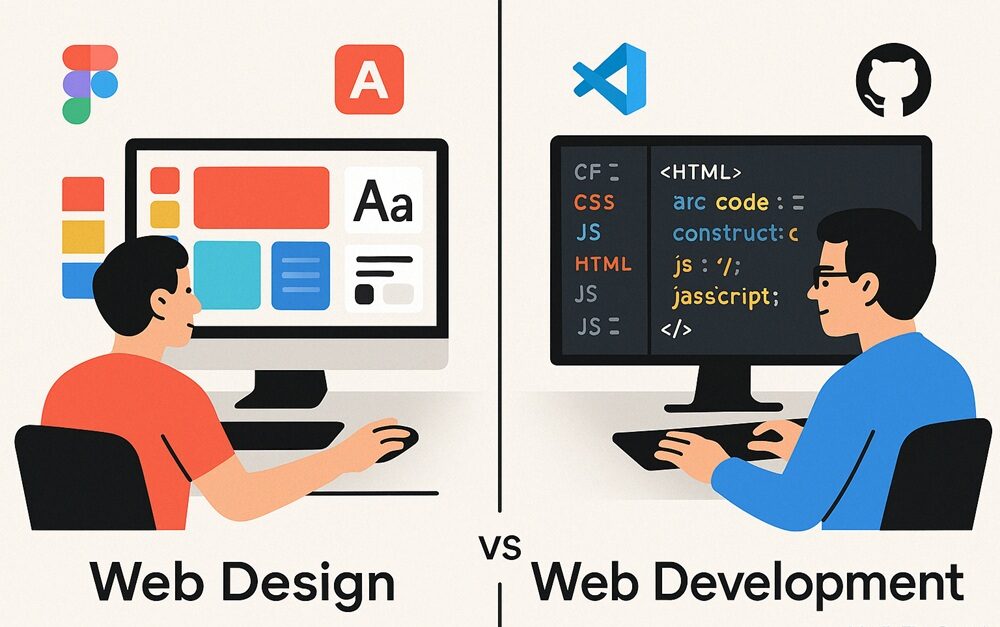
Web design vs web development at a glance
|
Web design |
Web development |
|
|
Main question |
Will people understand this and act on it? |
Will this work correctly for everyone, on every device? |
|
Typical output |
Wireframes, UI screens, design system, clickable prototype |
HTML, CSS, JavaScript, back end, CMS, integrations |
|
Core skills |
Layout, typography, colour, UX research, information architecture |
Programming, databases, APIs, hosting, security, performance |
|
Common tools |
Figma, Adobe XD, Sketch, Maze, Hotjar |
VS Code, Git, WordPress, Shopify, Laravel, React, Node |
|
Measured by |
Task completion, bounce, scroll depth, conversion rate |
Load speed, Core Web Vitals, uptime, error rate, accessibility |
|
Fails look like |
A pretty site nobody knows how to buy from |
A functional site that people abandon in five seconds |
|
Where it sits |
Before and during the build |
During and after the build |
Read the standalone explainers if you want more depth on either side: what is web design and what is web development.
What web design actually covers
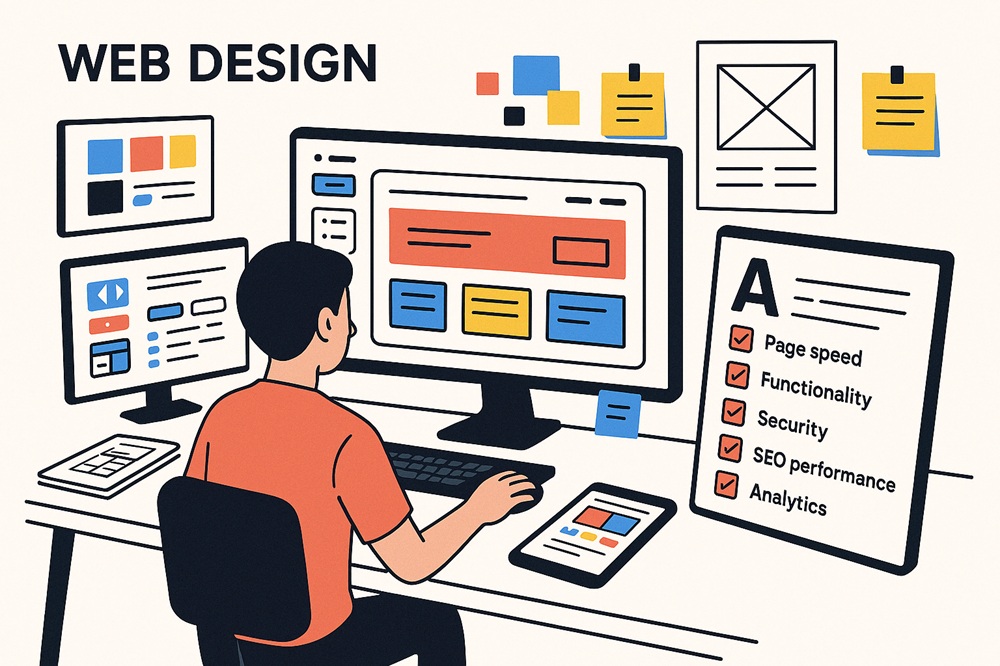
Design is not the decoration stage. By the time anyone picks a colour, most of the decisions that affect revenue have already been made: what goes on the homepage, how many steps the enquiry form has, what a first-time visitor sees in the first screenful.
A web designer normally owns:
- Information architecture. The page list, the menu structure, what lives under what. This is what makes a 60 page corporate site navigable.
- Wireframes. Grey-box layouts that settle content order before visual style enters the discussion. See our guide to wireframing.
- UI design. The actual screens: type scale, spacing, buttons, forms, states for hover, error, empty and loading.
- A design system. Reusable components and tokens so page 40 still looks like page 1 and your marketing team can build new pages without breaking the look.
- Responsive behaviour. How each layout reflows on a 390px phone, a tablet and a 27 inch monitor. Not “shrink it”.
- Prototypes and testing. A clickable file, put in front of five real users, tends to expose more problems than three rounds of internal review.
Designers do touch metrics. Scroll depth, form drop-off and heatmaps belong to design, not to the developer.
UI and UX are not the same thing. UX is the reasoning about flow and friction. UI is the surface people touch. Our breakdown is here: UI vs UX.
What web development actually covers
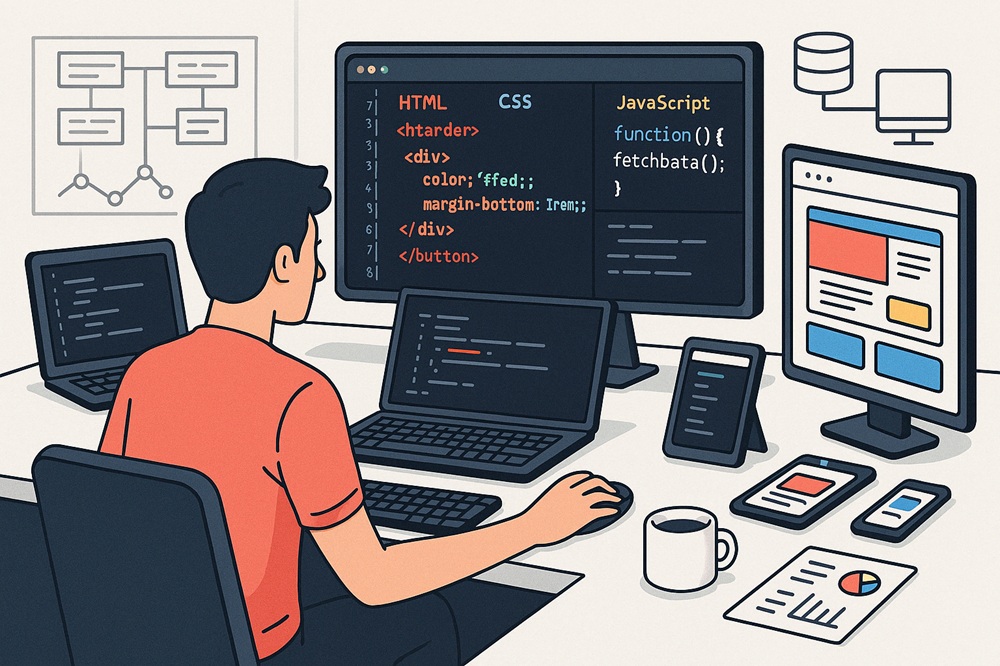
Development is where the design becomes something a browser can run and your team can update.
Front end. HTML, CSS and JavaScript. The front-end developer is responsible for the design surviving contact with reality: real content lengths, 4G connections, older Android phones, screen readers, and the 12 different states a form can be in.
Back end. Databases, server logic, authentication, payments, stock, CRM and email platform connections. This is where an ecommerce site stops being a brochure.
CMS work. Setting up WordPress, Shopify or a headless stack so that non-technical staff can publish without a developer. Badly done, this is why some companies still email their agency to change a phone number.
Performance, security and accessibility. Image formats and lazy loading, caching, Core Web Vitals, SSL, hardening and updates, WCAG basics like keyboard navigation and colour contrast. Our website speed optimisation guide covers the performance half.
Deployment and maintenance. Staging environments, launch checks, backups, plugin and framework updates. A site is not finished at launch, which is why website maintenance is a separate line item.
Six real differences
1. Different deliverables, not different opinions about beauty
The clearest way to separate the two roles is to ask what lands in your hands at the end. Design ends with files you can review in a browser preview. Development ends with a URL, a repository and a login. If a quotation promises “a website” but only lists Figma files, you have bought design, not a website.
2. Different definition of “done”
A design is done when the flows are agreed and every state is drawn. Development is done when the site passes testing across browsers and devices, forms submit into the right inbox, tracking fires, and the CMS is documented. The second list is longer and it is where timelines usually slip.
3. Different skills, with a narrow overlap
Some designers write HTML and CSS. Some developers have a good eye. In practice the overlap is thin: design thinking is about people and priority, development is about systems and edge cases. Hiring one person for both works for a five page site and starts to hurt anywhere past that.
4. Development usually costs more, but not always
Development typically consumes more hours because it carries integrations, testing and maintenance. The exception is a content-heavy marketing site built on an existing template, where research, copy structure and design account for most of the budget and the build is close to configuration. We break the numbers down in web design cost in Singapore and website development cost in Singapore.
5. They are measured with different tools
Design is judged with Hotjar, Clarity, GA4 and user testing. Development is judged with PageSpeed Insights, Search Console, Lighthouse and uptime monitoring. When a site underperforms, checking both sets of numbers tells you which side to fix. High traffic with low conversion points at design. Good rankings with slow pages and crawl errors points at development.
6. The consequences of skipping each are different
Skip design and you get a site that works but sells nothing, plus a long tail of “can we move this button” requests. Skip proper development and you get a beautiful site that loads in six seconds, breaks on Safari, and cannot be edited without paying someone.
Where design and development overlap
- Responsive rules. A designer decides what should stack at 768px. A developer decides how. Both need to be in the same conversation. See responsive web design.
- Performance. A 4MB hero image is a design decision with a development consequence.
- Accessibility. Contrast, focus order and touch target sizes start in design and are enforced in code.
- SEO. Heading hierarchy, internal links and content layout are shared ground with technical implementation. Our guide to SEO friendly web design covers what each side owns.
- Content. Both roles suffer when copy arrives after the layout. Real content should exist before the design is signed off.
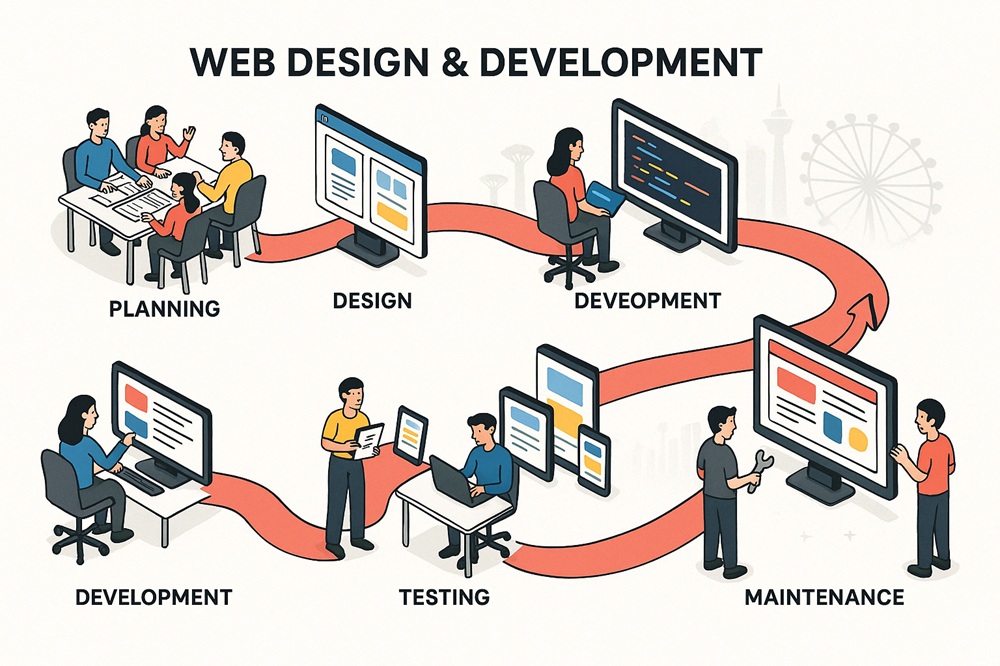
Who does what, phase by phase
|
Phase |
Owner |
What is produced |
What you approve |
|
Discovery |
Strategy plus design |
Goals, audience, competitor review, sitemap |
The page list and primary actions |
|
Content structure |
Design plus client |
Page outlines, copy deck |
Message order per page |
|
Wireframes |
Design |
Grey-box layouts, mobile and desktop |
Layout logic before visuals |
|
UI design |
Design |
Key screens, design system |
Look and feel, component set |
|
Prototype and test |
Design |
Clickable prototype, findings |
Fixes before build starts |
|
Front-end build |
Development |
Coded, responsive pages |
Cross-device review |
|
Back end and CMS |
Development |
CMS, forms, integrations, payments |
Editing workflow, data flows |
|
QA |
Development |
Browser, device, form and speed tests |
Bug list closed |
|
Launch |
Development |
DNS, SSL, redirects, tracking, sitemap |
Go-live checklist, see our website launch checklist |
|
Post-launch |
Both |
Analytics review, iteration, maintenance |
30 and 90 day reviews |
The highest risk moment is between “UI design” and “front-end build”. Ask for a design handover that includes spacing rules, component states, font files and image assets. Without it, developers improvise, and the site drifts from what you approved.
Hiring in Singapore: designer, developer, agency or builder
|
Option |
Works when |
Watch out for |
|
Freelance designer |
You have a developer already, or you are buying a template refresh |
You still need someone to build and maintain it |
|
Freelance developer |
The design exists and is well documented |
No one owns UX decisions |
|
Website builder (Wix, Squarespace, Shopify themes) |
Small brochure site or a first store, speed over uniqueness |
Template limits, harder to scale, migration cost later |
|
Agency |
You need design, build, SEO and maintenance to line up |
Ask who actually does the work, and what happens after launch |
|
In-house team |
You ship changes weekly and have the volume to justify salaries |
Hiring and retention cost, coverage when someone leaves |
We compare the options in more detail in web design agency vs freelancer vs in-house team.
On salary, our own Singapore web development careers and salaries report found monthly web developer pay clustering between S$3,000 and S$5,100 on Indeed and Glassdoor 2025 data, with NodeFlair and Morgan McKinley data pointing to a S$6,750 average and a S$3,500 to S$10,000 range. Junior roles sit around S$3,000 to S$4,500 and senior roles run past S$12,000. That range is the reason an in-house pair of designer and developer rarely costs less than an agency retainer until you are publishing constantly.
PSG funding. Singapore SMEs can claim up to 50% support under the Productivity Solutions Grant for pre-approved website and ecommerce solutions, capped at S$30,000 per company per financial year. Apply and wait for the Letter of Offer before you commit to a vendor. Details on our PSG web development grant page, and confirm current terms on the GoBusiness portal.
What drives the price on either side
Cost questions are usually answered with a range that means nothing. These are the variables that actually move the number:
Design side – Number of unique page templates, not number of pages – Whether a design system is built or a theme is adapted – Research and user testing rounds – Brand work: does a visual identity exist – Revision rounds written into the contract
Development side – Custom build versus theme configuration – Integrations: payment, CRM, ERP, booking, stock, membership – Multi-language or multi-currency – Data migration and redirect mapping from an old site – Performance and accessibility targets – Ongoing maintenance and hosting
Ask any quotation to split these two columns. If a vendor cannot tell you which hours are design and which are development, they have not scoped the project.
How to tell which one your site needs
Answer these before you brief anyone:
- Do people land and leave without scrolling? Design problem.
- Do they scroll, read, then never fill the form? Design and copy problem.
- Does the site take more than three seconds on mobile data? Development problem.
- Do you need to email someone to change a price? Development problem, specifically CMS setup.
- Does it look fine on your laptop and break on a phone? Both, usually a missing responsive spec.
- Is traffic flat despite good content? Start with a technical website audit.
- Are you adding online payments, bookings or a members area? Development led, with design support.
A website redesign that fixes only one column tends to disappoint. Sites that convert were designed and built by people who talked to each other.
Frequently asked questions
Is web design the same as web development?
No. Design decides structure, layout and interaction. Development builds it in code and connects it to the systems behind it. A full website project needs both.
Which comes first, design or development?
Design, in almost all cases. Discovery and wireframes settle what the site must do. Development starts once screens and states are approved. Exceptions exist when you are replatforming and the design stays as it is.
Can one person do both?
For a small site, yes. Past roughly ten templates, or once integrations appear, a single person becomes the bottleneck and quality drops on whichever side is their weaker skill. See software engineer vs web developer for how the technical titles differ.
Which costs more in Singapore?
Development usually, because it absorbs integrations, testing and maintenance. On template-based marketing sites, design and content can be the larger half. Compare the ranges in our web design cost and website development cost guides.
How long does each phase take?
On a typical SME corporate site, discovery and design run about three to six weeks, build and QA about four to eight weeks, depending on how fast content and feedback arrive. Content is the most common cause of delay, not code.
Do I need a designer if I use a website builder?
You need design decisions either way. A builder gives you a template that someone else designed for a different business. Someone still has to choose the page order, write the calls to action and decide what is removed.
What about “web design and development” as one service?
That is how most agencies sell it, including us. It is a fair description as long as the scope document still separates design deliverables from development deliverables, with different sign-off points.
Where does SEO fit?
Both. Site structure, URL planning and content layout are design-time decisions. Speed, crawlability, schema and redirects are development-time. Leaving SEO until after launch is how sites lose rankings during a redesign. See our SEO safe website redesign guide.
Getting both sides in one team
MediaPlus Digital has spent 13 years building sites in Singapore, with a team of 60 and more than 1,800 projects delivered, rated 4.9 out of 5 on Google. Designers and developers sit on the same project from discovery, which removes the handover gap that causes most rework.
If you are planning a new site or fixing one that looks right but does not perform, see our web design services in Singapore or ask for a scoped quotation that separates design and development line by line.




