
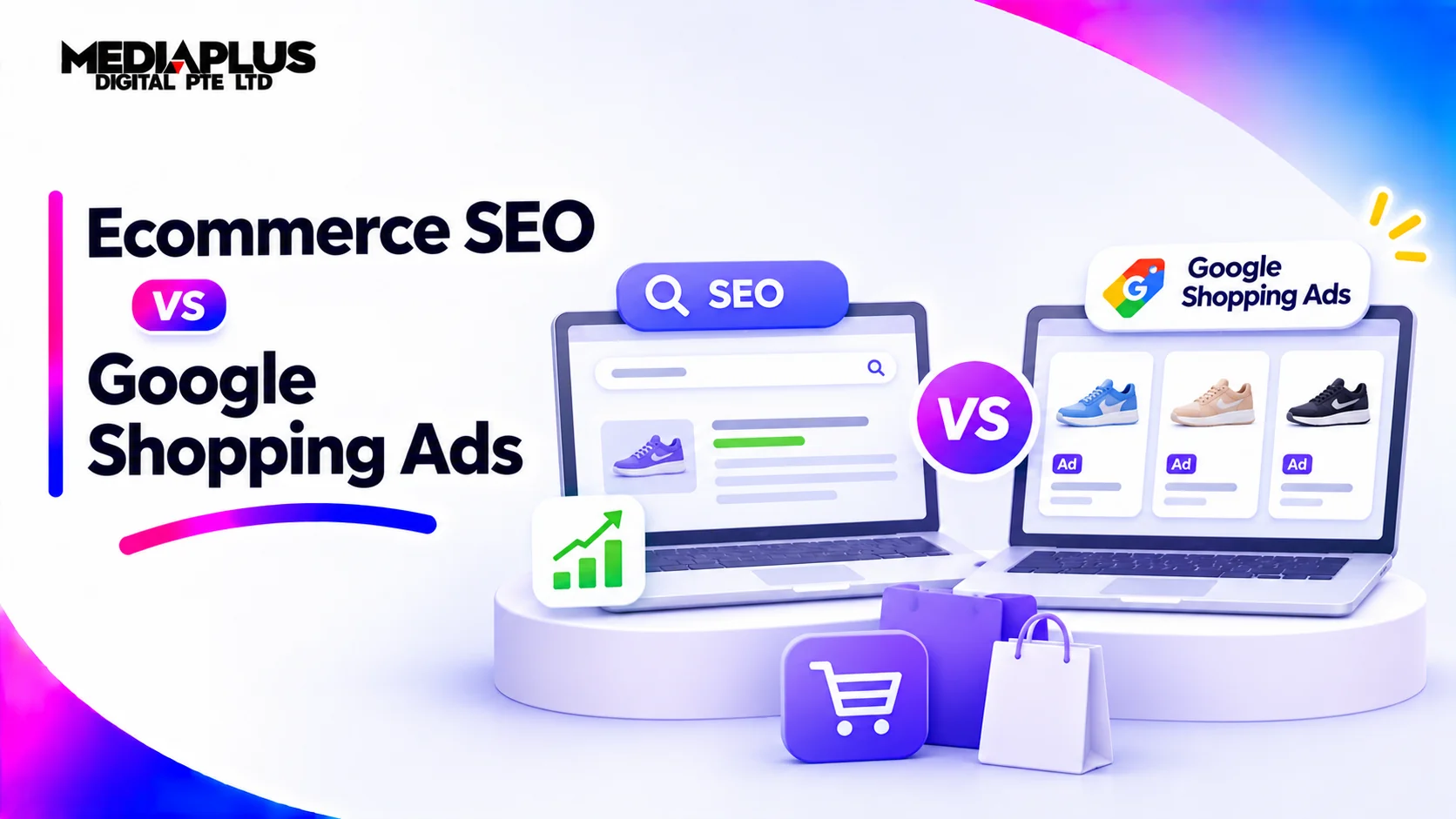
If you run an online store in Singapore, someone has probably told you to “do SEO” and someone else has told you to “just run Shopping ads”. Both are right some of the time. Which one gets your next dollar depends on your margins, your catalogue and how long your cash flow can wait.
We already have general comparisons of SEO vs SEM and SEO vs PPC, so this piece skips the definitions. It focuses on product and category searches, where Shopping ads, free product listings and organic results all compete on the same screen.
The short answer
- Start with Shopping ads if you have a new store, a product with healthy margin, a seasonal window or stock to clear. Ads can bring sales within days of your feed being approved. SEO usually can’t.
- Start with SEO if your margin per order is thin, people search for your category by name, you sell repeat-purchase items, or your CPCs already eat most of your profit.
- Do one thing first either way: set up Google Merchant Center with a clean product feed. In Singapore that one feed powers free listings on the Shopping tab and your Shopping ads.
- Check the maths before you spend. For our example S$60 product, the break-even cost per click is about S$0.54 at a 2% conversion rate. Above that, every sale loses money.
- Most stores end up running both, with ads covering the months SEO needs to build, then a shift in spend as organic category pages start to rank.
What a product search in Singapore looks like in 2026
Search “running shoes women” or “air purifier for bedroom” in Singapore and you’ll usually see several result types on one page, some paid and some earned.
| Result type | Paid or free? | What feeds it | What you control |
|---|---|---|---|
| Shopping ads (product image, price, store name, marked “Sponsored”) | Paid per click | Merchant Center feed + Google Ads campaign | Bids, budget, which products are in the campaign |
| Text search ads | Paid per click | Google Ads keywords or AI Max / Performance Max | Ad copy, keywords, landing page |
| Free product listings (Shopping tab, product results on Search, Google Images) | Free | Merchant Center feed and/or product structured data on your site | Feed quality, price, stock, reviews |
| Organic results (category and product pages, buying guides) | Free | Your website pages | Content, site structure, links |
| AI Overviews and AI Mode answers | Free | Google’s AI, citing web pages | Only indirectly, through useful pages Google trusts |
A few facts worth knowing:
- Singapore is a supported country for Shopping ads and free listings, with prices in SGD. Google’s Merchant Center country list marks Singapore with the note that “the Shopping tab is available to users in this country”.
- Free listings are wider than the Shopping tab. Google’s free listings help page says your products “can appear at no cost on Google Search, Google Maps, Gemini, YouTube”, plus Google Images and Lens. Some surfaces are limited to certain countries.
- AI Overviews and AI Mode are live in Singapore in English. Google launched AI Mode in Singapore in August 2025. For broad research queries (“best air purifier for allergies”), the AI answer often sits above the organic links, which pushes classic product pages further down. Our guide to getting cited in AI Overviews covers how pages earn those citations.
So on a product search, paid and free results sit side by side. A store with a good feed, a strong category page and a Shopping campaign can appear three times on one screen.
What each channel needs before it works
Both channels need setup work, and some of it overlaps.
Google Shopping ads
- Google Merchant Center account with your site verified, shipping and returns set up, and a product feed synced from your store. Our Merchant Center setup guide has the step-by-step version.
- Prices in SGD including GST. Google requires prices outside the US and Canada to include VAT or GST, so a S$60 product with GST shows as S$60, not S$55.05.
- A linked Google Ads account with conversion tracking that passes the order value, so you can judge return on ad spend.
- A campaign type. Google’s Shopping ads help page lists two ways to run them in 2026:
- Standard Shopping: you choose which products to bid on and see search terms. You can add negative keywords. Since April 2026, Google also offers AI Max for Shopping campaigns as a beta upgrade that matches longer, conversational searches.
- Performance Max: one campaign that uses your feed across Search, Shopping, YouTube, Display, Gmail and more, with Google automating most placements. Read what Performance Max is and our notes on Performance Max and AI Max before choosing.
If you run both types on the same products, Google’s help page on how Performance Max interacts with other campaigns says they now compete on Ad Rank. Performance Max no longer wins automatically, which changed from October 2024.
Ecommerce SEO
- Category pages that match how people search. “Women’s running shoes” deserves its own indexable page with a short intro, filters that don’t create thousands of duplicate URLs, and internal links. Our upcoming guide to category page SEO goes into the layout.
- Product pages with unique descriptions, specs, photos and reviews. The product page SEO checklist covers the details.
- Product structured data (Product, Offer, shipping and return details) so your products are eligible for merchant listings in organic results even without a feed. See our guide to product structured data.
- Technical health and supporting content: fast pages, clean crawl paths, plus buying guides for research queries. The ecommerce SEO audit checklist finds the gaps.
For the basics, read what is ecommerce SEO and ecommerce SEO vs traditional SEO.
Cost structure and timeline side by side
| Google Shopping ads | Ecommerce SEO | |
|---|---|---|
| How you pay | Per click, every click, for as long as you run ads | Mostly fixed: content, development and agency or staff time |
| Minimum to start | No Google minimum budget, but you need enough clicks to learn (see the maths below) | Time and budget to fix the site and build category content |
| When sales can start | Within days of feed approval and campaign launch | Usually months for competitive category terms. New domains take longer |
| What happens when you stop | Traffic stops the same day | Rankings fade slowly, if at all, for a while |
| Cost per extra order over time | Stays roughly flat or rises with competition and CPC inflation | Falls as more pages rank and traffic grows on the same fixed spend |
| Main risk | Paying for clicks that don’t make a profit | Spending for months on terms that never rank or don’t convert |
Neither column is “cheaper”. Ads pay back faster. SEO costs more before the first sale but gets cheaper per order as it compounds. Your cash position decides how long you can carry that upfront cost.
The margin maths: a worked example for a S$60 product
If a Shopping click costs more than the profit it brings, more ad spend just loses money faster. So start here.
Assumptions (illustrative, not market data):
| Item | Value | Note |
|---|---|---|
| Selling price | S$60.00 | Including 9% GST, as Google requires in the feed |
| Price excluding GST | S$55.05 | S$60 ÷ 1.09. The GST isn’t your money |
| Landed product cost | S$22.00 | Supplier price plus inbound freight |
| Payment fees, packaging, shipping subsidy | S$6.00 | Varies by payment provider and courier |
| Contribution per order | S$27.05 | S$55.05 − S$22 − S$6, about 49% of the ex-GST price |
| Conversion rate from Shopping clicks | 2.0% | 1 order per 50 clicks |
Step 1: break-even cost per acquisition (CPA). If an order brings S$27.05 of contribution, you can pay up to S$27.05 in ad spend per order before you lose money.
Step 2: break-even cost per click. Multiply break-even CPA by conversion rate: S$27.05 × 0.02 = S$0.54 per click. Pay more than that on average and each sale costs more than it earns.
Step 3: break-even ROAS. Google Ads usually reports ROAS on the order value you send it, which for most stores is the GST-inclusive S$60. Break-even ROAS = S$60 ÷ S$27.05 = 2.22, or 222%. If you set a target ROAS lower than this, you are telling Google it’s fine to lose money on every order. Our explainer on what ROAS is covers the formula in more detail.
Step 4: add the profit you actually want. Say you want S$8 profit per order after ads. Your maximum CPA drops to S$19.05, maximum CPC to S$0.38, and target ROAS rises to S$60 ÷ S$19.05 = 3.15 (315%).
Conversion rate moves the answer more than anything else. Here is the same product at different conversion rates:
| Conversion rate | Break-even CPC | Max CPC for S$8 profit per order |
|---|---|---|
| 1.0% | S$0.27 | S$0.19 |
| 1.5% | S$0.41 | S$0.29 |
| 2.0% | S$0.54 | S$0.38 |
| 3.0% | S$0.81 | S$0.57 |
With your own numbers: use real contribution per order (fees and shipping included), then get actual CPCs from a two-week test campaign. If actual CPC is well under break-even, Shopping ads are a sensible first spend. If it’s close to or above, fix the economics first (bundles to raise order value, better conversion rate, cheaper fulfilment) or put the money into SEO.
The simple maths leaves out two things. Bigger baskets raise contribution per order, and repeat buyers add profit without another click. Some stores accept break-even on the first order for that reason, but only with data showing people actually come back.
The SEO side has its own break-even. If you put S$2,000 a month (an illustrative figure) into SEO, you need about 74 extra organic orders a month at S$27.05 contribution to cover it. That won’t happen in month two. It might by month nine or twelve, and the orders keep coming after the work that produced them is paid for.
When Shopping ads should come first
- New store, no organic traffic. You need sales and data now, and ads show which products deserve SEO effort later.
- High margin per order. Premium skincare, furniture, specialist equipment: if contribution per order is S$80, a S$1.20 click is affordable even at a 2% conversion rate.
- Seasonal windows. Chinese New Year hampers, mooncakes, 11.11, Black Friday, Christmas gifting. SEO started in October won’t help you in November. Ads can.
- Clearance and launches. You want to move specific stock or test a new product quickly, then switch the budget off.
- Page one is full of marketplaces and big retailers. Ads get you on the page while SEO works on longer-tail terms.
When SEO should come first
- Thin margins. If the break-even CPC for your product is S$0.20 and the market CPC is S$0.60, ads lose money on every sale. Organic traffic is the only scalable route.
- Category demand. People search “linen bedsheets singapore” or “standing desk” far more than single SKUs. One good category page can rank for dozens of these terms. Ads charge for every click.
- Research-heavy purchases. Buyers of air purifiers or baby car seats read guides first. Content that answers them earns organic and AI Overview visibility.
- Repeat-purchase products such as pet food, coffee beans or skincare refills. A customer who comes back directly costs nothing on the second order.
- Large catalogues. Thousands of SKUs are hard to bid on well. Good templates scale across the whole catalogue.
How the two channels help each other
One product data source feeds both. Your Merchant Center feed drives Shopping ads and free listings. Your product structured data drives merchant listings in organic results. Both should come from the same product database, with matching titles, prices, GTINs and stock. When they disagree, Google may flag the mismatch, and shoppers lose trust.
Feed optimisation improves paid and free at the same time. A better product title (“Linen bedsheet set, queen, sage green, 100% French linen” instead of “Sage Set Q”) lifts click-through rate on Shopping ads and helps the same product appear in free listings for more searches. Our Google Shopping optimisation guide covers titles, images and attributes in depth.
Search terms data tells SEO what to build. Standard Shopping campaigns show you the exact searches that triggered your ads. Performance Max now has a search terms report too. Look for:
- Search terms with good conversion rates but no matching category page on your site. Build that page.
- Question searches (“which air purifier for 40 sqm room”). These belong in a buying guide.
- Searches that convert badly. Add them as negatives and skip them in SEO too.
SEO pages make ads cheaper. Product pages that load fast and show prices, delivery times and reviews convert better, which lowers your real cost per order. See how to improve your ecommerce website sales.
Spend can shift as organic grows. When a category page holds a top-three ranking, test lower Shopping bids on that query group. If total orders hold, move the budget elsewhere.
Decision table by store stage and catalogue size
Use this as a starting point. Your margin maths overrides it.
| Store situation | Catalogue size | Lead with | Why | Keep doing alongside |
|---|---|---|---|---|
| New store, under 6 months | Under 100 SKUs | Shopping ads (Standard Shopping on best sellers) | Need sales and product data fast | Merchant Center free listings, basic category pages |
| New store | 100 to 2,000 SKUs | Shopping ads on top 20% of products, SEO on top categories | Too many SKUs to bid on all at once | Feed clean-up, category templates |
| Established, steady sales | Under 100 SKUs | SEO on category and buying-guide content | Ads already cover the core. Organic lowers cost per order | Shopping on best sellers and seasonal ranges |
| Established | 2,000+ SKUs | SEO (templates, internal linking, structured data) | Scales across the catalogue | Performance Max or Standard Shopping with clear product groups |
| Thin margin (contribution under S$10 per order) | Any | SEO | Break-even CPC is too low for most categories | Free listings, ads only for high-margin bundles |
| High margin (contribution S$60+ per order) | Any | Shopping ads, scaled carefully | Ads can stay profitable at higher CPCs | SEO for category terms and research content |
| Seasonal business | Any | Shopping ads in season, SEO in the months before | Ads catch the peak. SEO pages need lead time | Evergreen gift guides updated every year |
A 6-month budget split example
This example is illustrative only. It assumes a new store with about 150 products, average contribution of around S$27 per order, and S$4,000 a month to spend across SEO and Shopping ads. It does not reflect MediaPlus pricing or a promised result.
| Month | Shopping ads | SEO | What happens |
|---|---|---|---|
| 1 | S$2,800 (70%) | S$1,200 (30%) | Merchant Center and feed clean-up, conversion tracking, Standard Shopping on top 30 products. SEO: technical audit, fix category structure |
| 2 | S$2,800 (70%) | S$1,200 (30%) | Cut products that spend without selling. SEO: rewrite top 5 category pages using search terms data |
| 3 | S$2,600 (65%) | S$1,400 (35%) | Test Performance Max or AI Max on best performers if conversion data is steady. SEO: product page templates, structured data |
| 4 | S$2,400 (60%) | S$1,600 (40%) | Raise bids only where ROAS beats your target. SEO: first buying guides from question-type search terms |
| 5 | S$2,200 (55%) | S$1,800 (45%) | Review Search Console: which category pages gain impressions? SEO: internal links to them |
| 6 | S$2,000 to S$2,400 | S$1,600 to S$2,000 | Decide the next six months from data: profitable ads keep their budget, categories ranking on page one get less paid support |
Watch the direction, not the exact percentages. Ads carry the store early where the maths works, and SEO takes a growing share as it starts producing orders. If ads never reach target ROAS by month three, shift budget to SEO and conversion fixes sooner.
Considering grants? Our EDGE grant guide explains what the scheme covers.
How to measure both fairly
Don’t judge ads in Google Ads and SEO in Search Console with no shared view of orders. Compare both on contribution per order.
| Tool | What it shows | What to check monthly |
|---|---|---|
| GA4 | Orders and revenue by channel | “Paid Shopping” and “Organic Shopping” versus “Organic Search”. GA4’s default channel definitions put Google Ads Shopping campaign traffic in Paid Shopping and traffic with the source platform “Shopping Free Listings” in Organic Shopping |
| Google Ads | Cost, clicks, conversions, conversion value, search terms | ROAS against your break-even (222% in our example), cost per order by product |
| Merchant Center | Free listing and ad performance by product, disapprovals, price competitiveness | Clicks from free listings, products with errors, products priced above competitors |
| Google Search Console | Organic queries, pages, clicks, merchant listing appearances | Impressions and clicks for category pages, and the “Merchant listings” search appearance filter |
Setup checklist:
- GA4 ecommerce events (view_item, add_to_cart, begin_checkout, purchase) with order value excluding or including GST, but the same choice everywhere. Our GA4 setup guide walks through it.
- Google Ads conversion tracking passing transaction value, with Merchant Center linked.
- Search Console verified for the whole domain.
- A monthly sheet with orders, contribution and spend by channel, so you can compare cost per order. Give free listings (Organic Shopping) their own line, because many stores never notice the orders their feed already brings.
Common mistakes
- Not knowing break-even ROAS. “300% ROAS” can still be a loss for a low-margin store.
- Leaving GST in the ROAS maths. If you send GST-inclusive order values to Google Ads, set targets on that basis, as in our example.
- One Performance Max campaign for the whole catalogue. Low- and high-margin products get the same target. Group by margin first.
- Letting the feed and website disagree. Different prices or stock between the feed and the product page lead to disapprovals and lost sales.
- Judging SEO after six weeks. Judge new category pages on impressions and positions first, then orders.
Frequently asked questions
Is SEO or Google Shopping better for a new online store in Singapore?
For most new stores, Shopping ads come first because they bring sales and data within days. Start basic SEO at the same time so organic traffic builds while ads pay the bills. With very thin margins, the order flips.
Are Google Shopping listings free in Singapore?
Some are. Free listings on the Shopping tab and other Google surfaces cost nothing once your Merchant Center feed is approved. The “Sponsored” Shopping ads at the top of search results are paid per click through Google Ads.
What ROAS do I need for Google Shopping to be profitable?
It depends on your margin. Break-even ROAS is order value divided by contribution per order. In our S$60 example it’s 222%. A store with higher margins can break even at a lower ROAS, and a thin-margin store needs a much higher one.
Should I use Performance Max or Standard Shopping?
Standard Shopping gives more control and clearer search term data, which suits new stores and tight budgets. Performance Max reaches more Google surfaces and works better with steady conversion data. Many stores start with Standard Shopping and test Performance Max later.
How long does ecommerce SEO take to bring sales?
It depends on competition and your domain’s history. Fixes to an existing site can show within weeks. New category pages up against large retailers usually take several months. Watch impressions and positions in Search Console before orders appear.
Get help with both channels
If you want a second opinion on your numbers, our ecommerce SEO team works on category pages, product templates and structured data, and our Google Shopping ads team handles feeds, Standard Shopping and Performance Max. We can look at both from one set of product data. Contact us with your margin per order and current ad spend, and we’ll tell you which one we’d fund first.