Most articles on this topic are written by domain registrars selling .sg extensions, which means the answer is always “use .sg”. That is partly true and partly self-serving. The real answer depends on what you sell, where else you sell it, how mature your brand is, and how much SEO ground you have already built.
This piece is the write-up of an observational study we ran across 24 Singapore client websites, tracked from January 2025 to March 2026, comparing performance across .com, .com.sg and .sg domains. It follows a journal-style format: hypothesis, method, results, findings and recommendations. We have also added the practical questions the results always raise: who is allowed to register each domain, how Google actually uses a domain extension, and what to do if you are thinking of switching. For context on the SEO programme behind the data, see our SEO services in Singapore.
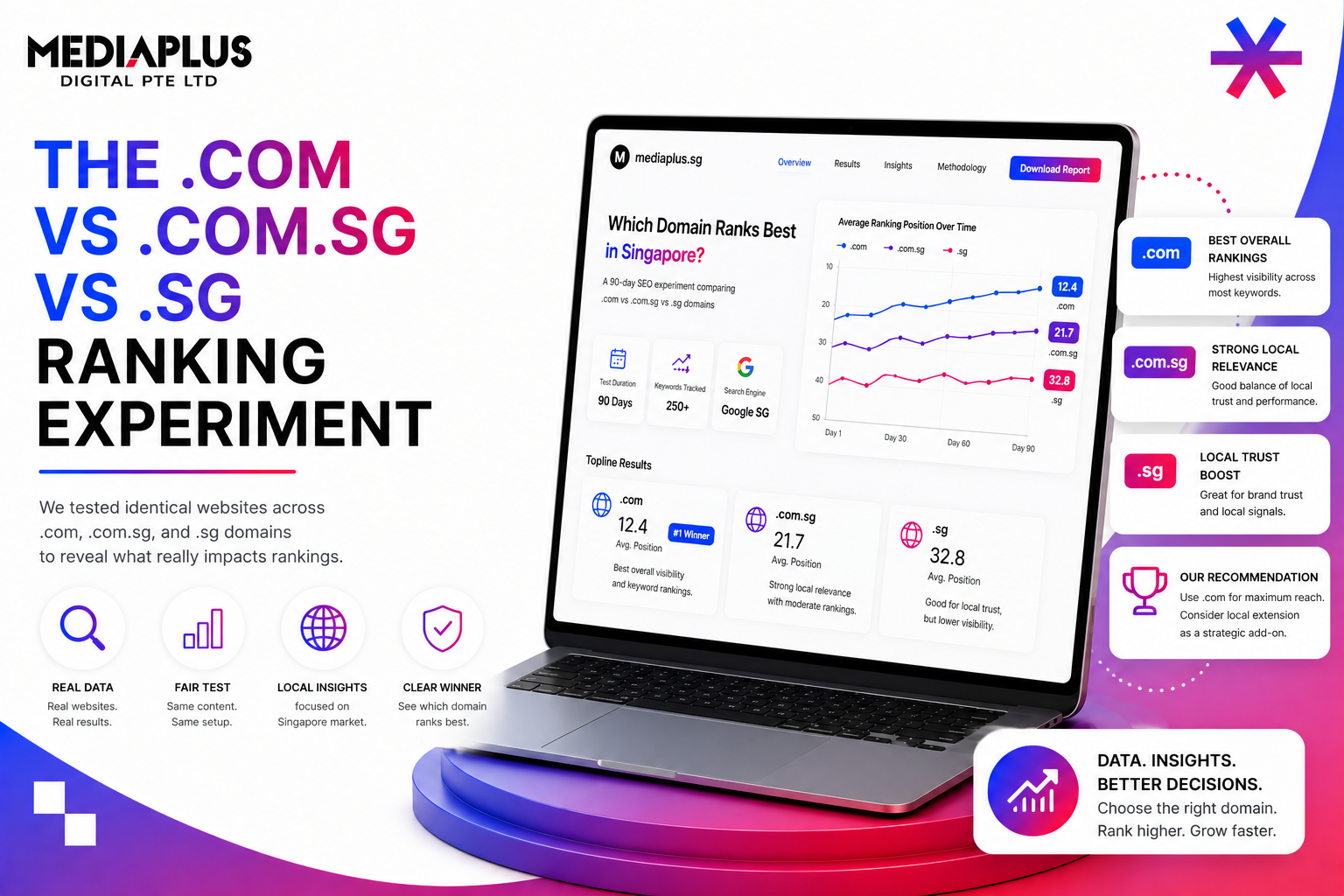
Quick answer: In our data, the domain extension mattered most for new, low-authority websites. Sites under DR 30 on .com.sg or .sg outranked comparable .com sites by an average of 4.6 positions on Singapore-intent commercial keywords. For established sites with DR 50 and above, the difference shrank to within 1.5 positions, and for branded searches it disappeared. .sg and .com.sg performed almost identically. Moving an existing site from .com to .com.sg was costly: both migrated sites lost 20 to 35% of organic traffic for the first 60 days and took 6 to 9 months to recover. New Singapore-only brands should start on .com.sg or .sg; established .com brands should usually stay put and strengthen their Singapore signals instead.
Results at a glance
|
What we measured |
Result |
|
Low-authority sites (under DR 30) |
.com.sg and .sg outranked .com by an average of 4.6 positions on Singapore-intent commercial keywords |
|
High-authority sites (DR 50+) |
Rankings within plus or minus 1.5 positions across domain types |
|
Branded searches |
No detectable effect on ranking position or CTR |
|
CTR at position 3, category queries |
.com.sg 6.8%, .sg 6.5%, .com 5.9% |
|
Migration from .com to .com.sg (2 sites) |
20 to 35% organic traffic loss in the first 60 days; 6 to 9 months to recover |
Hypothesis
The conventional wisdom from 2024 to 2026 has settled on three claims:
- .sg and .com.sg both signal Singapore relevance to Google equally well.
- A .com domain can rank in Singapore but must work harder, especially when domain authority is low.
- A .com.sg ranks indistinguishably from .sg for Singapore-intent queries.
These are mostly correct but are usually stated with more confidence than the underlying data justifies. We wanted to test how much difference the domain extension actually makes once other factors are accounted for, and where the differences show up in real client search results.
Method
We studied 24 Singapore client websites across six sectors: SaaS, professional services, F&B, healthcare, e-commerce and B2B services. Each site had at least 12 months of consistent SEO investment. We grouped them by primary domain:
|
Domain type |
Number of sites |
Sector mix |
|
.com (Singapore audience) |
9 |
SaaS, professional services, regional B2B |
|
.com.sg |
8 |
Local services, retail, F&B, healthcare |
|
.sg |
5 |
B2B services, e-commerce |
|
.com with .sg redirect |
2 |
Regional SaaS expanding into Singapore |
For each site we tracked:
- Ranking position for 30 to 50 priority keywords with Singapore intent
- Organic clicks from Singapore (Google Search Console)
- Branded versus non-branded traffic split
- Click-through rate on impressions for the same query across domain types, where comparable data was available
Tracking ran from January 2025 to March 2026. Domain authority bands use Ahrefs Domain Rating (DR).
Limitations
Read the results with these in mind:
- This is observational, not experimental. We did not run controlled A/B tests of the same brand on different domains in production.
- The sample is small (24 sites) and weighted toward the sectors we work in.
- Some findings rest on very small groups, most notably the migration finding, which is based on two sites.
- Sites differ in more than their domain: content, links, competition and budgets all vary.
The findings are directional, not definitive. Read them alongside larger industry studies rather than as the final word.
Results
Finding 1: For low-authority sites, .com.sg and .sg outrank .com by a meaningful margin
For sites under DR 30, .com.sg and .sg domains outranked .com domains by an average of 4.6 positions on Singapore-intent commercial keywords. The gap was largest for queries with explicit local intent, such as “HDB renovation contractor”, “SEO services Singapore” and “PSG grant agency”, and smaller for category queries without a location.
Interpretation: when Google cannot yet infer relevance from authority signals, the country-code domain acts as a strong Singapore relevance hint that visibly helps a new site.
Finding 2: For high-authority sites, the domain becomes a smaller factor
Sites with DR 50 and above ranked within plus or minus 1.5 positions across domain types. A well-established .com site with strong backlinks and Singapore-relevant content ranked comparably to a .com.sg site with similar authority. The effect of the domain was real, but small compared with backlinks, content depth and topical authority.
Interpretation: once a site has enough authority and local relevance signals, Google treats it as relevant to Singapore regardless of the extension. The domain becomes a marginal tiebreaker.
Finding 3: Branded search behaves identically across domains
For branded queries such as “[brand] singapore” or “[brand] pricing”, the domain had no detectable effect on ranking position or CTR. Google knows which result the searcher wants and serves it regardless of extension.
Interpretation: the domain does not matter for branded discovery. It matters for non-branded, category-level discovery.
Finding 4: CTR at the same position differs slightly by domain
For position-3 listings on Singapore-intent category queries, click-through rates looked like this:
|
Domain |
Average CTR at position 3 |
Variance |
|
.com.sg |
6.8% |
Low (sites cluster tightly) |
|
.sg |
6.5% |
Low |
|
.com |
5.9% |
High (some lifted by brand recognition, some hurt by a weaker local signal) |
Interpretation: at the same rank, Singapore users clicked .com.sg and .sg results slightly more often than .com results on category queries. The gap is small, under one percentage point, but consistent. For some brands, the recognition of a well-known .com offsets the weaker local signal.
Finding 5: Migrating from .com to .com.sg without full redirect work is costly
Two of the 24 sites had migrated from .com to .com.sg in the 18 months before tracking. Both lost 20 to 35% of organic traffic in the first 60 days after migration and needed 6 to 9 months to recover. Recovery did happen, and afterwards both ranked slightly better than their pre-migration baseline. With only two sites, treat this as a warning rather than a rule: a domain migration has a real cost, and the size of that cost depends heavily on how carefully it is executed.
Why this happens: how Google uses your domain extension
Our results line up with what Google says publicly about targeting a country.
- Country-code domains are a geotargeting signal. Google’s Search Central documentation says country-code top-level domains “provide a strong signal to both users and search engines that your site is explicitly intended for a certain country.” Both .sg and .com.sg are Singapore country-code domains, which explains why they performed so similarly.
- A .com site can no longer choose a target country in Search Console. Google deprecated the International Targeting report, including the country targeting setting, and removed it from Search Console in September 2022. A .com site now relies entirely on other signals to show that it serves Singapore.
- Google uses several other signals, including hreflang annotations, server location, and cues such as local addresses and phone numbers, the language and currency on the page, links from local sites and Google Business Profile information.
- Some signals are ignored. Google states that it ignores location meta tags such as geo.position.
This helps explain Findings 1 and 2. A new site has few of those other signals, so the country-code domain carries more weight. As authority, local links and local content build up, those signals do the work and the extension matters less.
What this changed in our recommendations
Before this analysis, our default recommendation to Singapore clients was “buy both, point .com.sg at the canonical .com”. Our recommendation now depends on the situation:
|
Situation |
Recommended domain |
Why |
|
New brand, Singapore-only audience |
.com.sg or .sg, whichever is available |
Faster traction while domain authority builds |
|
New brand, regional or global audience from day one |
.com, with the .sg variant registered and redirected as brand protection |
Easier multi-country expansion using country folders and hreflang |
|
Established brand with strong .com authority, expanding to Singapore |
Stay on .com and build Singapore-specific pages, content and local signals |
Migrating costs more than the marginal domain lift |
|
Established Singapore brand on .com, considering a move to .com.sg |
Usually do not migrate |
Recovery took 6 to 9 months in our data; the gain rarely justifies the cost |
|
Singapore-focused, local-intent business (renovation, F&B, clinics) |
.com.sg or .sg |
Local-intent organic results benefit from the country signal while authority builds; the Google Business Profile still drives local pack results |
If you stay on .com: strengthen your Singapore signals
Since Search Console no longer offers country targeting, a .com site serving Singapore needs to make its local relevance obvious in other ways.
|
Signal |
What to do |
|
Local contact details |
Show a Singapore address and +65 phone number, consistent with your Google Business Profile |
|
Currency and language |
Price in SGD and use Singapore English terms and spelling |
|
Local content |
Create pages and articles written for Singapore customers, locations and regulations |
|
Local links and mentions |
Earn coverage from Singapore publications, associations and directories |
|
hreflang |
If you run versions for several countries, mark the Singapore version as en-SG. See our international SEO checklist |
|
Google Business Profile |
Keep it complete, verified and linked to your website. See what local SEO is |
.sg vs .com.sg: who can register each
A recommendation is only useful if you are allowed to act on it. Singapore domains are administered by the Singapore Network Information Centre (SGNIC) and registered through SGNIC-accredited registrars.
|
Domain |
Who can register it, according to SGNIC |
|
.sg |
Available to anyone with a valid Singapore postal address. Foreign applicants must appoint a local agent with a Singapore address as the administrative contact. |
|
.com.sg |
Commercial entities registered, or in the process of registering, with ACRA, IE Singapore (now Enterprise Singapore) or a professional body in Singapore. A foreign company not registered locally must appoint a local agent as the administrative contact. |
|
.org.sg |
Organisations such as societies, town councils, community centres, places of worship and embassies |
|
.edu.sg |
Educational institutions only |
|
.gov.sg |
Singapore government organisations only |
|
.net.sg |
Providers of infocomm networks or services, data storage or hosting |
|
.per.sg |
Personal domain names |
In practice:
- A Singapore company with a UEN can register either .sg or .com.sg.
- A foreign company can still register a Singapore domain, but needs a local agent as the administrative contact.
- Registrars also require identity verification of the administrative contact for new Singapore domains, usually through Singpass or Corppass. Ask your registrar how this works before paying.
- Register the domain in your company’s name, not in the name of an employee or an agency, so ownership stays with the business.
Rules can change, so confirm current requirements with SGNIC or your registrar when you register. See our comparison of domain registrars and our domain and hosting services.
If you decide to migrate domains
Finding 5 is the reason to treat a domain change as a project, not a settings change.
- Keep the old domain registered and renewing indefinitely
- Map every old URL to its new equivalent and set page-to-page 301 redirects, not a blanket redirect to the homepage
- Verify both domains in Google Search Console and use the Change of Address tool
- Update canonical tags, internal links, XML sitemaps and structured data to the new domain
- Update your Google Business Profile, directory listings and social profiles
- Ask partners and publications that link to you to update important links
- Move email carefully and set up SPF, DKIM and DMARC on the new domain
- Update tracking: Google Analytics, Google Ads, Meta Pixel and conversion tags
- Monitor indexing, rankings and traffic weekly for at least three months
For the full process, see our guide to SEO-safe website redesign and our technical website audit checklist.
The things that move rankings more than the domain
The domain effect is real but small. Once a Singapore site is past DR 30, the levers that actually move rankings all matter more than the choice between .com and .com.sg. These are the same levers we cover in our B2B SEO playbook, content cluster strategy and E-E-A-T and topical authority guides:
- Topical authority: depth of coverage on the topic you want to rank for
- Backlink profile: the quantity, quality and relevance of referring domains
- Internal linking: hub-and-spoke content clusters
- On-page optimisation: title, H1, schema and search intent match
- Core Web Vitals and mobile performance
- Freshness for time-sensitive queries
- Brand mentions across the open web, including unlinked citations
A brand that obsesses over its domain extension and ignores these is optimising the wrong variable.
A note on AI search
AI Overviews, ChatGPT and Perplexity do not appear to weight the domain extension in their citation decisions. They appear to weight authority, content quality and entity relationships. In our experience, a well-cited .com beats a poorly cited .com.sg in AI search. The implication is that as AI search grows, the domain matters less for discovery. Read our piece on AI SEO and Generative Engine Optimisation in Singapore for the broader shift.
Frequently asked questions
Is .sg or .com.sg better for SEO?
Both are Singapore country-code domains and send the same country signal to Google. In our data they performed almost identically, with .com.sg averaging 6.8% CTR at position 3 against 6.5% for .sg. Choose based on availability and brand preference.
Can a .com website rank in Singapore?
Yes. In our study, .com sites with DR 50 and above ranked within about 1.5 positions of comparable .com.sg sites. Low-authority .com sites found it harder, so they need stronger local signals such as Singapore content, SGD pricing, local links and a Google Business Profile.
Can I set Singapore as my target country in Google Search Console?
No longer. Google removed the International Targeting report and its country setting from Search Console in September 2022. Country relevance now comes from signals such as your domain, hreflang, local content and links.
Can a foreign company register a .sg or .com.sg domain?
Yes, but it must appoint a local agent with a Singapore address as the administrative contact. .com.sg is intended for entities registered with ACRA or another recognised Singapore body.
Does buying multiple domain extensions help SEO?
There is no direct ranking benefit, but there is defensive value. Owning the .com, .com.sg and .sg versions of your brand name stops competitors or squatters from taking them. Point them all to one main domain with 301 redirects.
Should I migrate my .com site to .com.sg?
Usually not if the site is established. The two migrated sites in our study lost 20 to 35% of organic traffic in the first 60 days and needed 6 to 9 months to recover. For most established brands, building Singapore-specific content on the existing domain is the better investment.
Will Google ever stop using domain extensions as a geo signal?
It will probably weigh them less over time as it leans more on hreflang, structured data and entity understanding. We do not expect the signal to disappear in the near term.
What about .asia or .xyz?
.asia is a generic domain with no Singapore-specific advantage, and novelty extensions like .xyz are treated like any other generic domain. Neither replaces the country signal of .sg or .com.sg.
Does the domain extension affect email deliverability?
We saw no measurable difference once SPF, DKIM and DMARC were configured. Modern email providers treat extensions consistently.
Bottom line
For new Singapore brands starting with little authority, .com.sg or .sg is the better starting point, because the country signal helps most during the early phase when every signal counts. For established brands with a strong .com, a migration is rarely worth it: build Singapore-specific content, local links and local signals on the .com instead. For regional or global brands, stay on .com and use country folders, hreflang and local content depth to compete, since Search Console country targeting no longer exists.
The domain extension is a small but real lever. It is not the lever that decides whether your site ranks. For a candid second opinion on your domain strategy alongside the rest of your SEO programme, talk to MediaPlus Digital about SEO in Singapore, or browse more research on the MediaPlus blog.
Sources: Google Search Central, “Managing multi-regional and multilingual sites”; Google Search Console Help, “The International Targeting report is deprecated”; SGNIC e-Guide, “Choosing a .SG Domain Name”. Study data: MediaPlus Digital client websites, January 2025 to March 2026.