
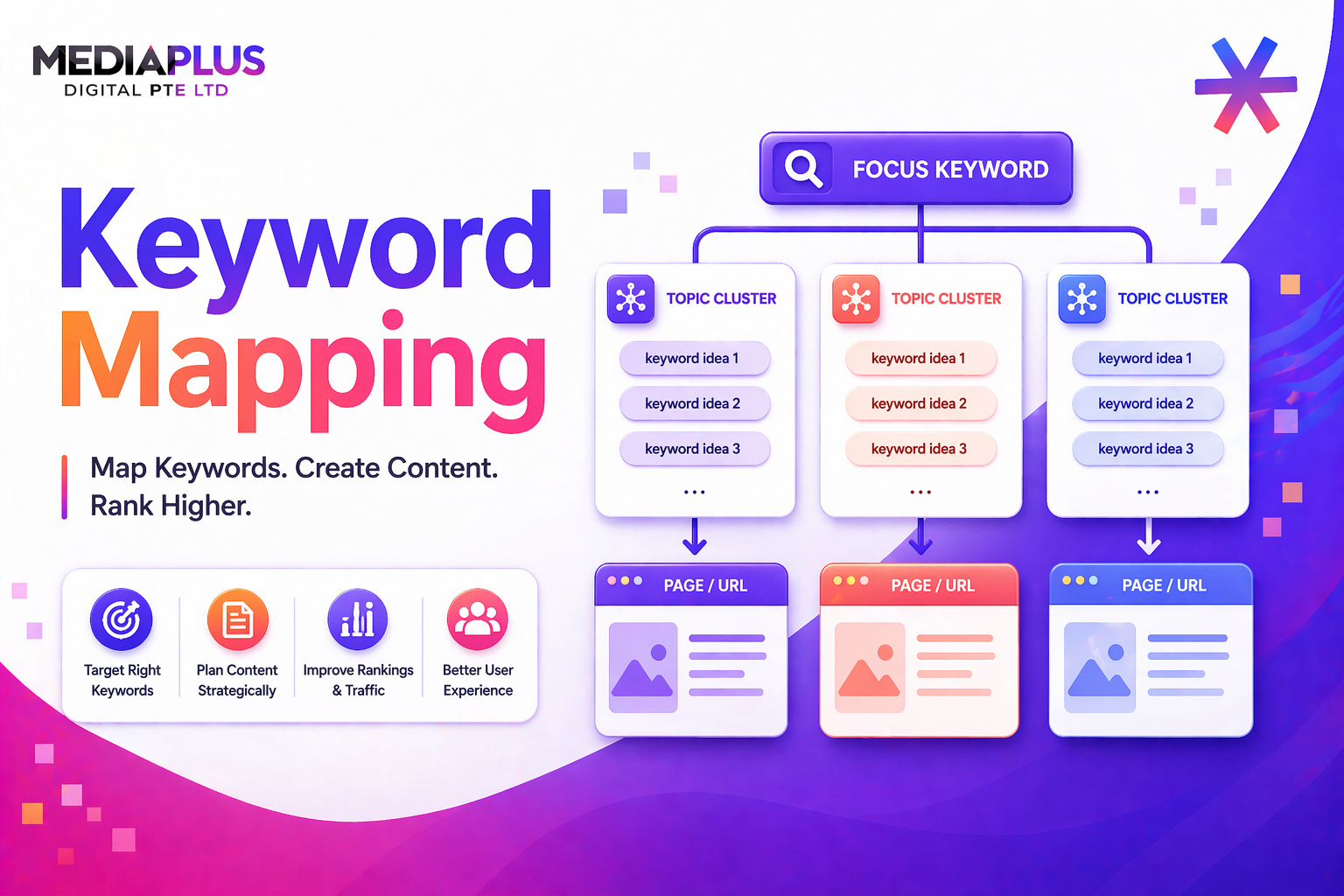
If two of your pages target the same keyword, they compete with each other and both rank worse. If a keyword has no page at all, you cannot rank for it. Keyword mapping fixes both problems by assigning every target keyword to exactly one page. This guide explains what keyword mapping is, how to do it step by step, and gives you a keyword mapping template you can copy and use today.
Quick answer: Keyword mapping is the process of assigning each target keyword (and its close variants) to one specific page on your site, based on search intent. It prevents two pages competing for the same term (cannibalisation), shows where you have content gaps, and gives every page one clear job. The output is a keyword map: a simple table linking keywords to URLs, page types, and intent.
What is keyword mapping?
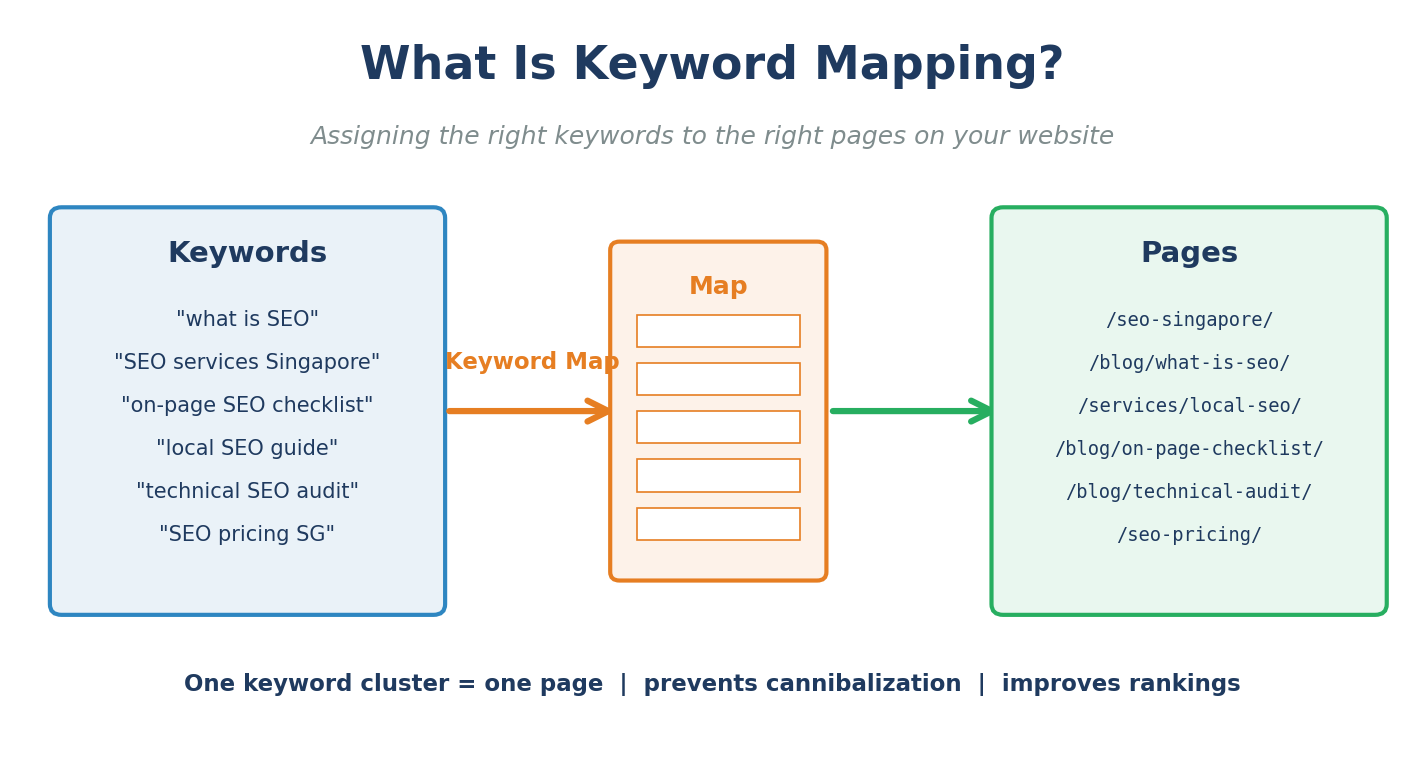
Keyword mapping is the step between keyword research and content. Research gives you a list of keywords; mapping decides which page each keyword belongs to. Every important keyword gets one home page, and every page has a clear primary keyword plus a few related secondary ones.
Done well, a keyword map becomes the blueprint for your whole site: it tells you which pages to create, which to optimise, and which to merge. It is one of the highest-leverage tasks in SEO because it fixes structural problems that no amount of content or links can overcome. It underpins a strong SEO strategy.
Why keyword mapping matters
- It stops keyword cannibalisation. When several pages target the same term, Google struggles to pick one, and they suppress each other. Mapping gives each keyword a single owner.
- It reveals content gaps. Keywords with no matching page are opportunities you are missing.
- It gives every page a job. One primary keyword and intent per page makes on-page optimisation obvious.
- It builds topical authority. Mapping keywords into clusters around a topic tells Google you cover a subject deeply.
- It saves time and money. You create the right pages once, instead of publishing overlapping content that competes with itself.
Keyword mapping vs keyword research vs content mapping
These three get confused:
|
Term |
What it is |
|
Keyword research |
Finding the keywords worth targeting, with volume and difficulty |
|
Keyword mapping |
Assigning each keyword to one page, by intent |
|
Content mapping |
Planning content around the buyer journey and funnel stages |
Research is the input, mapping is the structure, and content mapping is how you fill it. You do them in that order.
Match keywords to search intent and page type
Every keyword carries an intent, and each intent suits a different page type. Map them accordingly.
|
Search intent |
What the searcher wants |
Page type it maps to |
|
Informational |
To learn or understand |
Blog post, guide, FAQ |
|
Commercial |
To compare options |
Comparison, “best” listicle, review |
|
Transactional |
To buy or act now |
Service or product page |
|
Navigational |
A specific brand or page |
Homepage, brand page |
Putting a transactional keyword on a blog post, or an informational one on a product page, is one of the most common mapping mistakes.
The keyword mapping template
Here is a simple keyword map you can copy into a spreadsheet. One row per target page.
|
URL |
Primary keyword |
Secondary keywords |
Search intent |
Page type |
Title tag |
Status |
|
/seo-singapore/ |
seo services singapore |
seo agency singapore, seo company |
Transactional |
Service |
SEO Services Singapore | Brand |
Optimise |
|
/what-is-seo/ |
what is seo |
seo meaning, seo basics |
Informational |
Guide |
What Is SEO? A Simple Guide |
Live |
|
/affordable-seo-agencies-in-singapore/ |
affordable seo agencies singapore |
cheap seo, seo packages |
Commercial |
Listicle |
Top Affordable SEO Agencies |
Optimise |
|
(gap) |
ecommerce seo services |
ecommerce seo agency |
Transactional |
Service |
Ecommerce SEO Services |
Create |
The columns that matter: the primary keyword each page owns, secondary keywords it also targets, the intent and page type (so content matches), and a status (live, optimise, create, or merge). Add columns for search volume and keyword difficulty to help prioritise. You can download our full keyword mapping template as a spreadsheet.
How to do keyword mapping, step by step
1. Gather your keywords
Start from keyword research: your seed terms, competitor gaps, and related questions. Free and paid tools help; see how to find SEO keywords for free and the best SEO tools.
2. Group by topic and intent
Cluster keywords that mean the same thing and share intent. “seo services singapore”, “seo agency singapore”, and “seo company singapore” are one cluster for one page, not three pages.
3. Weigh volume against difficulty
Do not map only by search volume. A high-volume keyword you cannot realistically rank for is a poor target. Balance volume with keyword difficulty and your site’s authority, and target a mix of achievable terms and a few ambitious ones.
4. Assign one keyword cluster to one page
Give each cluster a single owner page. List one primary keyword and the secondary variants it will also target. This is the core of the map.
5. Find and fill the gaps
Any valuable keyword with no page is a gap. Mark it “create” and plan the page.
6. Prioritise what to do first
You cannot fix everything at once. Prioritise by opportunity: pages already close to ranking (striking distance), high commercial value, and low difficulty first. A page sitting at position 8 for a valuable term is a faster win than a brand-new page for a competitive one.
7. Optimise, create, or consolidate
Work through the map: optimise existing pages to their assigned keyword, create the gap pages, and merge duplicates (see below).
The pillar and cluster model
For topics you want to own, map keywords into a pillar-and-cluster structure: one broad pillar page for the main topic, and several cluster pages for sub-topics, all internally linked. This tells Google you cover the subject in depth and builds topical authority. See our content cluster strategy guide.
How to detect and fix cannibalisation
Before mapping, find where you already compete with yourself:
- Search site:yourdomain.com keyword in Google to see how many of your pages rank for a term.
- Check Search Console: if several URLs get impressions for the same query, that is cannibalisation.
- Look for overlapping titles targeting the same keyword.
To fix it: pick one canonical page per keyword, de-optimise or differentiate the others, and if two pages serve the same intent, consolidate them. Merge the content into the stronger page and 301-redirect the weaker URL, so its ranking equity transfers instead of being lost. The keyword map is where you record these decisions with a “merge” status.
Tools for keyword mapping
- Spreadsheet (Google Sheets or Excel): the map itself lives here.
- Google Search Console: to spot cannibalisation and current rankings.
- Ahrefs, Semrush, or SE Ranking: for volume, difficulty, and competitor gaps.
- A crawler (Screaming Frog) to pull your existing URLs and titles into the map.
Common keyword mapping mistakes
- Mapping several pages to the same keyword, which causes cannibalisation.
- Ignoring intent, so the page type does not match what searchers want.
- Chasing volume over difficulty, targeting terms you cannot rank for.
- Leaving gaps unmapped, missing easy opportunities.
- Never updating the map, so it drifts out of date as you publish.
- Forgetting redirects when merging pages, losing the old page’s authority.
Measuring whether your keyword map works
Judge the map on outcomes, not activity:
- Rankings: the assigned keyword rising for its owner page, and cannibalisation resolving.
- Organic traffic: growth on the mapped pages in Search Console and GA4.
- Leads and revenue: conversions from the commercial pages against a baseline.
- Coverage: fewer gaps and fewer duplicate pages over time.
Frequently asked questions
What is keyword mapping in simple terms?
It is assigning each target keyword to one specific page on your site, so every page has a clear primary keyword and no two pages compete for the same term.
What is a keyword mapping template?
A simple spreadsheet with one row per page, listing the URL, primary keyword, secondary keywords, search intent, page type, title tag, and status. It becomes your SEO blueprint.
Why is keyword mapping important?
It prevents keyword cannibalisation, reveals content gaps, gives every page one clear job, and builds topical authority, which makes all your other SEO work more effective.
How do I map keywords to pages?
Group keywords by topic and intent, assign each cluster to one page, match the page type to the intent, fill any gaps with new pages, and merge duplicates with redirects.
What is the difference between keyword mapping and keyword research?
Research finds the keywords worth targeting. Mapping decides which page each keyword belongs to. Research is the input; mapping is the structure.
How often should I update my keyword map?
Review it whenever you publish new content, at least quarterly, and after any major keyword research or site change, so it stays your single source of truth.
Turn your keyword map into rankings
A keyword map is only as good as the optimisation that follows it. If you want a keyword map built and executed by a team that does this every day, talk to MediaPlus Digital. Explore our SEO services in Singapore, or start with our complete SEO checklist.