
CTR is one of the first numbers anyone looks at in Google Ads, Search Console or Meta Ads Manager, and one of the most misread. A “good” CTR on a search ad would be a disaster on a display banner, a rising CTR can hide a falling conversion rate, and in 2026 your organic CTR can drop even when your rankings do not move. This guide explains what CTR means, how to calculate it, what realistic benchmarks look like, why yours might be low, and how to improve it without chasing the wrong clicks.
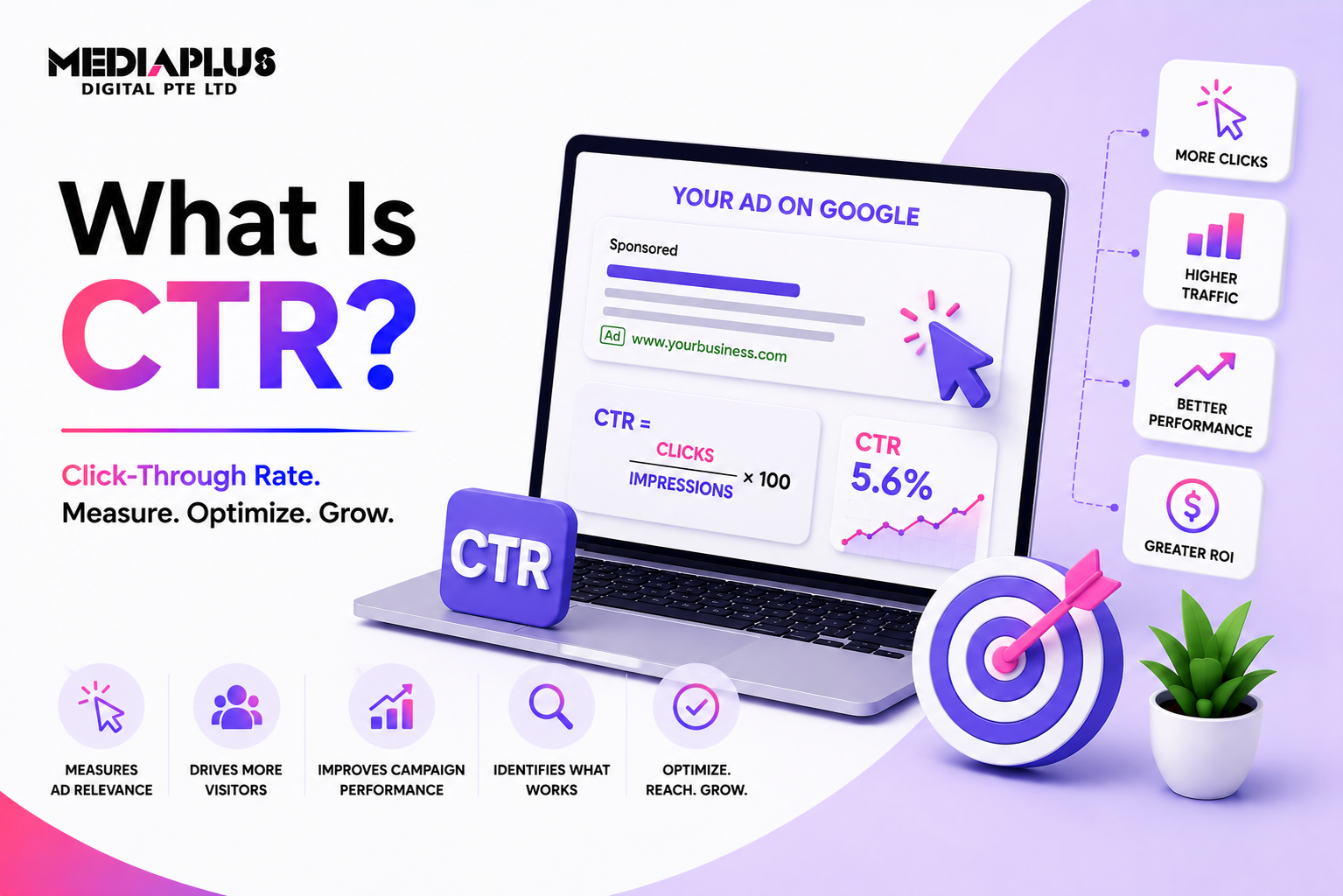
Quick answer: CTR (click-through rate) is the percentage of people who click after seeing your ad, search result, email link or post. The formula is clicks divided by impressions, multiplied by 100. If an ad gets 60 clicks from 1,000 impressions, the CTR is 6%. What counts as good depends on the channel: LocaliQ and WordStream put the average Google search ad CTR at 6.64% in 2026, while social and display ads usually sit much lower. Always judge CTR alongside conversions, because clicks that do not convert only cost you money.
What does CTR mean?
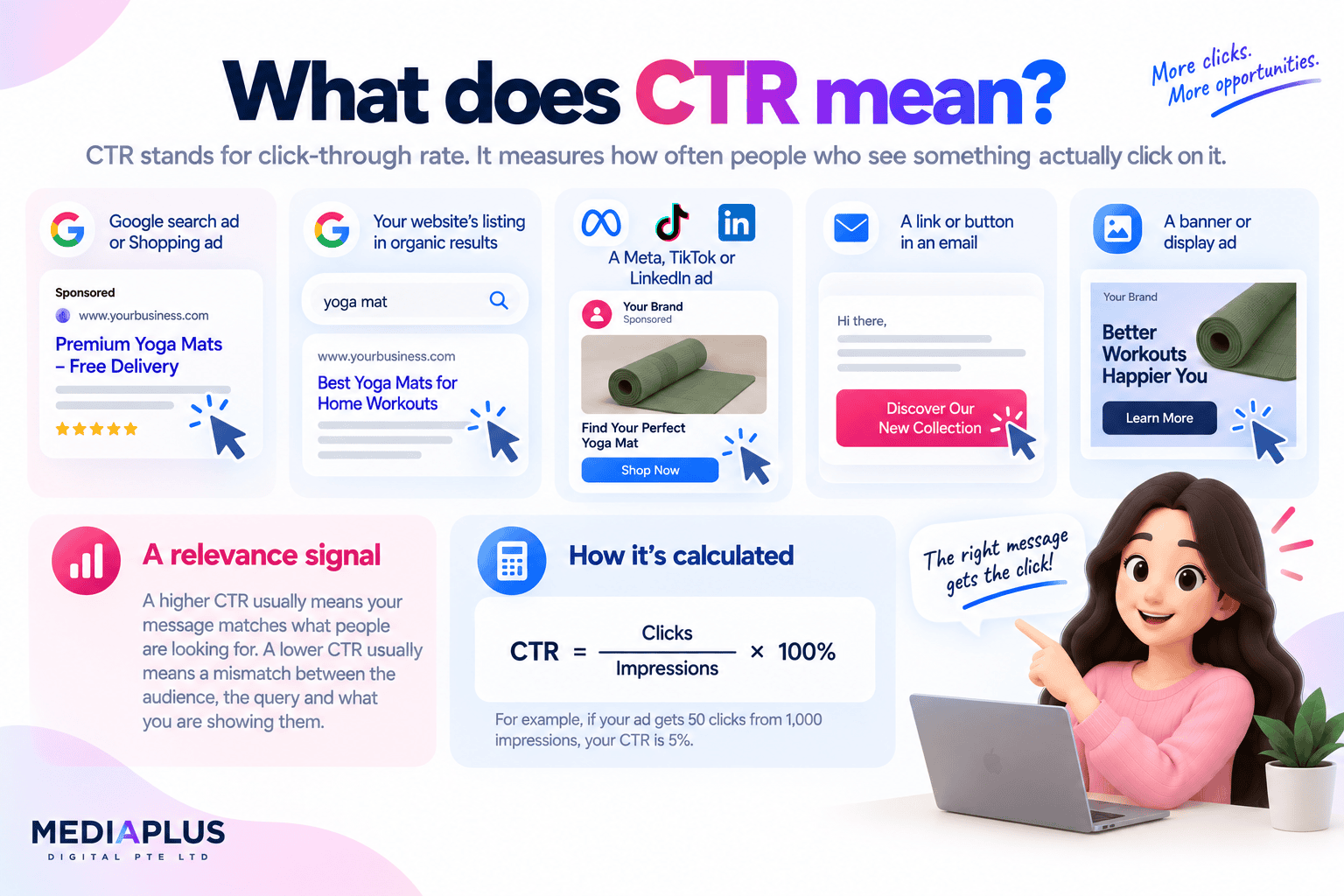
CTR stands for click-through rate. It measures how often people who see something actually click on it. That “something” can be:
- A Google search ad or Shopping ad
- Your website’s listing in Google’s organic results
- A Meta, TikTok or LinkedIn ad
- A link or button in an email
- A banner or display ad
CTR is a relevance signal. A higher CTR usually means your message matches what people are looking for; a lower CTR usually means a mismatch between the audience, the query and what you are showing them.
The CTR formula
CTR = (Clicks ÷ Impressions) × 100
- Clicks: the number of times people clicked
- Impressions: the number of times your ad or listing was shown
Worked examples
|
Scenario |
Clicks |
Impressions |
CTR |
|
Google search ad for an aircon servicing company |
84 |
1,200 |
7.0% |
|
Organic result for a blog post in Search Console |
45 |
3,000 |
1.5% |
|
Meta traffic campaign for an online store |
170 |
10,000 |
1.7% |
|
Email link to a promotion |
120 |
4,000 |
3.0% |
Two notes that trip people up:
- Email platforms often report two versions: click rate based on emails delivered, and click-to-open rate based on emails opened. They are not interchangeable, so check which one you are comparing.
- Meta shows “CTR (all)” and “CTR (link click-through rate)”. CTR (all) counts every click, including likes and profile clicks; link CTR counts clicks to your destination, which is usually the one that matters.
Where you find CTR
|
Platform |
Where to look |
What it measures |
|
Google Ads |
Campaigns, ad groups, ads and keywords tables (CTR column) |
Clicks on your ads divided by ad impressions |
|
Google Search Console |
Performance report, tick “Average CTR” |
Clicks on your organic listings divided by impressions |
|
Meta Ads Manager |
Columns: “CTR (link click-through rate)” and “CTR (all)” |
Link clicks or all clicks divided by impressions |
|
Email platforms |
Campaign reports: click rate, click-to-open rate |
Clicks divided by delivered or opened emails |
|
Google Analytics 4 |
Does not report ad or organic CTR directly |
Use it for what happens after the click. See our GA4 setup guide |
What is a good CTR?
There is no single good CTR. It depends on the channel, the industry, the ad position, the intent behind the search and even the device. Use benchmarks as rough context, and use your own historical CTR as the real baseline.
|
Channel |
Benchmark |
Source |
|
Google search ads, all industries |
6.64% average |
LocaliQ and WordStream search advertising benchmarks, 2026 |
|
Google search ads, highest industry |
12.75% (Arts and Entertainment) |
LocaliQ, 2026 |
|
Google search ads, lowest industry |
5.66% (Dentists and Dental Services) |
LocaliQ, 2026 |
|
Facebook traffic campaigns |
1.71% average |
WordStream Facebook ads benchmarks, 2025 |
|
Organic search, position 1 |
Roughly a quarter to a third of clicks on desktop, varying by query type |
Advanced Web Ranking CTR studies, 2025 |
|
Organic search, queries with an AI Overview |
2.36% average organic CTR, versus 3.8% without |
Seer Interactive, February 2026 data |
How to read these numbers
- Benchmark studies are largely based on US and global campaign data. Singapore results can differ, especially in competitive sectors such as legal, finance and home services.
- Display, video and awareness campaigns normally have much lower CTRs than search, because people see them while doing something else.
- The Seer figures are averages across positions and many brands, not what a single top-ranking page earns. They are useful for the trend: AI Overviews reduce organic clicks on the queries where they appear.
Why CTR matters
It affects what you pay for Google Ads
Expected CTR is one of the three components of Google Ads Quality Score, alongside ad relevance and landing page experience. Better Quality Score can improve ad rank and lower the cost per click you pay for the same position. See our Google Ads optimisation checklist.
It shows whether your message matches intent
A low CTR on a keyword or audience often means the targeting is too broad, or the ad does not answer what people want.
It multiplies your SEO results
Moving from a 1% to a 2% CTR on a page with 20,000 monthly impressions doubles its clicks from 200 to 400 without improving its ranking.
But it is not the goal
CTR is a means to an end. The goal is enquiries, sales or sign-ups at a profitable cost.
CTR in SEO: why your clicks can fall while rankings hold
Organic CTR has changed more in the last two years than in the previous decade.
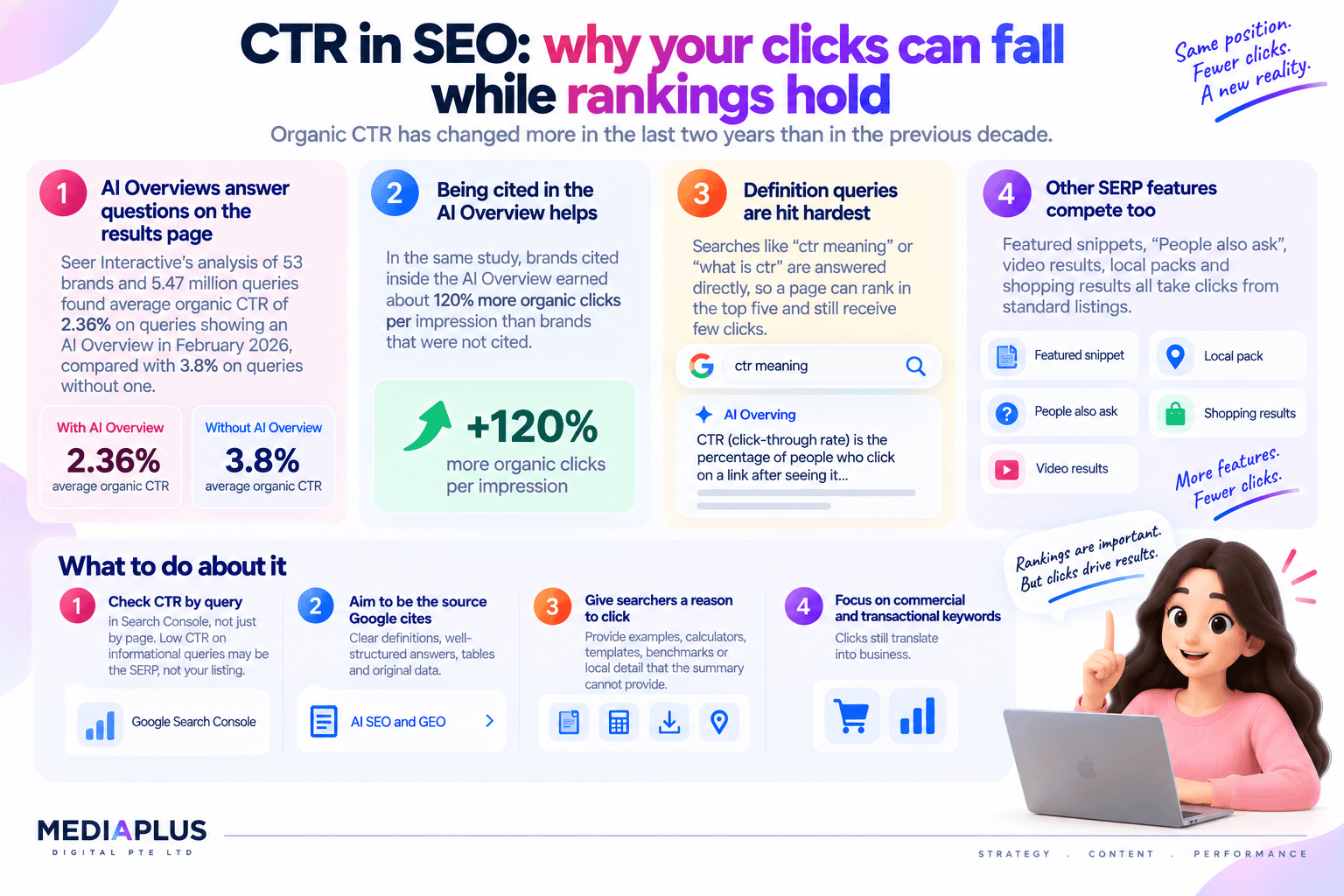
- AI Overviews answer questions on the results page. Seer Interactive’s analysis of 53 brands and 5.47 million queries found average organic CTR of 2.36% on queries showing an AI Overview in February 2026, compared with 3.8% on queries without one.
- Being cited in the AI Overview helps. In the same study, brands cited inside the AI Overview earned about 120% more organic clicks per impression than brands that were not cited.
- Definition queries are hit hardest. Searches like “ctr meaning” or “what is ctr” are answered directly, so a page can rank in the top five and still receive few clicks.
- Other SERP features compete too: featured snippets, “People also ask”, video results, local packs and shopping results all take clicks from standard listings.
What to do about it
- Check CTR by query in Search Console, not just by page. Low CTR on informational queries may be the SERP, not your listing.
- Aim to be the source Google cites: clear definitions, well-structured answers, tables and original data. See our work on AI SEO and GEO.
- Give searchers a reason to click that the summary cannot provide, such as examples, calculators, templates, benchmarks or local detail.
- Put more effort into commercial and transactional keywords, where clicks still translate into business.
Why your CTR is low: a diagnostic table
|
Symptom |
Likely cause |
Fix |
|
Low CTR on many search ad keywords |
Broad match or loosely related keywords |
Tighten keywords, add negative keywords, review search terms weekly |
|
Low CTR on one ad group |
Ad copy does not reflect the keyword |
Put the main keyword and the customer’s problem in the headline |
|
CTR dropped suddenly on ads |
New competitors, lower ad position, or disapproved assets |
Check auction insights, impression share and ad status |
|
Low CTR on organic pages ranking 1 to 5 |
Weak title, AI Overview or other SERP features taking clicks |
Rewrite title and meta description; check what the SERP shows |
|
Low CTR on organic pages ranking below 10 |
Normal: few people scroll that far |
Improve rankings first; CTR follows position |
|
Low link CTR on Meta ads |
Weak hook, wrong audience, creative fatigue |
Test new first three seconds, refresh creative, narrow or broaden audience |
|
High CTR but few conversions |
Misleading ad or poor landing page |
Align offer and landing page; see landing page optimisation |
|
Low email click rate |
Unclear call to action, too many links, poor list quality |
One main call to action, segment the list, clean inactive subscribers |
How to improve CTR
For Google search ads
- Match the headline to the search. If someone searches “aircon chemical wash Singapore”, say that, not “Professional Aircon Solutions”.
- Use all relevant assets: sitelinks, callouts, structured snippets, call and location assets. Larger ads take more space and earn more clicks.
- Lead with a specific reason to choose you: price from, same-day service, years in business, a guarantee.
- Add negative keywords so your ads stop showing for irrelevant searches that drag CTR down.
- Test ad variations and let data decide. See types of Google Ads and our Google Ads strategy guide.
For organic search results
- Write titles for people, not only for keywords. Include the keyword, then a reason to click, such as the year, a number, a location or what the page includes.
- Use the meta description as ad copy. Google does not always show it, but when it does, a clear promise helps.
- Earn rich results with structured data where eligible, such as FAQ, product, review and breadcrumb markup.
- Keep pages current. Titles showing an old year lose clicks.
- Match the format searchers expect. If the top results are lists or calculators, a long essay will struggle.
For social ads
- Hook in the first seconds of video and in the first line of copy.
- Show the product or result, not just the logo.
- Refresh creative before frequency builds and CTR falls.
- Use a clear call to action button that matches the offer.
For email
- One primary call to action per email.
- Make buttons obvious and easy to tap on mobile.
- Send relevant content to segmented lists rather than everything to everyone.
CTR vs conversion rate
|
CTR |
Conversion rate |
|
|
Measures |
How many people click after seeing |
How many people act after clicking |
|
Formula |
Clicks ÷ impressions × 100 |
Conversions ÷ clicks (or sessions) × 100 |
|
Tells you |
Whether the message attracts attention |
Whether the offer and landing page persuade |
|
Main levers |
Targeting, keywords, headlines, creative |
Offer, landing page, trust, form, price |
Look at both together. High CTR with low conversions means you are attracting the wrong clicks or losing people on the landing page. Low CTR with high conversions means the right people buy, but too few see a reason to click. See what conversion rate optimisation is.
When a high CTR is a bad sign
- Clickbait headlines that promise something the page does not deliver
- Accidental clicks on mobile display placements
- Broad audiences who click out of curiosity with no buying intent
- Prices hidden in the ad so price-sensitive people click, then leave
A lower CTR from the right people is often more profitable than a high CTR from the wrong ones.
Frequently asked questions
What does CTR stand for?
CTR stands for click-through rate: the percentage of people who click after seeing an ad, a search result, an email link or a post.
How do you calculate CTR?
Divide clicks by impressions and multiply by 100. For example, 60 clicks from 2,000 impressions is a 3% CTR.
What is a good CTR for Google Ads?
LocaliQ and WordStream’s 2026 benchmarks put the average Google search ad CTR at 6.64%, with industries ranging from about 5.7% to 12.8%. Compare against your own account history and industry rather than a single number.
What is a good CTR in SEO?
It depends heavily on position and on what else appears on the results page. A top-ranking result can earn a large share of clicks, while pages below position 10 receive very few. AI Overviews and other SERP features reduce organic CTR on many informational searches.
Does CTR affect Google rankings?
For Google Ads, expected CTR is part of Quality Score, which affects ad rank and cost. For organic search, Google does not publish CTR as a ranking factor, so focus on relevance and on titles that earn clicks from the right people.
Why is my CTR high but my sales low?
Usually the clicks are coming from people with the wrong intent, or the landing page does not match what the ad promised. Check search terms, audience targeting and landing page relevance.
What is the difference between CTR (all) and link CTR on Meta?
CTR (all) counts every click on the ad, including likes, comments and profile clicks. Link CTR only counts clicks to your website or destination, which is normally the metric to optimise.
Want more of the right clicks?
CTR is useful when it leads to enquiries and sales. If you want Google Ads and SEO managed around clicks that convert, talk to MediaPlus Digital. Explore our Google Ads management and SEO services in Singapore, or read what PPC is, with PSG support for eligible SMEs.




