
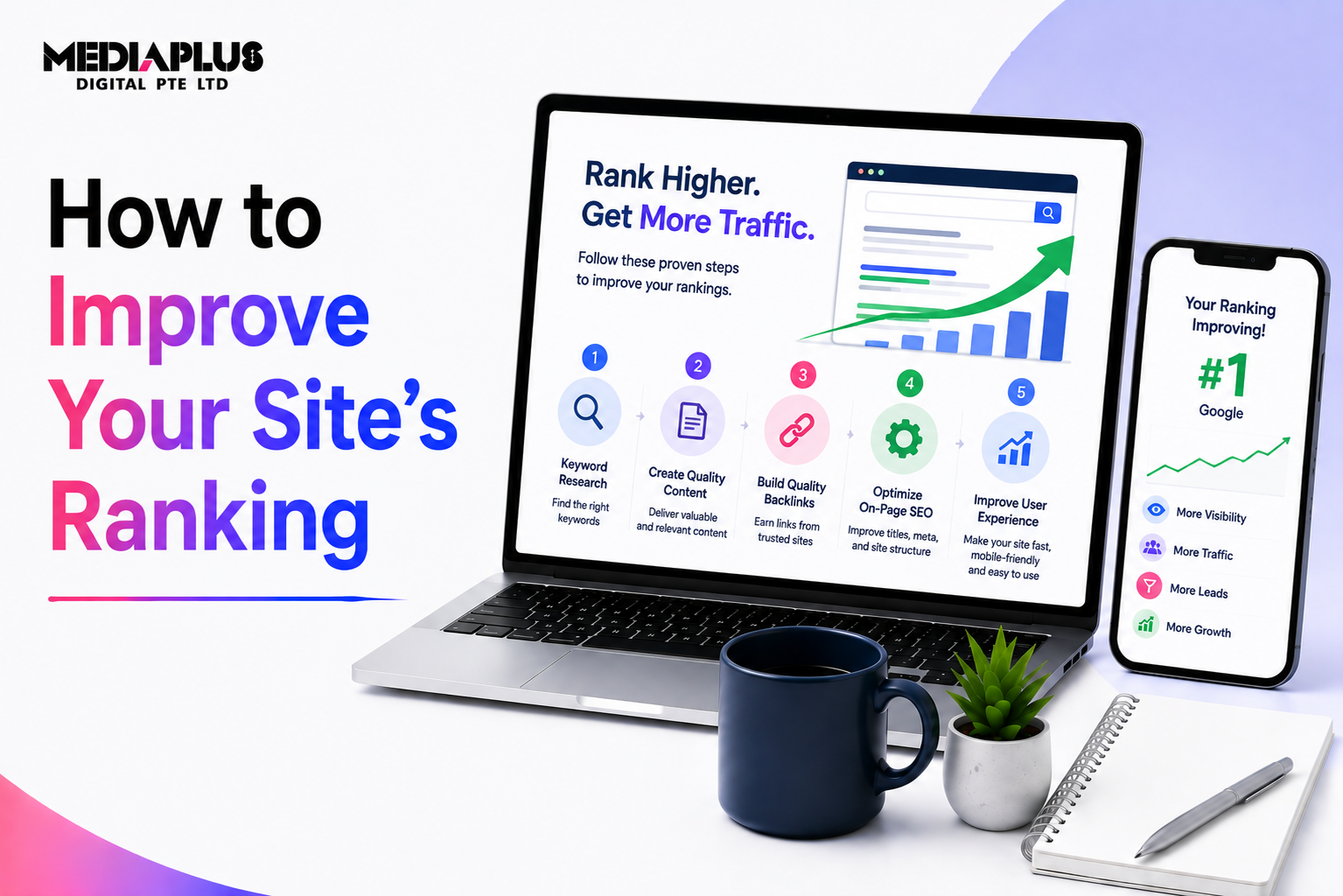
Most websites do not rank because of one big problem. They rank lower than they should because of a dozen small ones: a slow page here, a vague title there, thin content, and no links pointing in. The good news is that ranking is fixable, and you do not need tricks. This guide walks through exactly how to improve your site’s ranking on Google, step by step, from the quick wins to the work that compounds over months.
Quick answer: To improve your site’s ranking, make sure Google can crawl and understand your pages (technical SEO), match each page to what people actually search for (keywords and intent), publish genuinely useful content, earn quality links, and keep the site fast and mobile-friendly. Fix the technical and on-page basics first, then build content and authority. Rankings follow relevance plus trust, on a site that loads well.
How Google decides rankings (the short version)
Google ranks pages on two questions: is this page relevant to the search, and can it be trusted? Relevance comes from your content, keywords, and how clearly the page answers the query. Trust comes from authority signals like backlinks, brand mentions, and a track record of quality (what Google calls E-E-A-T). Underneath both sits technical health: if Google cannot crawl, render, or index a page quickly, nothing else matters. Improve all three and rankings rise. For the fundamentals, see our guide on what SEO is.
Step 1: Fix the technical foundations
Before chasing keywords or links, make sure the site works for search engines.
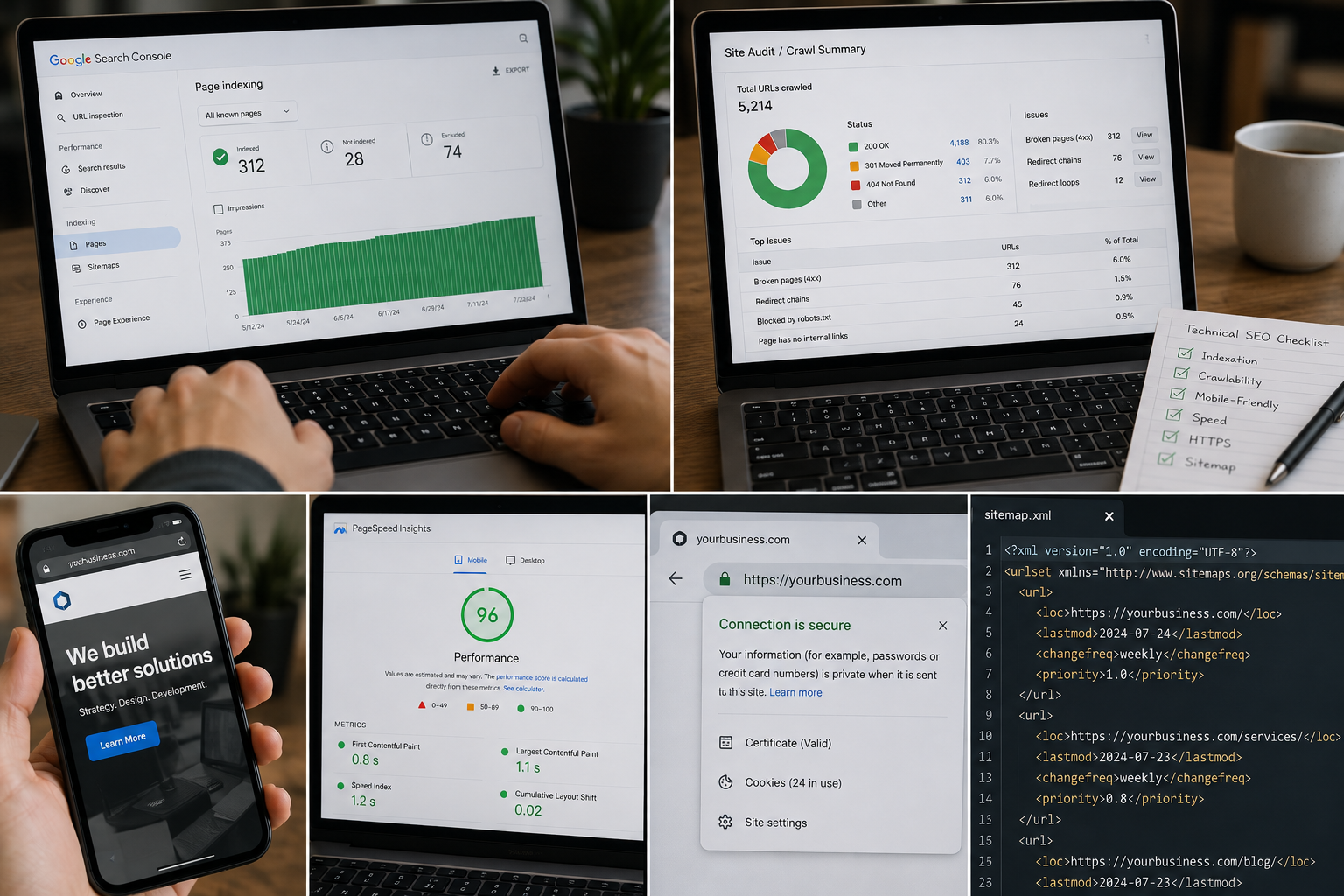
- Confirm your pages are indexed. Check Google Search Console’s Pages report. A page that is not indexed cannot rank.
- Fix crawl and redirect issues. Repair broken pages (404s), avoid redirect chains, and point internal links to final URLs.
- Make it mobile-first. Google ranks the mobile version of your site, so it must be fully usable on a phone.
- Improve speed and Core Web Vitals. Compress images, clean up code, and use good hosting so pages load in a couple of seconds.
- Use HTTPS and a clean structure. Secure the site and keep URLs short and logical.
- Submit an XML sitemap so Google can find every important page.
Run a full crawl to surface these issues. Our technical SEO guide covers the details.
Step 2: Target the right keywords and search intent
A page ranks when it matches what a searcher wants. Start there.
- Research real keywords your customers use, including the questions and modifiers around them.
- Match intent. A commercial page (“buy” or “best”) should not target an informational query, and vice versa. Give each page one clear job.
- Map keywords to pages. Build a simple keyword-to-page map so two of your pages do not compete for the same term (cannibalisation), which quietly suppresses both. See keyword mapping.
- Find gaps. Look at what competitors rank for that you do not, and fill those gaps with content.
Step 3: Optimise your on-page SEO
On-page work tells Google, and the reader, exactly what a page is about.
|
Element |
What to do |
|
Title tag |
Lead with the target keyword; keep it under about 60 characters |
|
Meta description |
Write to earn the click, with the keyword and a clear benefit |
|
H1 and headings |
One clear H1, logical H2 to H3 structure |
|
URL |
Short, descriptive, keyword-relevant |
|
Content |
Fully answer the query and related questions |
|
Images |
Descriptive alt text, compressed files |
|
Internal links |
Link to and from related pages with descriptive anchors |
For the full breakdown, see what on-page SEO is.
Step 4: Publish content that deserves to rank
Content is still the biggest lever. The pages that rank in 2026 are the ones that genuinely help.
- Answer the question fully. Cover the main query and the follow-ups a reader would have, so they do not need another page.
- Write for people first. Clear, useful, and specific beats keyword-stuffed every time.
- Show experience and expertise. Real examples, data, author credentials, and sources build the E-E-A-T Google rewards. See E-E-A-T and topical authority.
- Build topic clusters. Group related articles around a main topic and link them, so you rank for a whole subject, not one keyword. See content cluster strategy.
- Refresh old content. Updating pages that are close to page one is often faster than writing new ones.
Step 5: Strengthen internal linking
Internal links are the lever you fully control. They pass authority between your pages and help Google understand your site structure.
- Link from strong, high-authority pages to the pages you want to rank.
- Use descriptive, keyword-relevant anchor text, not “click here”.
- Give every important page enough internal links; fix orphan pages with none.
- Point links at your money pages, not just the blog.
Step 6: Earn quality backlinks
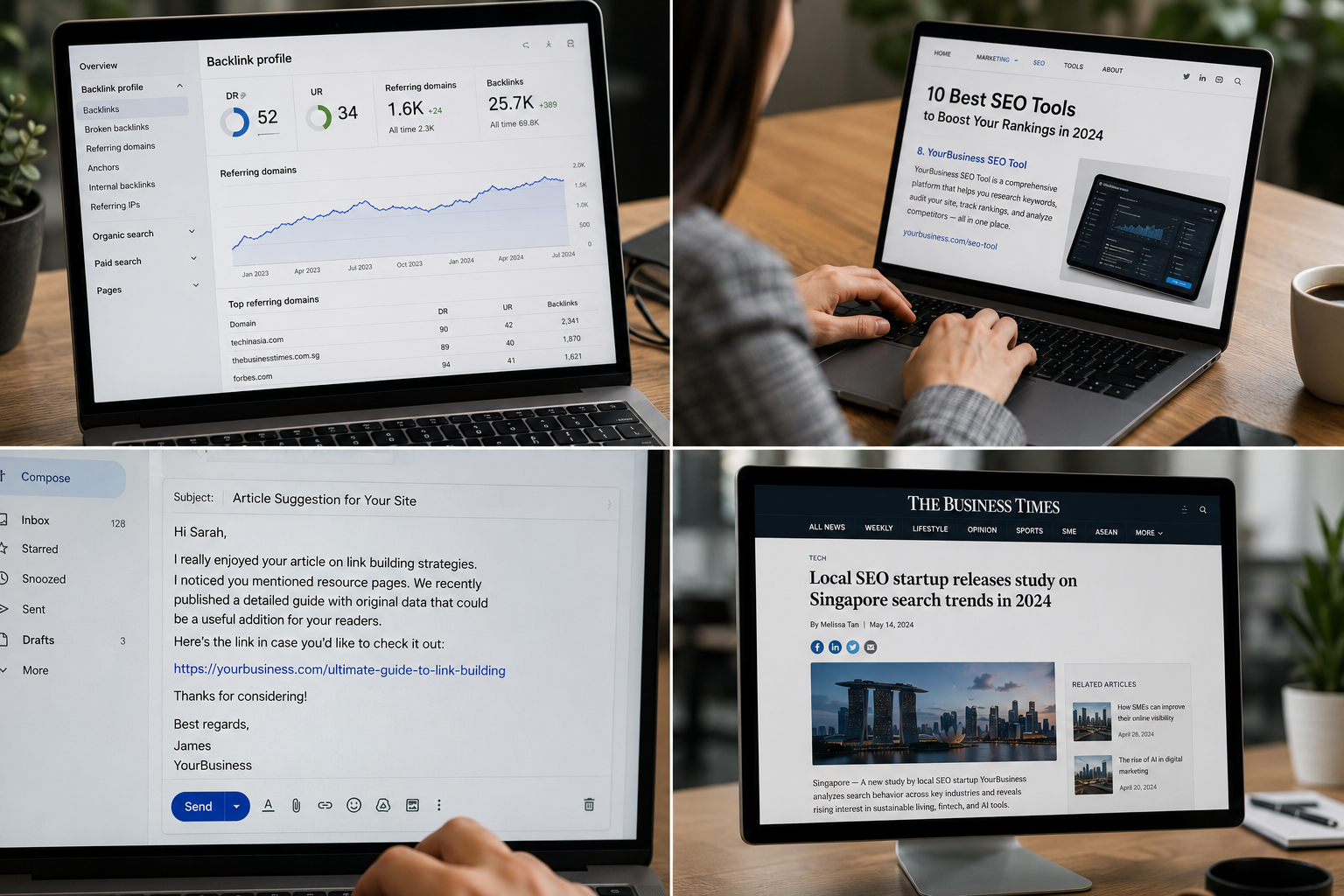
Backlinks remain one of Google’s strongest trust signals. Quality and relevance beat quantity.
- Create linkable assets: original data, guides, and tools that others want to cite.
- Earn editorial links through digital PR, guest posts on relevant sites, and journalist requests.
- Reclaim unlinked mentions of your brand.
- Avoid buying links or bulk directories, which can hurt more than help.
See our off-page SEO guide and what backlinks are.
Step 7: Do local SEO (if you serve a location)
If you have a physical presence or serve a specific area, local SEO can lift you fast.
- Claim and optimise your Google Business Profile.
- Keep your name, address, and phone consistent across directories.
- Earn and respond to reviews.
- Target location keywords on your pages.
More in our local SEO guide.
Step 8: Get ready for AI search (GEO)
Ranking is no longer only about blue links. Buyers now ask ChatGPT, Perplexity, and Gemini, and read Google’s AI Overviews. To be cited by AI, build on strong SEO and add answer-first content, schema, and consistent entity information. This is Generative Engine Optimisation, and it uses the same authority signals as classic SEO. See answer engine optimisation.
Step 9: Measure and keep improving
SEO is not a one-time project. Track progress and double down on what works.
- Google Search Console: impressions, clicks, average position, and indexing.
- Rank tracker: watch your target keywords, especially those in positions 4 to 20 that are one push from the top 5.
- GA4: organic traffic, conversions, and revenue against a baseline.
- Recrawl monthly to catch new technical issues.
Our roundup of the best SEO tools can help.
A quick-win checklist
If you only have a week, start here:
- Fix any pages that are not indexed
- Compress large images and improve page speed
- Rewrite weak title tags and meta descriptions on your top pages
- Add internal links to your most important pages
- Update one or two pages that are stuck on page two
- Claim or optimise your Google Business Profile
How long does it take to improve rankings?
Technical fixes can show impact within a few weeks. On-page and content improvements usually move rankings over 2 to 3 months. Competitive keywords and new sites take longer, often 4 to 6 months or more, as authority builds. The trend matters more than any single week.
Frequently asked questions
How can I improve my website’s ranking on Google?
Make the site fast and crawlable, match each page to a clear search intent, publish genuinely useful content, strengthen internal links, and earn quality backlinks. Fix the technical and on-page basics first, then build content and authority.
What is the fastest way to improve SEO ranking?
The quickest wins are usually technical and on-page: fix indexing and speed issues, rewrite weak titles, resolve keyword cannibalisation, and update pages already sitting on page two. These can move within weeks.
Why is my site not ranking despite good content?
Common causes are technical problems (not indexed, slow, not mobile-friendly), keyword cannibalisation, weak internal linking, or a lack of authority (backlinks). Great content still needs a crawlable page and trust signals to rank.
Do backlinks still matter in 2026?
Yes. Backlinks remain one of the strongest trust signals, though quality and relevance matter far more than quantity. A few links from authoritative, relevant sites beat hundreds of low-value ones.
How often should I update my SEO?
Treat SEO as ongoing. Recrawl monthly for technical issues, refresh key content a few times a year, and keep earning links. Search, competitors, and Google’s algorithms all keep changing.
Get help improving your rankings
Improving your site’s ranking is a mix of quick wins and steady, compounding work. If you want a team to audit your site and lift it methodically, talk to MediaPlus Digital. Explore our SEO services in Singapore, or start with our complete SEO checklist.