
Quick answer
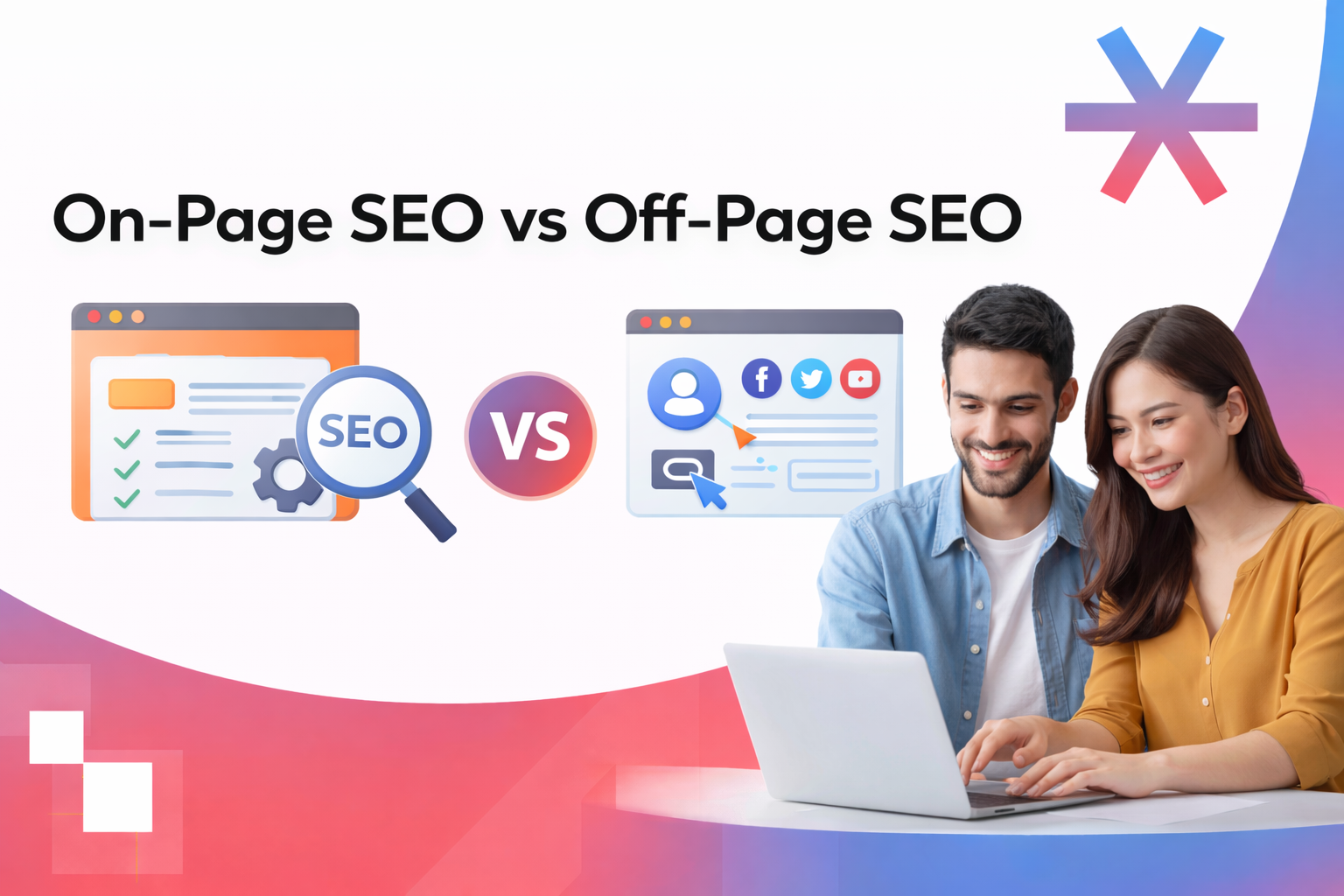
On-page SEO is everything you do on your own pages to help search engines and people understand them: content, titles, headings, internal links, images and structured data.
Off-page SEO is everything that happens elsewhere on the web that signals your site is worth trusting: backlinks, brand mentions, reviews, your Google Business Profile and digital PR.
On-page decides whether a page deserves to rank for a query. Off-page decides whether it beats the other pages that also deserve to. Most sites need both, but not in equal measure, and the right order depends on where you are starting from.
A third discipline, technical SEO, sits underneath both: whether search engines can crawl, render and index the site at all.
On-page vs off-page vs technical SEO at a glance
|
On-page SEO |
Off-page SEO |
Technical SEO |
|
|
Where it happens |
On your pages |
On other websites and platforms |
In your site’s infrastructure |
|
Main question |
Does this page answer the query best? |
Do others trust and reference you? |
Can search engines access and process it? |
|
Who controls it |
You, fully |
You, partly |
You or your developer, fully |
|
Typical work |
Content, titles, headings, internal links, schema |
Links, mentions, reviews, PR, Google Business Profile |
Crawling, indexing, speed, mobile, canonicals, redirects |
|
Speed of effect |
Weeks |
Months |
Days to weeks once recrawled |
|
Main risk |
Thin or mismatched content |
Buying manipulative links |
Pages silently not indexed |
|
Main tools |
Search Console, content editor, crawler |
Backlink tools, Business Profile, PR outreach |
Search Console, crawler, PageSpeed Insights |
For deeper guides on each: what is on-page SEO, the off-page SEO guide and technical SEO explained.
What on-page SEO covers
On-page SEO is the part you control completely, which is why it is usually where work should start.
Content and intent
Everything else on this list is secondary to one question: does the page answer what the searcher actually wants? Google’s own starter guide says that creating compelling and useful content “will likely influence your website’s presence in search results more than any of the other suggestions in this guide.”
In practice that means checking the current search results before writing. If the top results for your keyword are comparison guides and your page is a sales page, the mismatch will hold you back regardless of anything else you optimise.
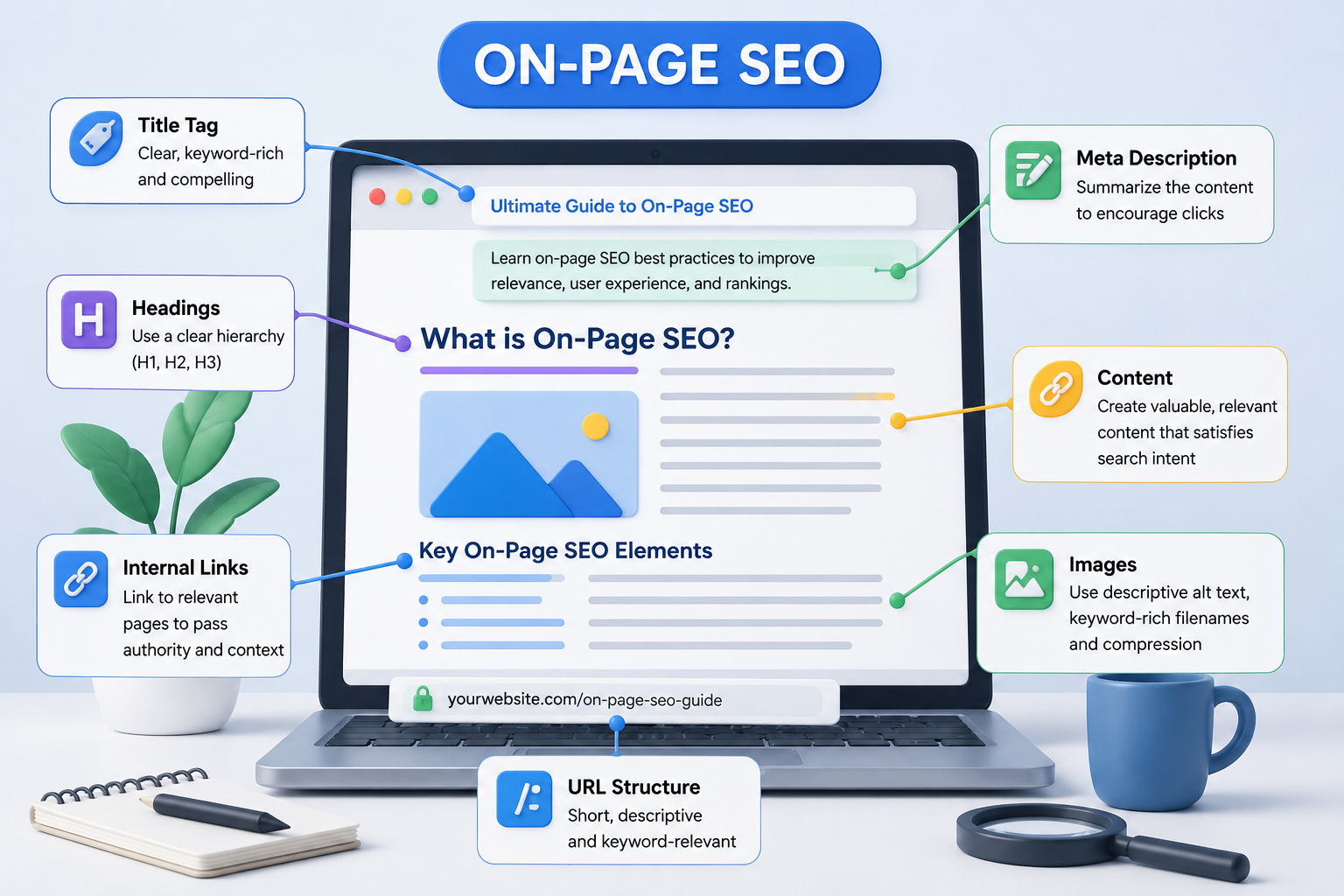
The elements to get right
|
Element |
What good looks like |
Common mistake |
|
Title tag |
Leads with the topic in the searcher’s words, specific, unique per page |
Same template title on every page, or a long site-name suffix pushing the topic out |
|
Meta description |
One or two sentences a searcher would click on |
Left blank or duplicated site-wide |
|
H1 |
One per page, matches the page’s main topic |
Logo or tagline marked as H1 |
|
H2 and H3 structure |
Follows the content logically, each section answers one question |
Headings used for styling |
|
Opening paragraph |
States the answer or offer immediately |
Three paragraphs of preamble |
|
URL |
Short, readable, topic-based |
Dates, IDs or stop words |
|
Internal links |
From relevant, stronger pages with descriptive anchor text |
Orphan pages with no internal links |
|
Images |
Compressed, descriptive file names and alt text |
3MB hero images, empty alt text |
|
Structured data |
Accurate markup matching visible content |
Markup describing things that are not on the page |
|
Freshness |
Visible updated date, facts and prices current |
Last year’s prices in a “2026” title |
|
E-E-A-T signals |
Named author, sources, contact details, real experience |
Anonymous content with unsourced claims |
What not to spend time on
Google’s starter guide is direct about two old habits: “Google Search doesn’t use the keywords meta tag”, and “Excessively repeating the same words over and over (even in variations) is tiring for users, and keyword stuffing is against Google’s spam policies.” There is no keyword density to hit.
What off-page SEO covers
Off-page SEO is harder because you influence it rather than control it.
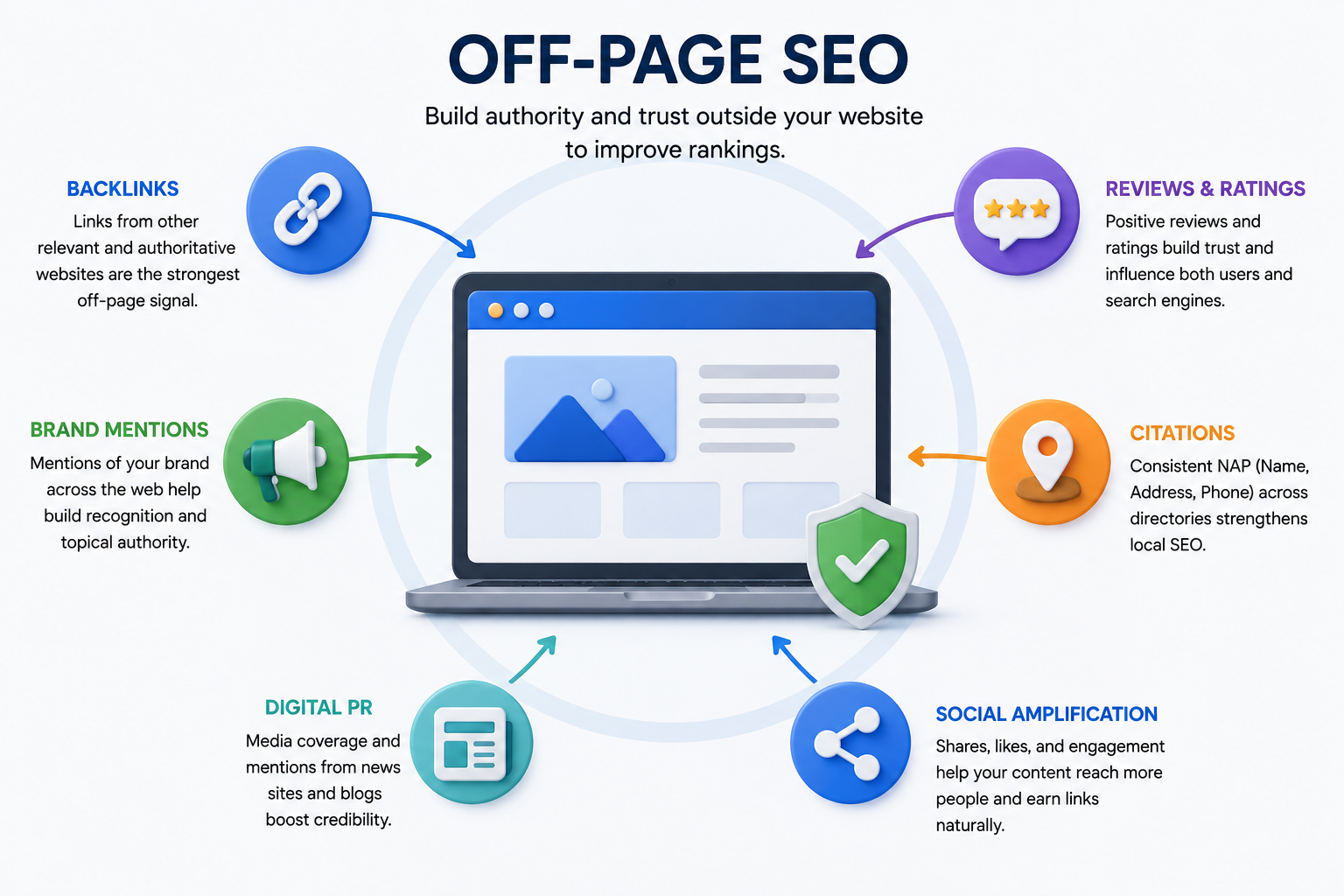
Backlinks
Links from other sites are still one of the strongest signals. They also matter for discovery: Google notes that “the vast majority of new pages Google finds every day are through links.”
What makes a link valuable is closer to common sense than most link sellers admit:
- Relevance. A link from a Singapore renovation association to an interior design firm beats a link from an unrelated blog with higher metrics.
- Editorial placement. A link within an article, placed because it helps the reader, beats a footer or sidebar link.
- Real traffic. If a site has no real readers, its links usually carry little weight.
- Variety. Links from many different relevant sites beat many links from one.
See what are backlinks and what makes a good backlink.
Beyond links
- Brand mentions on news sites, industry publications, forums and in AI-generated answers, even without a link.
- Google Business Profile: complete categories, services, hours, photos, posts and reviews. For local businesses this is often the most valuable off-page asset.
- Reviews with substance on Google and industry platforms.
- Citations: consistent business name, address and phone number across directories.
- Digital PR: original data, expert commentary, useful tools that journalists and bloggers reference.
- Partnerships: suppliers, clients, associations, event organisers and educational institutions linking to you because a real relationship exists.
Social media shares are not a direct ranking factor, but social visibility often leads to the mentions and links that are.
What Google counts as link spam
This section matters because most off-page SEO that goes wrong goes wrong here. Google’s spam policies, last updated in August 2026, define link spam as “the practice of creating links to or from a site primarily for the purpose of manipulating search rankings.”
Examples Google lists include:
- Buying or selling links for ranking purposes
- Exchanging goods or services for links
- Automated programmes or services that create links
- Excessive link exchanges (“link to me and I’ll link to you”)
Google also accepts that “buying and selling links is a normal part of the economy of the web for advertising and sponsorship purposes.” The condition is that paid links are labelled with rel=”sponsored” or rel=”nofollow”, and user-generated links with rel=”ugc”.
Three related policies are worth knowing when you evaluate an off-page proposal:
- Site reputation abuse: third-party content published on a host site “mainly because of that host’s already-established ranking signals.” Paying to place articles on strong sites purely to borrow their ranking falls here.
- Scaled content abuse: “many pages generated for the primary purpose of manipulating search rankings and not helping users”, which includes mass guest posts spun from the same article.
- Expired domain abuse: buying an expired domain and repurposing it “primarily to manipulate search rankings by hosting content that provides little to no value.”
If a vendor offers a fixed number of links per month at a fixed price, with no say over where they appear, ask which of these policies it avoids.
Where technical SEO fits
Technical SEO is neither on-page nor off-page, and it is the most common reason both fail silently. If a page is not indexed, no amount of content or links helps it.
Check these before investing in either:
- Pages you want to rank are indexed (Search Console, Pages report)
- No accidental noindex, blocked resources or wrong canonicals
- Main content is present in the HTML, not only after JavaScript runs
- Mobile pages load acceptably on real devices
- Redirects are single hops, no chains or loops
- XML sitemap lists only live, indexable URLs
Start with a technical website audit if you have not had one recently.
How on-page and off-page work together
The fastest way to decide what to work on is to diagnose which one is missing.
|
Situation |
What it usually means |
What to do |
|
Strong on-page, weak off-page |
Page is good but lacks authority against competitors |
Build relevant links and mentions to this page and its cluster |
|
Weak on-page, strong off-page |
Domain is trusted but the page does not answer the query well |
Rewrite content to match intent before building more links |
|
Weak on both |
New or neglected site |
On-page first, technical checked, then off-page |
|
Strong on both, still not ranking |
Intent mismatch, cannibalisation or a technical block |
Check which page Google ranks for the query, check indexing |
|
Ranking on page 2 (positions 11 to 20) |
Usually close on both |
Improve content depth and internal links first, then targeted links |
|
Ranking for the brand only |
Almost no off-page authority for non-brand topics |
Digital PR and topic-relevant links |
Internal links are the bridge between the two. A page that has earned external links can pass authority to related pages through internal links, which is why a strong topic cluster often ranks better than an equally good standalone page.
Which matters more?
It depends on how competitive the query is, not on a universal rule.
- Low-competition and long-tail queries: on-page usually wins alone. A well-structured page answering a specific question can rank with very few links.
- Local service queries: Google Business Profile, reviews and local citations often matter as much as the website itself. See what is local SEO.
- Competitive commercial queries such as “web design singapore” or “seo agency singapore”: every ranking page has good on-page work, so off-page authority becomes the deciding factor.
- New domains: on-page first, because links to a weak page are wasted.
A practical way to check: look at the pages ranking in the top five for your query with a backlink tool. If they have few referring domains, on-page work can get you there. If they all have hundreds, you need an off-page plan too. Our guide to competitor analysis for SEO walks through it.
How to split effort by stage
|
Site stage |
On-page |
Technical |
Off-page |
|
New site, first 3 months |
Most of the effort |
Set up correctly from launch |
Business Profile, directories, partner links |
|
Established site, flat traffic |
Rewrite pages ranking 8 to 25, fix cannibalisation |
Audit indexing and speed |
Targeted links to priority pages |
|
Competitive market, strong content |
Maintain and refresh |
Monitor |
Digital PR, original data, relationships |
|
Local service business |
Service and location pages |
Mobile speed |
Reviews, Business Profile, local citations |
On-page SEO checklist
|
Check |
Pass when |
|
Keyword mapping |
Each priority keyword is assigned to one page. See keyword mapping |
|
Search intent |
Page format matches what currently ranks |
|
Title tag |
Unique, topic first, readable length |
|
Meta description |
Unique, written to earn the click |
|
H1 |
One, matching the topic |
|
Headings |
Logical H2 and H3 structure |
|
Answer placement |
Main answer in the first paragraph under each heading |
|
Content depth |
Covers the questions the top results cover, plus something they miss |
|
Internal links in |
At least a few relevant pages link to it |
|
Internal links out |
Links to related pages with descriptive anchors |
|
Images |
Compressed, alt text written |
|
Structured data |
Valid and matching visible content |
|
Author and dates |
Named author, visible updated date |
|
Cannibalisation |
No other page on the site targets the same query |
Off-page SEO checklist
|
Check |
Pass when |
|
Backlink profile |
Links come from relevant, real sites. No bought link packages |
|
Referring domains vs competitors |
You know the gap for each priority page |
|
Paid or sponsored links |
Marked rel=”sponsored” or rel=”nofollow” |
|
Google Business Profile |
Complete, correct categories, recent photos and posts |
|
Reviews |
Steady flow, replies to reviews |
|
Citations |
Name, address and phone identical everywhere |
|
Brand mentions |
Monitored, unlinked mentions followed up where appropriate |
|
Digital PR |
At least one linkable asset: data, tool, guide or expert commentary |
|
Partner links |
Suppliers, clients and associations that should link to you, do |
|
Toxic patterns |
No sudden spikes of irrelevant or foreign-language spam links |
The complete SEO checklist covers both in more detail.
Off-page SEO for Singapore and APAC sites
A few things work differently for businesses targeting Singapore or the wider region:
- Local relevance beats global metrics. Links and mentions from Singapore publications, industry associations, trade bodies and local partners carry more meaning for a Singapore audience than high-metric links from unrelated overseas sites.
- Regional publications count. Business and technology outlets that cover Singapore and Southeast Asia are natural targets for expert commentary and data stories.
- Associations and chambers. Membership directories and event pages are among the most legitimate links a B2B company can earn.
- Multi-market sites need off-page signals in each market they target. A site serving Singapore and Malaysia benefits from mentions in both, not just one.
- Consistent business details matter more when you operate in several markets, because inconsistent addresses and phone numbers across country directories weaken local signals.
How to measure each
On-page: Google Search Console by page. Watch impressions, average position and click-through rate for the queries each page targets. Rising impressions with stable position means Google is testing the page on more queries. Good position with low CTR points at the title and description.
Off-page: referring domains over time in a backlink tool, branded search volume, Google Business Profile interactions, review count and rating, and mentions.
Both: organic conversions by landing page in GA4. Rankings and links only matter if they end in enquiries or sales.
Common mistakes
- Building links to pages that do not answer the query well
- Buying monthly link packages without knowing where the links appear
- Treating on-page SEO as a one-time task instead of refreshing pages
- Ignoring internal links, which cost nothing and move rankings
- Leaving Google Business Profile incomplete while paying for backlinks
- Two pages targeting the same keyword, splitting signals
- Measuring off-page work by link count rather than relevance and results
Frequently asked questions
What is the difference between on-page and off-page SEO?
On-page SEO covers what you change on your own pages: content, titles, headings, internal links and structured data. Off-page SEO covers signals from outside your site: backlinks, mentions, reviews and your Google Business Profile.
Which should I do first, on-page or off-page SEO?
On-page, with technical basics checked. Links pointing to a page that does not match search intent are largely wasted.
Is on-page or off-page SEO more important?
For long-tail and low-competition queries, on-page often ranks a page alone. For competitive commercial queries, every top page has good on-page work, so off-page authority usually decides the order.
Is technical SEO part of on-page SEO?
It is usually treated as a separate discipline. It covers the infrastructure that decides whether pages can be crawled and indexed at all.
Can I rank with on-page SEO only?
Yes, for specific, low-competition queries. For competitive terms in Singapore, it is rare without some off-page authority.
Are internal links on-page or off-page?
On-page. They are fully under your control and one of the most underused ranking levers.
Is Google Business Profile on-page or off-page?
Off-page. It sits outside your website but strongly affects local rankings.
Are paid links against Google’s rules?
Paying for links is allowed for advertising and sponsorship, as long as the links carry rel=”sponsored” or rel=”nofollow”. Paying for links to manipulate rankings is link spam under Google’s policies.
How long does each take to work?
On-page changes typically show within weeks once pages are recrawled. Off-page work usually takes months, because links and mentions build gradually.
Get both working together
MediaPlus Digital runs on-page, technical and off-page SEO as one programme for Singapore businesses, with 13 years in market, a team of 60 and more than 1,800 projects delivered. We fix the page before we build links to it, because that is the order that produces results.
See our SEO services in Singapore, or start with the SEO audit checklist to see which side is holding your site back.